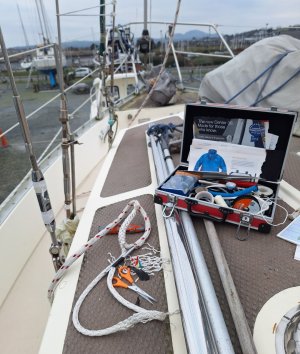
Splicing the mainbrace

It's nothing compared to splicing Marlowbraid, which you'd think would be the same but it's actually completely different and additionally has a very tight sheath. My favourite these days is cruising dyneema because it has an intermediary layer that gets removed so there's plenty of space to work inside the rope.
I may well have blurred the difference there. Any rope with a very tight sheath is difficult, Marlowbraid may well be the worst. It’s why I don’t splice the cover on Dyneema.
 
I may well have blurred the difference there
lol I didn't even know there was a difference at first, it was only when a braid on braid splice went a bit weird I looked it up and realised my folly. Naked dyneema and lazyjack like (same as dyneema but polyester) are easily my favourites it's just so much easier
 
on a first rate man-o-war such as HMS Victory the main brace was five inches (13cm) in diameter.
A good summary, but to nit-pick, 3-strand rope was traditionally measured by circumference, not diameter. The practice of measuring ropes by diameter only became the norm when braided ropes were introduced in the last century. A 5 inch circumference rope would be about 1.6 inch diameter: large but not unwieldy. A 5 inch diameter rope would be too too large for a hand to effectively grasp and would need a sheave larger than the diameter of the mainmast. In comparison, the shrouds holding up the mainmast on Victory (which take far more strain than the brace would) are tarred rope, 11 inch circumference (3.5 inch diameter).
 
A good summary, but to nit-pick, 3-strand rope was traditionally measured by circumference, not diameter. The practice of measuring ropes by diameter only became the norm when braided ropes were introduced in the last century. A 5 inch circumference rope would be about 1.6 inch diameter: large but not unwieldy. A 5 inch diameter rope would be too too large for a hand to effectively grasp and would need a sheave larger than the diameter of the mainmast. In comparison, the shrouds holding up the mainmast on Victory (which take far more strain than the brace would) are tarred rope, 11 inch circumference (3.5 inch diameter).
When I was a boy (1960s), ropes were still measured by circumference. As you say, I think it was only when braided ropes became prevalent that it changed; it's difficult to measure the diameter of a laid rope.
 
When I was a boy (1960s), ropes were still measured by circumference. As you say, I think it was only when braided ropes became prevalent that it changed; it's difficult to measure the diameter of a laid rope.

Nylon ropes should be determined by weight, not size.

Its the 'density' of nylon that determined their character.

I suspect that the characteristics of many ropes is determined by the method of construction (and raw material) not size. Even ropes of the same base fibre and same (or similar) construction will have different characteristics.

Jonathan
 
I was always amused by the phrase 'the sun's over the yardarm ', indicating that it was ok to start drinking. When stationed in the tropics, the sun - as viewed by an officer on the poop deck - would be over the main yardarm by about 9.00 am ...
 
I was always amused by the phrase 'the sun's over the yardarm ', indicating that it was ok to start drinking. When stationed in the tropics, the sun - as viewed by an officer on the poop deck - would be over the main yardarm by about 9.00 am ...
Sounds about right..
 
I daresay there are one or 2 here who’ve had a rum ration issued to them. Back in the days of the sun over the yardarm in the Caribbean, you got about half a pint. Double, when the mainbrace was spliced. Permanently pissed barely covers it, back then. Just as well the issue was halved, and halved again. Otherwise, someone with half a pint of rum inside them would have had their finger on the big red button in a Polaris class.
 
I daresay there are one or 2 here who’ve had a rum ration issued to them. Back in the days of the sun over the yardarm in the Caribbean, you got about half a pint. Double, when the mainbrace was spliced. Permanently pissed barely covers it, back then. Just as well the issue was halved, and halved again. Otherwise, someone with half a pint of rum inside them would have had their finger on the big red button in a Polaris class.
All things bright and beautiful
All creatures great and small
All things wise and wonderful
Polaris kills them all....
 
Brion Toss' The Rigger's Apprentice
shopping


When you're feeling ambitious
shopping
The Brion Toss book is good as I used it to learn how to splice my 7x7 wire standing rigging.

www.solocoastalsailing.co.uk
 
surely sailers should be able to splice their own ropes instead of relying on a professional service or is the modern sailer too busy on his/her iPhone or screen to have time for mundane things like splicing and whipping?
There’s lots of things boat owners can do, either with no refresher or by watching a YouTube video on that pesky iPhone, that some outsource because life is too short: anti fouling; servicing the engine; small sail repairs; fibreglass work; etc.

I can splice 3 ply without looking it up, octoplait with a reminder and probably others with a little help. But I am slow. As a quick fix 95% of the time a knot will do the job. A splice can be quite therapeutic if it’s not somewhere if needs to be particularly neat but if you are buying rope it’s not a massive cost to get someone else to do it so you have more time for the other jobs on the list.
 
There’s lots of things boat owners can do, either with no refresher or by watching a YouTube video on that pesky iPhone, that some outsource because life is too short: anti fouling; servicing the engine; small sail repairs; fibreglass work; etc.

I can splice 3 ply without looking it up, octoplait with a reminder and probably others with a little help. But I am slow. As a quick fix 95% of the time a knot will do the job. A splice can be quite therapeutic if it’s not somewhere if needs to be particularly neat but if you are buying rope it’s not a massive cost to get someone else to do it so you have more time for the other jobs on the list.
I do most of my splicing at home with the TV on. It's only the splicing into place that I do on the boat.
 
surely sailers should be able to splice their own ropes instead of relying on a professional service or is the modern sailer too busy on his/her iPhone or screen to have time for mundane things like splicing and whipping?

I admit I should be able to, but I've never learnt.

On the rare occasions I could have done with one I haven't had the time or patience to try it, and I've either made do with a knot, or on a very, very few occasions paid someone else to do it.

I plead in mitigation that I can do whipping, which I taught myself aged 13. (About 20 years before I actually got my first boat!)
 
I admit I should be able to, but I've never learnt.

On the rare occasions I could have done with one I haven't had the time or patience to try it, and I've either made do with a knot, or on a very, very few occasions paid someone else to do it.

I plead in mitigation that I can do whipping, which I taught myself aged 13. (About 20 years before I actually got my first boat!)
I used Reeds Almanac as a guide went on to spicing ships ropes and from a little helpful hints for yachtsmen booklet spiced steel hawsers on a dredger,I must admit to deceit as I hid the book if the mate came to inspect ….he didn’t know how to splice 😏
 
I'm confident in my ability to splice laid rope, so I do it, including making a double mooring pennant, but I never learned to splice braid (parachute cord apart, was that even a thing in 1960?), so I'll let the experts do it. Yes, there may be an element of old dogs and new tricks there, but the last thing I want is a splice coming apart at the top of the mast.
 
I just put a new splice on my genoa halyard as the original was starting to show wear and UV damage. Much harder to splice in a 5 year old well stretched rope, unless you reverse it.Loosening the outer braid helps. With new rope it's much easier. I still use a book but only for reassurance. One of the keys is how much to feather off the outer casing. Marlowbraid defeats me though. Anything out of sight aloft gets a whipping in case. Dyneema is OK with practice. Plenty of online info and tutorials.

Freezing work and I needed a drink after that....!
Screenshot_20240116_131100_Gallery.jpg

If you want practice, make some fender lines spliced to the fender eye. Looks good, useful practice and shouldn't come undone.
 
Top