Snubbers

Hi Vic,

Hurge thanks for your original post - it’s certainly food for thought.
I completely agree with you regarding attaching bridle to chain hook. In our new set up I’ll attach each leg separately using soft Shackles - my winter lockdown project was learn to make dymeena soft shackles & this is a perfect use!
 
Vic,

When you get your new hooks can you post a pic, - I'm interested in what is available.

I have posted this before, I think, or one similar.

Most hooks from the lifting industry come painted, or powder coated. I strip the paint with paint stripper and have them galvanised, the dark gray ones are galvanised.

The stainless hook is a typical Oz chandler sourced hook, I would not use them, note that the 'inside' of the jaw of the hook has a sharp edge, 2 actually one on each side - but that specific hook is there to illustrate the gate I make. I don't like the claw either prone to falling off and if a product of the lifting industry they are so well made they are difficult to disengage - unless you line the claw up perfectly - so difficult if you are in a hurry. They are commonly used in the transport industry for load restraint and come in a G70 spec. The 3 left hand hooks comes as G80 or G100 specs and are all specified as not impacting chain strength. The G80 hooks can be really cheap - the G100 hooks a bit more expensive, but not wallet threatening :)

The three left hand hooks are from the lifting industry, the far left is 'state of the art'. The far left hook - the tension is imposed on the link in the jaw resting on that 'sloping' surface (at the bottom) and by the crown of the next link that sits in two little recesses about half way down the jaw. The pin is a waste of time - bends easily - I replace with a bicycle spoke (hard drawn steel), I fill the hole with Sika, insert the piece of spoke and then rotate the pin as the Sika sets off. The Sika stops the pin falling out - but you need to be careful when you retrieve.

The stainless hook and the middle hook have an added gate. The stainless hook has a stainless gate retained by the clevis pin the galvanised hook I tapped before galvanising and then secured a thin piece of fibre glass as the gate and secured the gate with a pan head bolt. The hooks with gate can be operated one handed using the thumb to swing the gate. You might need to buy a slightly longer clevis pin to accomodate the extra thickness demanded for the stainless gate. The dimensions are simply those to allow the gate to swing but not too easily.

I have not found a way to make a gate for am eye hook (the eye is for a splice on the end of your snubber) - sewing is one way to make the eye.

View attachment 122699


Testing the Effects of Chain Hooks - Practical Sailor

Snubber Chain Hooks Revisited - Practical Sailor

This, below, better illustrates lifting hook in use.

These are 2 of the same hooks as above, stripped of paint

The left hand hook - the chain link in the jaw is sitting on that flat 'saddle' so the long of the link takes the tension, no point load. The crown of the next link, the yellow link facing is retained in a part of the casting sized to match the crown of the link - so the 2 links take the tension. The right hand hook - the link facing us is retained in 2 little dimples sized for the crown and the next link, our of focus and behind would, under tension, sit on the recessed slope (on the back side of the hook). In both cases the tension is split between 2 links.

These hooks, and all lifting components, are designed to be only used by the size of chain designated - in this case the clevis pin the slot within which the chain would be secured only accepts 6mm to a specific specification EN 818. The chain in the jaw is also 6mm and the slot is too narrow for 8mm chain and the thickness of the hook is too large for a smaller chain.

None of this is rocket science - why chandler hooks are not made to the same design is a mystery - but the lifting industry would laugh, or cry in horror, at our hooks.

View attachment 122700

Vic - I would have sent you a hook - but we use 6mm chain and I test 6mm components (I buy them and 6mm is the cheapest and the tensions needed for testing are lower)

Take care, stay safe

Jonathan
Jonathan,

I've just bought four hooks from a commercial supplier. These were extraordinarily cheap so I bought 4 - to make the P&P cost worthwhile! They were under £2 each. MBL of 9,000kg. That compares to the 1,000kg SS version from the chandlery at £12 each.

Hooks.jpg
 

from an engineering /forces perspective, it seems to me that only the one to the right is acceptable in "passing" the tension form the chain link to the device and then rope. The others introduce bending forces that should be unnecessary and possibly dangerous.
OK the one on the far left is trying to ease things out by having these protrusions, but they are in my eyes plain wrong.
Am I missing something?

V.
 
from an engineering /forces perspective, it seems to me that only the one to the right is acceptable in "passing" the tension form the chain link to the device and then rope. The others introduce bending forces that should be unnecessary and possibly dangerous.
OK the one on the far left is trying to ease things out by having these protrusions, but they are in my eyes plain wrong.
Am I missing something?

V.
Yes,

You are arguing with the whole lifting industry, or more likely my explanation was appalling.

Jonathan
Jonathan,

I've just bought four hooks from a commercial supplier. These were extraordinarily cheap so I bought 4 - to make the P&P cost worthwhile! They were under £2 each. MBL of 9,000kg. That compares to the 1,000kg SS version from the chandlery at £12 each.

Hooks.jpg

These are typical, old fashioned, hooks from the transport industry. G70 is a Transport Specification for both metric and imperial chain. They are more than adequate in terms of strength, roughly twice the strength of G30/40. They appear to have been electro zinc coated, that will not last long. Maybe paint to give them a few more weeks before they start to annoy you. But you have 4 - use one until you feel it looks unsightly then retire and when you are at a loose end, abrade down and re-paint. This design was replaced by the centre hook in my picture with that saddle on which the long of the link will rest when under tension. The left hand hook would be current state of the art - it comes from the Weissenfels plant in Italy, now owned by Kito who also own Peerless (The US biggest chain maker). Yours look to have a sharp edge in the jaw.

You can add a little rotating gate to this design to better secure the chain, as in my stainless shackle above.

If you want stainless hooks that pass muster - Ketten and Waelder have a neat one in their Cromox range - different design to the ones I show - but from a highly reputable supplier - who make for the lifting industry. Stainless chain finds use in the pharmaceutical and food industries.

Other better lifting component makers in Europe would be Pewag, Rud and Gunnebo (now owned by Crosby). Van Beest are another quality supplier and you need to look at their Excel range for their lifting components.

All the companies I mention make hooks along the lines of that left hand end hook from Kito - so Vas has a lot of people who he says are wrong :). Somewhere in the literature of each of these companies they will make mention that the hooks can be used to the limit of strength of the chain - the hooks will not degrade the strength of the chain being held in the jaw. Most lifting component suppliers, the ones I list also make hooks with that flat saddle as part of their hooks to a variety of designs.

I make the point that the sharp edge will preferentially tension the link. I have no idea what impact point loading an anchor chain will really have especially as under normal circumstances the tensions will be low (because the chain is attached to a snubber). When I tested I found a reduction in strength of almost 50% but then I was tensioning to destruction. However the implication is that the yield point dropped from about 50% of strength to about 25% of strength - which is the WLL for metric chain. In a 50 knot storm you might be tensioning at WLL - if your snubber fails or is too beefy.

My point would be - there are better hooks, they are widely available, in the grand scheme of things why comprise. Its like StarLord with his monster swivel he has shown to his satisfaction it has no negative effect at 50 knots - lets hope he does not need to test it at 55 knots in loosely compacted sand - or whatever. There are better options - why compromise. What his swivel will do is resist burial and will lie at a high angle to the seabed - even with a 10:1 scope the tension angle might be 40 degrees - so instead of tensioning almost horizontal his tension is part lifting his shank - fine at 50 degrees with a Spade - maybe not so good with an Epsilon, Kobra, Delta - I don't know (not tested) but why compromise (apart from pride and having invested in a big lump of stainless - for which there is no other use).

I appreciate Starlord thinks I'm dreaming this up - about 2 months ago I spend a day setting anchors, digging them out carefully once the tide had receded and measure the tension angle at the shackle of the anchor - scope is irrelevant, or almost - its the shear strength of the seabed and the surface area of the rode at the shackle point that determines tension angle. Its not my idea - its critical if you are setting anchors for moorings or deploying anchors for an oil rig and its the reason we have anchors with thin shanks - beefy shanks, like a genuine CQR - resist burial. There will be an article on this in YM maybe early next year. In the meantime - if you don't believe do your own research and find contrary background - there's lots of data supporting what I say (I don't need to make it up)


My philosophy is very simple - if there are risks, you minimise the risks as there are other risks about which you know nothing (you don't know what the seabed is actually like). A lot of little risks compound - why accept any risk if there are better options? All I do is try to point out and where possible quantify the impact of using badly designed product. The individual needs to assess the risks and choose differently or accept those risks. I don't know exactly why Vic, who is the OP, almost lost his eye - but there was nothing exceptional about the circumstances - there are enough reports of snubbers failing at 50 knots and/or of people trying to add a second snubber in a storm - it happens. I know it will never happen to you - but it did happen to Vic - and he was lucky. It might happen to you and you might not be as lucky as Vic - he posted for a reason - take note.

Take care!

Jonathan
 
Most snubbers that I see are short, maybe 2m - they simply take the load off the windlass, which is good, but completely miss offering any elasticity (which is bad).

I don't blame the owners - I suspect they simply don't know. If they have heard of snubbers they think what they have is a snubber - becuause every windlass maker preaches - use a snubber (and they only imply short snubbers). As I mentioned when you buy a new yacht you get an anchor and chain - but never a long snubber - the very people who want you to enjoy your yacht and few years later buy a bigger one - don't consider it part of their responsibility to make anchoring safe and comfortable. I wonder if charter fleets have long snubbers. We are left with Vic's horror story, people like Geem (who live the dream) and my boringly repetitive posts to try to educate.

I do believe we are making progress - we are impacting intransigence. The trouble is it takes Vic's horror story to bring it home. Minimise the risks, you don't even know what some of the risks might be, as Vic found out.


And thanks Vic - a chilling lesson - but one that people seem to have noticed.

Jonathan
 
Yes,

You are arguing with the whole lifting industry, or more likely my explanation was appalling.

Jonathan

not interested in arguing with anyone Jonathan. Just stating the obvious: links are getting some serious forces not along the line of stretch but at 30-40deg which could damage them. Granted a stretchy rope will dumper the max loads, but a kosher solution it aint no matter your explanation.

cheers

V.
 
Each to their own, and far be it from me to preach to others as to what they should or shouldn't do. ?
I find that all this talk of snubbers failing, dodgy chain hooks, the necessity of having long stretchy lines along decks with the associated problems of chafe, makes me glad that I avoid all that hassle (and apparently danger), by having an all chain rode. When anchoring, once the desired length of chain is out, I merely stand on the chain, pressing it into the slot in the chain stopper, ease off the brake, and having taken the tension off the windlass, tighten the brake again. The chain is still on the gypsy, ready for instant use when required.
No doubt, some will call me a Luddite for not embracing their beliefs. ?
 
Each to their own, and far be it from me to preach to others as to what they should or shouldn't do. ?
I find that all this talk of snubbers failing, dodgy chain hooks, the necessity of having long stretchy lines along decks with the associated problems of chafe, makes me glad that I avoid all that hassle (and apparently danger), by having an all chain rode. When anchoring, once the desired length of chain is out, I merely stand on the chain, pressing it into the slot in the chain stopper, ease off the brake, and having taken the tension off the windlass, tighten the brake again. The chain is still on the gypsy, ready for instant use when required.
No doubt, some will call me a Luddite for not embracing their beliefs. ?


If it works for you - go for it.

Others have different yachts.

Most of us sail AWB's that benefit from lighter chain and are more fleety.

What works for you will not work for them.

Jonathan
 
I use a rolling hitch to connect my 10m 10mm nylon octplait Snubber to my 8mm chain. Is that a good or bad way?

Also I have my Snubber roughly half in the water and half above water and on deck. Is that good / bad?

I do use both ends on the chain and it is never exactly same length on cleat so the chaffe isn't always in one place.

I used to have a chain hook but it did fall from the chain a few time and disappeared from the yard. I wasn't upset and just got new octplait.

I am always happy to learn and just upgraded the generic stainless anchor shackle to a Crosby G209a.
Thanks,
Andrew
 
Most snubbers that I see are short, maybe 2m - they simply take the load off the windlass, which is good, but completely miss offering any elasticity (which is bad).

I don't blame the owners - I suspect they simply don't know.
When I bought our first yacht three years ago there was no snubber, I didn't have a clue on length and bought one 5m with a fancy Kong chain grip thing, I now realise that longer would be better.
 
Hi Jonathan

I can count on 2 hands the number of nights I have spent at anchor so please excuse my ignorance. (although hope to drastically change both the ignorance and number of nights in the near future!)

I have found your posts very informative. I have a few questions.

I understand the physics in maximising the stretch hence the need for an appropriately sized snubber for wind strength. You mention a storm snubber. Any thoughts on how to rig this Ona monohull so it becomes effective as the wind strength increases? Preferably with ANY intervention. Perhaps accepting the ‘comfort’ snubber becomes sacrificial.

The long snubber would concept would apply equally to a mooring buoy. Although leaving the boat for a longer period chaff would now become more of a priority. Any thoughts on maximising safety and minimising strain on the boat and ground tackle in this situation. (thinking about leaving boat on a river mooring over winter ?)

Lastly the YM article mentions running the snubber between the stanchions and toerail. Does this not stress the stanchions?

Thanks
 
I use a rolling hitch to connect my 10m 10mm nylon octplait Snubber to my 8mm chain. Is that a good or bad way?

Also I have my Snubber roughly half in the water and half above water and on deck. Is that good / bad?

I do use both ends on the chain and it is never exactly same length on cleat so the chaffe isn't always in one place.

I used to have a chain hook but it did fall from the chain a few time and disappeared from the yard. I wasn't upset and just got new octplait.

I am always happy to learn and just upgraded the generic stainless anchor shackle to a Crosby G209a.
Thanks,
Andrew

A rolling hitch is great - can your crew make a rolling hitch? if not teach them - or you need to be on the bow every time. A rolling hitch is good because it can be applied and disengaged without leaning beyond the bow. I have not seen reports of rolling hitches failing.

If you route your snubber from an amidships cleat, or the transom and route between stanchions and toe rail or through the stanchion supports then none of your snubber need be in the water (collecting seaweed). If you wanted to be really fancy you could use those devices used to route furling lines neatly along the stanchions - but they are - money - or you could use soft shackles to neaten it all up. I'm assuming transom to chain hook is about 10m. You can also mark your snubber and the deck and measure the amount of stretch, to ensure is stays within a 10% limit (which would be roughly 25% of working load). You do need to work out how to get a chafe free run of the snubber outboard (but that is fairly easy). The other advantage of commencing at the transom is that you can have a 20m snubber, say - and if the forecast turns out to be optimistic - you can apply more snubber fairly easily (though you might need to visit the bow to deploy a bit more chain).

Reading snubber usage - the greatest issue is unforecast bad weather prompting owners to try to attach a 'storm' snubber or replace a snubber that has failed - if you have an extra 10m at the transom - you are always ready to deploy a storm snubber. If you think your snubber a bit wimpy - and have commenced your snubber at the transom then if you hare using 10m of snubber then the snubber/chain attachment is near the bow - attaching a storm snubber is - easy. No need to deploy much more chain - just take the storm snubber back to a sheet winch - take in the tension - now you are only using your storm snubber and the 'everyday' snubber is slack.

There are lots of permutations - limited by your imagination - or your access to this forum :)

If you go back to the beginning of this thread and read through - there is illustration of a simple gate for a metal hook which will stop the hook falling of the chain - and chain hooks can be applied by those who cannot tie knots (of which there are a surprising number - not a criticism - we all have strengths and weaknesses). Chain hooks falling off the chain is a common problem - you are not alone.

The fact you retired your generic shackle and replaced with Crosby G209a - underlines you read and understand.

Take care, stay safe

Jonathan
 
I use a rolling hitch to connect my 10m 10mm nylon octplait Snubber to my 8mm chain. Is that a good or bad way?

Also I have my Snubber roughly half in the water and half above water and on deck. Is that good / bad?

I do use both ends on the chain and it is never exactly same length on cleat so the chaffe isn't always in one place.

I used to have a chain hook but it did fall from the chain a few time and disappeared from the yard. I wasn't upset and just got new octplait.

I am always happy to learn and just upgraded the generic stainless anchor shackle to a Crosby G209a.
Thanks,
Andrew

I thought to elaborate.

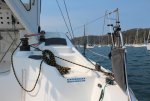
This is a snubber, it is part of a bridle on a cat so there is a mirror image on the port side. The snubber is the black and yellow rope. If you look carefully you will see that the snubber runs aft through the stanchion bases and is secured with a clutch (it could be a horn cleat). The snubber is then taken to a turning block and to a sheet winch, That loose coil of 'extra' snubber could be stored as you store a sheet. Our decks are about 10m long.

This snubber, or bridle, is 12mm dynamic climbing rope. It seemed too inelastic and we down sized to 10mm. This, the black and yellow rope we keep and carry on board as back up, replacement or storm snubber/bridle.

Image .jpeg

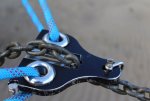
We don't use rolling hitches nor soft shackles nor hook but a bridle plate. The snubber, one half of the bridle, runs to a turning block on the bow and then to the bridle plate. These are the new 10mm snubbers - set up as a bridle. The snubbers run from the turning block on each bow to the low friction rings in the plate and then to pad eyes at the bow on the waterline. The pad eyes at the waterline are there as the termination for the bobstays, so dual usage. We have reinforced the backing for the pad eyes (for the bobstay fiunction). The chain is 6mm high tensile chain. The little shackle at the right of the plate is to secure the plate at the base of the forestay when not in use. There is a pin, gate, bottom left hand corner to retain the chain. This plate was custom made from duplex stainless and then painted black (an error in translation), the rings are 2 part 316 stainless and threaded,

IMG_4743 2.jpeg

A bridle, any bridle, manages, or reduces veering by virtue of being a triangle. By. introducing a vertical triangle, as well as the conventional horizontal triangle of a bridle, we manage or reduce horsing from chop. The other characteristic of our method of deployment is that we lower the scope point, the scope is not taken from tension at the bow roller but tension at the bridle plate. The difference is not great, 6.5:1 reduced to 5:1 - but every little helps.

IMG_4773 2.jpeg


If you have a pad eye at the water line - you can rig a 'similar' system for a monohull.

I can walk walk to the bow, release the back up chain lock, deploy more chain (from the helm or foot switches at the bow) and then deploy more snubber (by releasing through the sheet winches). Every metre I release only adds 0.5m forward - so in a tight anchorage I can increase my snubber length and only drop half that distance aft. So I have 10m along the deck, plus 6m, each side, as in the photo and I can release a further 14m and only move 7m aft - but I'm using 30m and its elasticity, each side.

Jonathan
 
Hi Jonathan

I can count on 2 hands the number of nights I have spent at anchor so please excuse my ignorance. (although hope to drastically change both the ignorance and number of nights in the near future!)

I have found your posts very informative. I have a few questions.

I understand the physics in maximising the stretch hence the need for an appropriately sized snubber for wind strength. You mention a storm snubber. Any thoughts on how to rig this Ona monohull so it becomes effective as the wind strength increases? Preferably with ANY intervention. Perhaps accepting the ‘comfort’ snubber becomes sacrificial.

The long snubber would concept would apply equally to a mooring buoy. Although leaving the boat for a longer period chaff would now become more of a priority. Any thoughts on maximising safety and minimising strain on the boat and ground tackle in this situation. (thinking about leaving boat on a river mooring over winter ?)

Lastly the YM article mentions running the snubber between the stanchions and toerail. Does this not stress the stanchions?

Thanks

Sorry Drifting I missed you post when I was concocting my previous one.

The snubber route's, as in my photo above, develops no load on the stanchions - its effectively a straight run. Any tension is at the point where there is the need to alter the line, or run, of the snubber to develop the orientation of the snubber to run outboard with minimum chafe. On most yachts you can use strops attached to the toe rail and a LFR, as shown in the article. The toe rail is a strong point (it commonly holds the deck to the hull) and is used on most yachts for barber hauls, blocks for spinnakers - well strong enough for a snubber. The 'trick' is getting the route from running along the line of the stanchions to outboard.

I can offer suggestions - but I need to see a picture of your foredeck.

If you set up as I indicate in my last post - I have almost half the snubber on standby - you can double your snubber length, relatively, easily. If you anticipate the bad weather you can have a lazy loop of chain (shown not very lazy in my 3rd photo, above) and you can do it all from the cockpit (in your jimjams). The other technique is set up as I have done, no need for the water line pad eyes - simply pull the snubber in to the bow roller, so shorten the snubber. your chain hook is now inches from the bow roller - and still operating as your snubber, (you still have deck length of snubber working for you) now add your storm snubber. The storm snubber can simply run aft to the cockpit - not need for fancy and neat arrangement - straight down/along the deck - but provide for chafe at the bow roller (have a piece of hose pipe already threaded on the storm snubber) and take to the other sheet winch (you are using one sheet winch already for the everyday snubber). Now release the everyday snubber and the tension is on the storm snubber - release the storm snubber to its maximum length )or the length to keep you safe if space is restricted. You will need to release some extra chain.

It sounds complex - but no more than changing hanked on headsails. You just need to think it through in advance (and have the hosepipe already threaded and a chain hook already attached).

If this is not sufficiently clear - ask, and ask again.

Some of this needs 2 people, its easier, or forward planning. I advise winching the chain hook to close to the bow roller. You cannot see the hook from the winch position, but someone on the bow can tell you - or you mark your snubber, precisely, so that you know. Marking is better as you really don't want people standing on the bow in a gale - too easy to misunderstand and it may be cause for marital discord. If you sail as a couple an ability to do everything single handed makes for a happier life (and shows 'care').


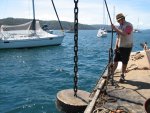
I would not suggest using, what I call, a snubber as part of a mooring arrangement. The simple point being you cannot offer the elasticity in a short length of rope. If you want to increase elasticity on a mooring use those rubber dog bone things (2 or 3) or one of those stainless steel spring devices or a different combination of chain on the seabed (bigger chain). We use a swing mooring, see below - it has a 1t block plus a half ton block, that big chain 10m long and a 10m 3./4 inch sweep chain and as we are moored in 10m deep we have a 12m 1" pennant. (that's our cat behind the mooring contractors shoulder. I don't know what your mooring is composed of - nor who is responsible for your mooring, you or a contractor. Happy to help - but need more detail.


40wandeen yachts mooring screen 027.JPG


Don't feel embarrassed to ask for clarification - I'm here to help (but I may go to bed in the interim :( - and not answer you till very late, your, tonight - or tomorrow morning).

But what's all this about 'leaving a boat over winter' - we sail 365, though restricted by pandemics - all you need are a decent pair of Ugg boots and a cap to keep the sun off. :)

Jonathan
 
not interested in arguing with anyone Jonathan. Just stating the obvious: links are getting some serious forces not along the line of stretch but at 30-40deg which could damage them. Granted a stretchy rope will dumper the max loads, but a kosher solution it aint no matter your explanation.

cheers

V.

More than a century of experience says otherwise. Really. You are not disagreeing with Neeves, you are disagreeing with an industry.
 
Thanks Jonathan.
You didn’t miss my post it was awaiting mod approval, so slipped in unnoticed! And actually between posting and approval your further explanation and photos cleared a lot up.
Thank you for your time.
 
Top