Seasick in the marina!!

For your Coastal Skipper course plan to spend as little time as possible down below. You won't be expected to be at the chart table for hours. Wrte a good passage plan on a sheet of paper or notebook you can stick in your pocket.

You'll need to put fixes on regularly. Practice 3 point fixes so you can do them quickly and use range and bearing where possible as it'll be quicker. You'll have to demonstrate you can navigate without relying on electronics but, once you've done that, you should be able to use modern equipment to help you.

Plan before you go to sea as much as possible. Think of alternatives, bail-out options etc before you leave.

Make drawings for pilotage with depths, distances, bearings etc and have it in your pocket. You should be on deck when within sight of land anyway.

Don't make the mistake of thinking you have to spend a lot of time below on your course. You don't. You'll be fine. As others have said, the situation you describe is one where many people would feel queasy, and not a reflection of how you'll be out at sea.
 
Stugeron beats all other remedies hands down in my experience as a sailor and as a pharmacist. Other medications are available (generally hyoscine-based or antihistamines) and there are infinite numbers of folk remedies and old wives' versions. However, if you go with Stugeron, start the night before you leave on your trip and take regularly for at least the first day or so (read the instructions!), until you are sure that you're over it.

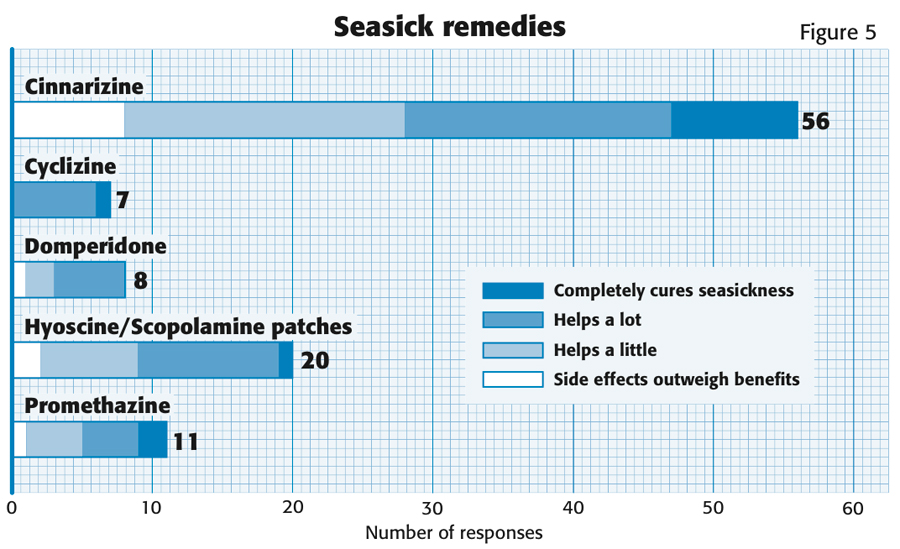
This is backed by a survey (http://www.yachtingworld.com/blogs/elaine-bunting/533100/how-to-treat-seasickness) stating that cinnarizine, the active pharmaceutical ingredient in Stugeron, is most effective.

seasickness-remedies.jpg


From personal experience also noted that somewhere around age 35, the tendency to get seasick reduced from "pretty often" to "very rarely" without any obvious reason :peaceful:
 
As a sailing god ( crossed barnstaple bay three times!) I am happy to advise. 10 pints is nowhecre nesr sufficient to avoid sea sickness particularly with less than 2 kebabs from the van outside the pub.Andby the sound of it you forgot to slosh a bit of old diesel around the bilges to create a proper boaty atmosphere. Try correcting tohese errors and see how you go.

Failing that a large piece of fat bacon taken together with a glass of seawater is a traditional cure. The thought of it usually prevents sea sickness for life.

Incidently you cannot yet be a sailing god. Too young. Sailing gods have white beards like mine and are to be found either sat !on chairs drinking tea talking about the work they have to do on their boats this winter ( sailing gods never actually do the work) or at the club bar on regatta days explaining how it was that Knox Johnson learned all he knows whilst acting as their cabin boy.
 
This is backed by a survey (http://www.yachtingworld.com/blogs/elaine-bunting/533100/how-to-treat-seasickness) stating that cinnarizine, the active pharmaceutical ingredient in Stugeron, is most effective.

seasickness-remedies.jpg

If I understand that chart correctly, all that that impressively long bar is actually saying is that cinnarizine is the one which the most people have tried. Which is hardly surprising, as Stugeron is a very well-known and widely available brand. But in fact fully half of the people who used it said that it either only helps a little or has no net benefit at all. Whereas everyone who tried Cyclizine found it effective, and Domperidone and Scopolamine are both in a similar league to Stugeron; perhaps better depending on how you weight problematic side-effects versus a full cure.

Pete
 
<<Failing that a large piece of fat bacon taken together with a glass of seawater is a traditional cure. The thought of it usually prevents sea sickness for life.>>

You omitted that the piece of fatty salt pork should be threaded, so it could be pulled back up without needing to vomit.

With regard to cinnazarine - the two really bad cases of seasickness to whom I gave it were pole-axed (almost immediately) and spent the rest of the voyage comatose in a bunk. One went on to becoming an enthusiastic offshore sailor.
The other, who was a GP, admitted she'd never appreciated how debilitating morning sickness must be!!!

As already pointed out, cinnazarine is probably the most widely used, because of being the most widely available - not that it's the best.
On US comparative tests, for control of really severe sea-sickness, scopolamine patches come out as significantly superior to any oral anti-histamines.
 
Last edited:
Well thanks for all the responses. I won't cancel the circumnavigation just yet.

A couple of good points. I am a bit loath to take any drugs as I fear that the side effects may wipe me out. I managed the nav on my dayskipper without any problem. In fact i seem to recall the only bad effect on that was when we moored for lunch and ate down below!

Another factor that I didn't mention yesterday was that I had a huge coffee on the way to the marina. I definitely find caffeine makes it worse so a good reminder to wean myself off the dreaded drug. I should do that anyway!! I spend enough on coffees to finance the next boat!!
 
Port Edgar. On some of the pontoons with the wind in certain directions the bouncing about is pretty horrific. It can be virtually impossible to work inside a boat, so don't blame yourself. The tyre 'wall' actually sometimes works were well there.

My wife takes Stugeron about an hour before we go out if conditions are expected to be rough and they seem to work very well. (We sail a 33ft 5 ton yacht). The only instance of her being queezy in the last five years was when we had to heave too outside Whitemills for a couple of hours in the darkness waiting for the tide in the aftermath of a week of gales. That was not very comfortable.

The weather in the Forth has also been very bad over the last couple of weeks. On Saturday and Sunday I have been working inside a steel ketch in the harbour at Dalgety Bay as it was bouncing up and down. I was replacing the head, heat exchanger etc. And every so often I had to go up for some air and to see the horizon.

A light and tender boat may be part of your problem but a lot of it will have been caused by the prevailing conditions at Port Edgar. Just go out as often as you can to acclimatise yourself to it.
 
I recall that I spent most of the time during my Dayskipper course/exam down below. There were 2 other students doing competent crew so they did all the deckwork and I did all the navigation/passage planning. I've been seasick twice and its not pleasant and comes upon you very suddenly. Nowadays I usually take Stugeron as a precaution if I haven't been sailing for a while - I don't notice that it makes me particularly drowsy as I often have a nap in the afternoon anyway.
 
I recall that I spent most of the time during my Dayskipper course/exam down below. There were 2 other students doing competent crew so they did all the deckwork and I did all the navigation/passage planning. I've been seasick twice and its not pleasant and comes upon you very suddenly. Nowadays I usually take Stugeron as a precaution if I haven't been sailing for a while - I don't notice that it makes me particularly drowsy as I often have a nap in the afternoon anyway.

Not sure taking a nap in the afternoon will go down too well on my coastal skipper course??!!
 
Another factor that I didn't mention yesterday was that I had a huge coffee on the way to the marina. I definitely find caffeine makes it worse so a good reminder to wean myself off the dreaded drug. I should do that anyway!! I spend enough on coffees to finance the next boat!!

As/Camelia.....I find that the smell of diesel can make me a bit nauseous....... could that have effected you whilst working on the engine for a while?

S.
 
Last edited:
I am a mild but frequent sufferer and have found that you really can help yourself with sea sickness. Some simple rules:

1/ never sail after a skinful
2/ never sail after a bad nights sleep
3/ never sail on an empty stomach
4/ dont let yourself get cold on deck
5/ dont spend more than the absolute minimum time either down below or reading. Eyes on the horizon
6/ dont sail when really stressed about something
7/ keep busy - there is a mental aspect to sea sickness. dwell on being sick and you will be.
8/ take the pills before you start off. if you are worried about them making you dopey, try them out on land, preferably not when driving

I was badly sea sick once - real want to die stuff. I had ignored 1 2 3 4 and 8
 
Crystallised ginger, or Green&Black's dark chocolate and ginger, should be part of normal ships' stores. Some may find it helps a bit. Tastes good, anyway.
On the other hand - there is one thing, one only, worse than sea sickness. It is sea sickness while overhung (or still drunk). I have only seen this once - the skipper wouldn't let him below, for fear of damaging upholstery, so he lay in the scuppers draining, while his sober mates carried on around him having the time of their lives
 
On the other hand - there is one thing, one only, worse than sea sickness. It is sea sickness while overhung (or still drunk). I have only seen this once - the skipper wouldn't let him below, for fear of damaging upholstery, so he lay in the scuppers draining, while his sober mates carried on around him having the time of their lives

Heh - I've seen that too. Harnessed up, secured on a short tether to a cleat in the cockpit, then laid face-down on the side-deck to empty over the side.

Too many "Irish carbombs" (curdling guinness/whiskey/baileys monstrosity) in Cowes the night before :)

Pete
 
Top