
ronsurf
Well-Known Member
It was built on an embankment of very iffy soil and required reinforced concrete piles about 5 - 8m deep.


I am a mild but frequent sufferer and have found that you really can help yourself with sea sickness. Some simple rules:
1/ never sail after a skinful
2/ never sail after a bad nights sleep
3/ never sail on an empty stomach
4/ dont let yourself get cold on deck
5/ dont spend more than the absolute minimum time either down below or reading. Eyes on the horizon
6/ dont sail when really stressed about something
7/ keep busy - there is a mental aspect to sea sickness. dwell on being sick and you will be.
8/ take the pills before you start off. if you are worried about them making you dopey, try them out on land, preferably not when driving
I was badly sea sick once - real want to die stuff. I had ignored 1 2 3 4 and 8
Was it built on mud of indeterminate depth?

Can you move to a North/south berth on D or E pontoon to be bow on to the swell?

The last couple of years I have been busy fantasising about my future as sailing legend in order to escape my humdrum middle aged life. Fastnet, Atlantic, Greenland, Jester etc etc.
All came crashing to earth this afternoon after an hour on the boat in the marina changing the oil in my engine. The marina (port edgar) just has a rubbish tyre wall in lieu of a wall so the swell is pretty bad and it was gusting over 30 knots so the (lightweight) boat was bouncing up and down quite a lot. The nausea was pretty bad, luckily I could escape to dry land. Even so I am still feeling a bit sick a couple of hours later. Bit worried about my coastal skipper in February if they make me do too much navigation at the chart table.
Funnily enough I have been out on the boat about 40 times this summer racing and a few weekends away and not felt a thing. And on previous 10 day trips away have only been sick in a force 7 in the minch and that had something to do with about 10 pints the night before.
So what to do:
a) Plan my sailing to ensure I never go below??!!
b) Go and sit on my boat for an hour at a time below in the marina until I beat it??
c) Buy a catamaran?? Or trimaran (I was looking at the dragonfly website yesterday dreaming of speed!!)
d) Buy a sports boat for racing that doesn't have a "below".
e) Face the fact that at 45 I am washed up and will never be a sailing god??!!
Hmmmmmmmm!!

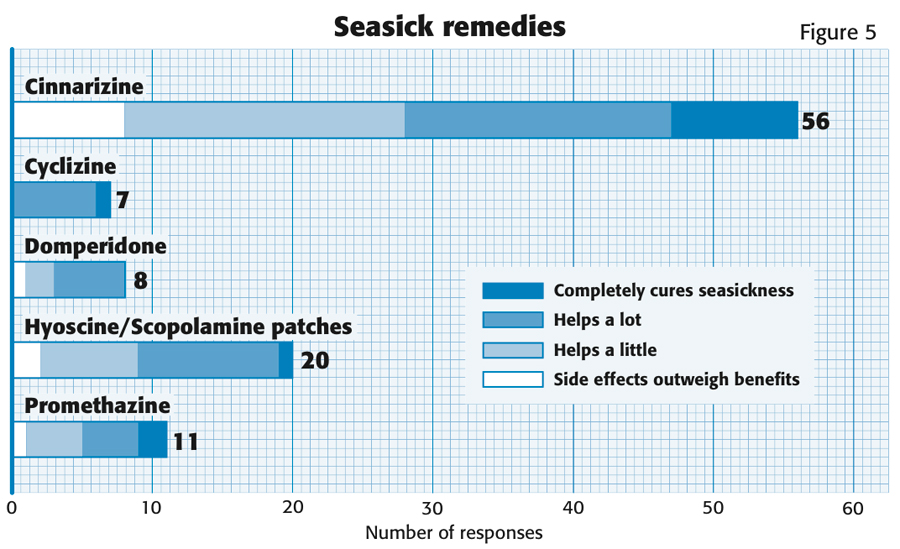
This is backed by a survey (http://www.yachtingworld.com/blogs/elaine-bunting/533100/how-to-treat-seasickness) stating that cinnarizine, the active pharmaceutical ingredient in Stugeron, is most effective.
From personal experience also noted that somewhere around age 35, the tendency to get seasick reduced from "pretty often" to "very rarely" without any obvious reasoneaceful:

.../... Funny as a young man I was inspired by round the world sailors and their stories. I did a bit of inshore sailing but life intervened and I ended up with a small trailer sailer. I came to realise that really I am a "Brown Water" sailor for short trips on sheltered water. I got into racing the little boat but the real pleasure came in teaching others to sail and enjoy the little boat. No real claim to fame but now coming near the end of my sailing life I am satisfied. Perhaps if I had a bigger boat I would have ventured further and enjoyed it but I don't think I missed too much. Travel is certainly easier by jet. Just relax and take it all as she comes and enjoy olewill


Yes, I spotted the flaw in that diagram, too! Why didn't they normalize it for the number of respondents? Certainly the evidence of the data presented is as you say; cyclizine works best. Can't be bothered to re-analyze the data (why did they use a graph background with 16 divisions in each major division?), but my estimate is that the league table is about Cyclizine (100% effective), Domperidone (75% effective), and the rest about equal (with a 50/50 chance of working). I'd just note one thing though, and that is that domperidone is widely used to relieve nausea from chemotherapy, and the (limited, second-hand) experience I have is that it is very effective. However, it may well be used at a higher dose level for chemo-therapy patients than would be advisable for unsupervised use for motion sickness.If I understand that chart correctly, all that that impressively long bar is actually saying is that cinnarizine is the one which the most people have tried. Which is hardly surprising, as Stugeron is a very well-known and widely available brand. But in fact fully half of the people who used it said that it either only helps a little or has no net benefit at all. Whereas everyone who tried Cyclizine found it effective, and Domperidone and Scopolamine are both in a similar league to Stugeron; perhaps better depending on how you weight problematic side-effects versus a full cure.
Pete
my estimate is that the league table is about Cyclizine (100% effective), Domperidone (75% effective), and the rest about equal (with a 50/50 chance of working).
Yes, I considered adding my anecdotal evidence on domperidone having watched my wife take it while on chemotherapy. I found it almost miraculous. It seemed to cure severe nausea completely in less than five minutes. They used to give it in whacking great doses to people in chemotherapy, but after an alert this year linking it to serious ventricular arrhythmia and sudden cardiac death, the current guidance is to reduce dosage even for chemotherapy patients - I think 10mg three times a day. I believe it is now only available on prescription, or at least the European guidance is that it should be - and you can see why if you look at its side effects and drug interactions...... I'd just note one thing though, and that is that domperidone is widely used to relieve nausea from chemotherapy, and the (limited, second-hand) experience I have is that it is very effective. However, it may well be used at a higher dose level for chemo-therapy patients than would be advisable for unsupervised use for motion sickness.
One they've missed off the graph is Prochlorperazine. Not used it myself (touch wood I'm mostly free of seasickness these days) but I've seen some impressive results in others and I do carry it on board (along with Stugeron and whatever it is the MCA specify for Cat C packs). Apparently it's also the anti-nausea ingredient in Migraleve, which is worth knowing should someone suffer that way on board.
Pete
Yes, I considered adding my anecdotal evidence on domperidone having watched my wife take it while on chemotherapy. I found it almost miraculous. It seemed to cure severe nausea completely in less than five minutes. They used to give it in whacking great doses to people in chemotherapy, but after an alert this year linking it to serious ventricular arrhythmia and sudden cardiac death, the current guidance is to reduce dosage even for chemotherapy patients - I think 10mg three times a day. I believe it is now only available on prescription, or at least the European guidance is that it should be - and you can see why if you look at its side effects and drug interactions.
Dunstaffnage was bad on tuesday - I was queasy by the time I got to the boat due to the pontoons writhing about! The main pontoon which was broadside on to the wind and waves was tilting badly and I had to stop and hang onto a fire and water point a couple of time or risk a dip in the drink.
My heavy steel ketch wasn't too badly affected compared to lighter yachts which were almost bouncing onto the pontoon fingers but as the wind wasn't storm force, I'm thinking I should have her hauled out for the winter. I can't imagine how bad it will be in Dunstaffnage bay in a west / north west storm.
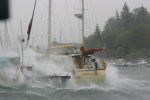
View attachment 46435
Photo from Dunstaffnage, May 2011.
(Not my photo, so apologies if I'm infringing anyone's copyright.)

Well port edgar didn't quite look like that though the pontoons were bouncing up and down on Tuesday. I made myself go on the boat inside for a bit. All this talk of drugs has made me determined to be able to beat the pontoon sickness by mind power alone!!


