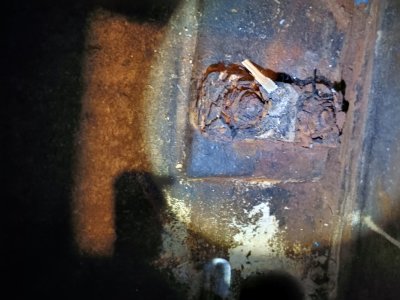
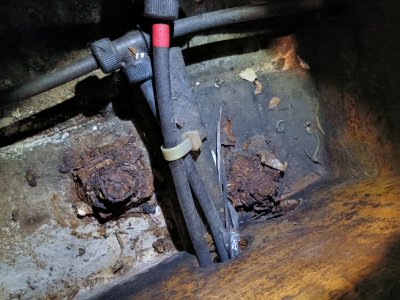
Rusty keel bolts on otherwise very tidy boat - should I walk away?

Friend bought an oldish boat very cheaply. Previous owner was told by surveyor that bolts were potentially bad. Cost to replace was more than boat was worth. Friend took nuts off, cleaned up threads and image he sent me was of new nuts and bolts. He sold it on for a healthy profit.

There are some very poor quality surveyors out there.
 
...although I suspect that's going to be a job for after purchase. "I'd like to disturb the keelbolts on your 43yo £5k boat before I decide if I'm going to buy it" is only going to result in one response.
Of course. But if the guy wants to sell it he must suck it up. It's not a big job and drawing one bolt won't disturb too much.
Personally I would just buy the boat and enjoy it
 
My previous boat, a Moody 28, had far more rust around the exposed part of the bolts than the OP picture. I cleaned up with wire brush and they looked almost like new. Remember rust expands to 15x original metal.
Fair point - no harm doing this when I've paid the balance and the boat is mine. And I'm going to make damned sure from now on that they're not standing in water, whether or not I replace them!
 
So that thread can be cleaned up to the point where the nut can be wound off and replaced? Literally just wire brush, heat and tap?

I don't doubt that it is sound if left alone, but to my totally untrained eye it looks like there's zero chance of getting the nuts off undamaged.

(Genuine question.)

Brush and scrape the rust off, particularly in the thread roots (I like to use the cut edge of a folded and flattened piece of beercan there) I suppose a sophisticate might run a die (not, AFAICT, a tap as you have above) down the thread but I've never been that sophisticated and doubt its necessary. You main ache is the rust in the threadspace between the nut and the stud
I suppose maybe apply an acid, perhaps pickling vinegar, but I dont think I've ever done that, and it might have negatives long term if it gets down the thread.
Heat and apply the penetrant of your choice (diesel, ATF, ATF/acetone, PlusGas, WD40, etc)
There is support for candle wax after heat but I've not found it to be particularly effective and it'll tend to seal the threads against cold penetrants.
In practice, of course, heat is a hassle, and you dont lose anything by trying it cold first as long as you dont break anything, though it will then smoke a lot when you do try heat, which might require forced ventilation in the bilges
If no budgee, make yourself a wee dam with a bit of tubing and sealant/filler/chewing gum and let it soak in penetrant for a while
If no impact gun (I dont have one) 6 point socket, T-bar (perhaps with extension/protection) and medium clouts with a club hammer
Then get an impact gun and repeat
Time is an asset here, perhaps more available if its your boat.
 
Last edited:
Discuss with seller .... maybe agree a lift - to see the hull to keel joint ..

Surveyor on a 5K boat ? I'm surveyor and I would actually suggest fee is better kept for any work needed !

I admit I don't like the look of those bolts / nuts and surround washers - but as other say - its a 1980's boat and not unusual. Its GRP judging by the photo ...
If it was a wooden boat - then my thoughts may be different ....

If the boat is basically dry in the bilge with keel bolts not leaking ... its probably good to go ... please note that often drawing bolts leads to silly leaks that you then spend effort trying to cure ! Those bolts have over the years bedded and literally sealed themselves.

Just commenting.
 
I’d recommend getting a survey. Then you’ll have had a thorough inspection of the whole boat and that will inform your maintenance programme for the next few years. Good to get professional advice and peace of mind.
Obviously select a surveyor based on recommendation.

Ed: And you may well need a survey to get insurance.

I disagree.

Insurance can be had without survey - especially if 3rd Party only ...
 
If you like the boat and the price I'd just buy it and go sailing. It would be unlucky if the keel fell off anytime soon and you will need to lift out and antifoul in the next year or so. Have a good look at the joint then rather than spending money now. I suspect the boat will be fine for many years and you will find plenty of other things to spend money on as you sail and use it. Nice boat for £5000.

ABSOLUTELY .... 101% agree.
 
Discuss with seller .... maybe agree a lift - to see the hull to keel joint ..

Surveyor on a 5K boat ? I'm surveyor and I would actually suggest fee is better kept for any work needed !

I admit I don't like the look of those bolts / nuts and surround washers - but as other say - its a 1980's boat and not unusual. Its GRP judging by the photo ...
If it was a wooden boat - then my thoughts may be different ....

If the boat is basically dry in the bilge with keel bolts not leaking ... its probably good to go ... please note that often drawing bolts leads to silly leaks that you then spend effort trying to cure ! Those bolts have over the years bedded and literally sealed themselves.

Just commenting.
Yes.

When I pulled one bolt there was a large "plug" of sealant on the end. So sealant that was continuous and uninterrupted now has a hole sealed with another sealant.

Did not leak, and does still not leak AFAIK. However, can't be as good as the original sealant.
 
Is there any sort of NDT approach that can be taken with keel bolts? It does seem a shame to disturb them if they're sound.
 
Moodys of that age are more likely to suffer problems with the base of the compression post collapsing which is far more troubling than rusty keel bolts.

Ill be honest I've not read the entire thread but those look fine to me, however a surveyor never has that approach!

The backing plates breaking up and going thin will happen long before a bolt breaks on a moody

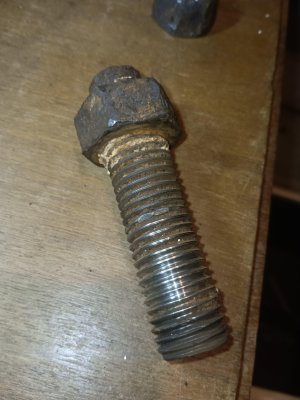
all of these came out, and and some even came off the stud! (Moody Eclipse Bilge keel)

IMG_20221130_165804_021.jpgIMG_20221130_165821_220.jpg

unnamed.jpg
 
Is there any sort of NDT approach that can be taken with keel bolts? It does seem a shame to disturb them if they're sound.
Not really - and as many here have suggested if the keel is sound and still firmly attached and sealed to the hull there is no need to disturb the studs even if the top is rusty. They are massively over engineered and when you think about it there is only one way that water can get at the stud is if the seal fails and usually that shows itself through rust streaks down the outside of the keel. Even then most of that will be from the top of the iron keel rather than the studs. Different of course if the failure is the result of a serious grounding enough to shift the keel. Even then the studs will almost certainly be fine in themselves when the keel is removed.

The whole keel bolt myth dates from wooden boat days where it was indeed problem because ballast keels were usually attached with long through bolts, much of which ran through damp wood. I did the job (removing the bolts for replacement) twice on my wooden boat and then a third time when I deepened the keel by 30cm. I used 316 for that and filled the holes with sealant before inserting the bolts. Still there when I sold the boat 15 years later.
 
Brush and scrape the rust off, particularly in the thread roots (I like to use the cut edge of a folded and flattened piece of beercan there) I suppose a sophisticate might run a die (not, AFAICT, a tap as you have above) down the thread but I've never been that sophisticated and doubt its necessary. You main ache is the rust in the threadspace between the nut and the stud
I suppose maybe apply an acid, perhaps pickling vinegar, but I dont think I've ever done that, and it might have negatives long term if it gets down the thread.
Heat and apply the penetrant of your choice (diesel, ATF, ATF/acetone, PlusGas, WD40, etc)
There is support for candle wax after heat but I've not found it to be particularly effective and it'll tend to seal the threads against cold penetrants.
In practice, of course, heat is a hassle, and you dont lose anything by trying it cold first as long as you dont break anything, though it will then smoke a lot when you do try heat, which might require forced ventilation in the bilges
If no budgee, make yourself a wee dam with a bit of tubing and sealant/filler/chewing gum and let it soak in penetrant for a while
If no impact gun (I dont have one) 6 point socket, T-bar (perhaps with extension/protection) and medium clouts with a club hammer
Then get an impact gun and repeat
Time is an asset here, perhaps more available if its your boat.
Few more (minor) points

I sometimes use(d) an intact (apart from being emptied) beercan to clean up loose bolts, as described here

Your favorite Macgyver moments\tricks

I'd think it might be useful to make a gizmo with two opposed beercan lids so the two V-slots were opposed and gripped the thread from opposite sides, maybe pulled together with elastic or cable ties. For bigger bolts/studs you might have to enlarge the V. No wheels now so probably will never be motivated to actually try it. Stacked in multiples, if this is practical, it could be quite like an aluminium die.

Worth using a "flank drive" socket on these probably stubborn nuts, certainly if you already have one, and probably worth getting one if you dont, though I dunno if impact sockets come as flank drive.

I would probably use polythene sheet on the threads (as well as perhaps aluminium antiseize and other protectants and maybe PTFE thread tape) when replacing the nuts/whole stud, since this should last forever in the nut-stud thread interface. (and maybe in the keel/stud thread interface too, but thats trickier since you cant see whats happening, so I'd have reservations there.)

It can take a bit of trial and error to get a polythene sheet thickness which doesnt rupture or make the nut difficult to drive, but on my car wheel nuts (which were re-done more often than any other fastners on cars or motorcycles) I found either bin bag plastic or the wee bag that my morning mantou (a steamed bun) came in worked well. The polythene deforms and comes off like a shed snakeskin when the nut is removed.

I think it may have a nylok effect, though I havnt confirmed this (wont be required on keel bolts anyway) and am not sure how one could. I havn't investigated the effect on torques either, since I hardly ever use a torque wrench, but from feel and thought I'd guess it will transition from negative to positive as the film thickness is increased.
 
Yes.

When I pulled one bolt there was a large "plug" of sealant on the end. So sealant that was continuous and uninterrupted now has a hole sealed with another sealant.

Did not leak, and does still not leak AFAIK. However, can't be as good as the original sealant.
How does one avoid sealing the bolt hole with the gooped-up stud and thus pressurising the airspace in the keel hole below it as you drive it, which I'd expect might eventually stop you?

Assuming it is a blind hole (which I believe they often are) I assume the stud must be a fairly loose fit and the air pushes up the threads through the sealant, displacing some of it?

(I have no experienece of keel bolts. Above pontificating was based on experience with car and motorcycle bolts)
 
It's a buyers market right now, but I suspect he'd still find it less of a gamble to look for another buyer.

I keep hearing this.

Of course sellers need to be realistic about their price but buyers also need to be realistic about the costs of boat ownership.

If you’re expecting to never put your hand in your pocket again after purchase you’ve picked the wrong hobby!

Obviously some boats have a maintenance deficit and need serious investment which is rarely reflected in the price, I’d not get too excited over a few bits that need attention.

Even on the most sorted vessel, there’s always something to fix or improve.

Get that boat bought OP and enjoy it.
 
running a die over the exposed thread is a waste of time. It’s only cleaning the exposed un-used part of the thread.

As you can see from my pics above the thread inside the keel is usually perfect so it lets go first.

I’ve changed keel bolts on several moodys, bilge and fin keeled. I’ve never had an issue with re-sealing in situ
 
Top