weustace
Well-Known Member
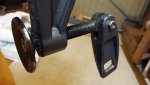
In a second thread which perhaps could be titled "start-of-season woes", I have found (despite fairly frequent lubrication) one of the transom clamp screws on my Mariner 4hp outboard to be seized solid. I have steeped it in oil, poured litres of boiling water over it, attacked it with a blowtorch, and used progressively longer levers until the screw began to yield plastically at the top of the clamp. I have now hacksawed the top and bottom off, and intend to replace the screw with a piece of 316 stainless studding with an appropriate block on one end and a handle of some sort on the other... not too worried about these two details, but quite concerned about where to drill. The existing screw is 8mm roughly, and I am faced with replacing with M6 (and thus drilling largely into the stainless steel and hopefully tapping into same) or with M8 and drilling out all of the stainless + tapping aluminium.
My experience from suffering similar trials in the past suggests that the M6 option may be preferable if I can get a 5.5mm hole sufficiently straight in the screw... views?
Also, am I correct in assuming the new screw should be 316 stainless? Can't imagine an aluminium screw would be hard enough, but given how readily stainless steel work hardens, I was surprised by how much the existing screw yielded—though a back-of-the-envelope calculation suggests a max shear stress at yield of ~180MPa, which is about right for stainless steel and far higher than what one might expect for aluminium.
My experience from suffering similar trials in the past suggests that the M6 option may be preferable if I can get a 5.5mm hole sufficiently straight in the screw... views?
Also, am I correct in assuming the new screw should be 316 stainless? Can't imagine an aluminium screw would be hard enough, but given how readily stainless steel work hardens, I was surprised by how much the existing screw yielded—though a back-of-the-envelope calculation suggests a max shear stress at yield of ~180MPa, which is about right for stainless steel and far higher than what one might expect for aluminium.