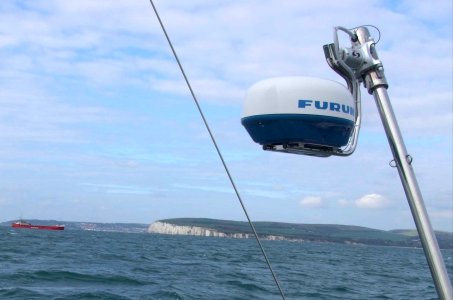
Adding radar - on pole or arch?

Nothing to do with rescue all to do with radar!

Recently met a current CG end of wire man. He is happy to rescue people off cliffs and mountains.
They don't get to practice taking people off yachts with or without back stays and radar poles! Most practice seems to be off a Stenna Ferry up this way.

Most yacht transfers are done in conjunction with lifeboats.
I photographed a helicopter practicing approaching a yacht in the Wallet a few years ago, so it does happen. I don't know what technical reason there may be for having radar to starboard but would be interested to know. I had always assumed that the system was symmetrical, other than the antenna rotation being in one direction.
 
Surely Starboard is the preferred side as stand on vessels will be approaching your track from Starboard. You will get a clear and uninterrupted view of the most important targets.
 
Surely Starboard is the preferred side as stand on vessels will be approaching your track from Starboard. You will get a clear and uninterrupted view of the most important targets.
Correct. The navigational dangers are not symmeytric!

The other most important feature of pole mount is you can reach it easily with a hammer when the scanner has seized due to lack of use!!!
 
Surely Starboard is the preferred side as stand on vessels will be approaching your track from Starboard. You will get a clear and uninterrupted view of the most important targets.
I hadn't thought of that, but the way I steer it's not going to be a problem anyway.
 
Do you need to book a course on how to use your radar as well as VHF?

Look up different guard zones in your hand book.
No I’ve done both. Our radar has a 360 view around us, mast mounted.
Guard zones have nothing at all to do with installation
 
Last edited:
I was assuming that the mast might cause some shadowing, though in practice it is not something that I have been able to observe.
Our radar is mast mounted but due to a jib with leech battens it needs to be mounted to the side. It is mounted on the starboard side to ensure there is no blind spot on the main danger side.
We don’t have a lot of traffic around, but surprisingly have not noticed any material issue on the port/mast side.
 
Well a motorboat has no choice but to mount the radar on an arch, pole, or cabin roof, and they still work fine.

I've seen them on the cross-trees and mine is on the forward facing part of the mast, so with a blind spot to the rear, but basically the standard installation spot.

I use mine more for watching rain squalls than detecting ships or other craft, it works well in identifying what is going to hit me.

Here is what AI says in answer to the question "On a sailing boat where is the best place to mount a radar to ensure the best performance?" ....

For best radar performance on a sailboat, mount it as high as possible (ideally 4m+ above water) on a dedicated radar mast or pole aft, clear of obstructions, to maximize range, using a self-leveling mount to correct for boat roll, and ensure it's above head height for safety. While the mast is common, an aft pole offers better horizon view and avoids mast interference, though a self-leveler is crucial there.

Top Mounting Locations
  • Aft Radar Pole/Arch: Often considered the best for range and minimizing blind spots from sails/mast.
  • Mast: A popular choice for height but can create blind spots near the mast; a self-leveling mount is highly recommended.
  • Hardtop/Wheelhouse: A good option if high enough, but a mast or pole might be needed for more height.

Key Performance Factors
  • Height is Key: Higher mounting increases the line-of-sight to targets, extending detection range significantly.
  • Clear Horizon: Mount it to see the horizon without sails, rigging, or the mast getting in the way.
  • Self-Leveling Mount: Essential for open-fisherman/pole mounts to keep the scanner horizontal as the boat heels.
  • Safety: Must be mounted well above head height to protect crew from radiation.
  • Avoid Obstructions: Don't place it where the mast or other gear creates a permanent "shadow".

Installation Tips
  • Minimize Cable Length: Longer cables can degrade performance; use the shortest possible run.
  • Drainage: Ensure any pole or pedestal allows rain and spray to drain away.
 
I was assuming that the mast might cause some shadowing, though in practice it is not something that I have been able to observe.
The mast is much narrower than the array so not an issue. There may be a slight loss of detail but not enough to notice. As masts get wider so does the array usually with the largest boats using open arrays. Of course, masts aren’t round so ideally mount in front for smaller cross section, but many would prioritise the sail and halyard issue and put it to the side.
 
The mast is much narrower than the array so not an issue. There may be a slight loss of detail but not enough to notice. As masts get wider so does the array usually with the largest boats using open arrays. Of course, masts aren’t round so ideally mount in front for smaller cross section, but many would prioritise the sail and halyard issue and put it to the side.
I was thinking in terms of a stern mount, but the effect must be very small.
 
I was thinking in terms of a stern mount, but the effect must be very small.
I think it would be worse as a stern mount in theory as the mast will return a solid signal and therefore shade anything in the very narrow strip behind it. This would be because it’s not close enough for the array to look around it as in a mast mount scenario. In theory if you were super unlucky you could end up on constant bearing with a vessel that didn’t show until too late, but in theory real world neither would hold that good of a course.
 
I think it would be worse as a stern mount in theory as the mast will return a solid signal and therefore shade anything in the very narrow strip behind it. This would be because it’s not close enough for the array to look around it as in a mast mount scenario. In theory if you were super unlucky you could end up on constant bearing with a vessel that didn’t show until too late, but in theory real world neither would hold that good of a course.
Yes, I think it is one of those things that I doubt ever happened. On the other hand, if something can happen, then sooner or later it will. A famous example of this was in a signal box around a hundred years ago. The levers were locked in such a way that another lever could not be operated while it was in transit, except for a fraction of a second while it crossed a gap at the top. Eventually, a second lever was operated during this period, putting another train onto a collision course with the inevitable result.
 
Top