OK - you have the boat .. you later bought an item that far exceeded expectation ?

I like the Douglas protractor. Very easy to use on a small chart table, no moveing parts, stable in rough weather, easy to mark off bearings or positions without sliding rolling or trying to find the best spot on the chart. Mine does not have the string in the centre, just a small hole which you place over the object to draw a position line, or over your position to mark off the course.
 
It's interesting how names change. The Breton Plotter (rectangle with the disc in the middle) is now known as The Portland Plotter and the Hurst Plotter (square with disc and long arm) is now known as the Portland Single Arm plotter. At least the Douglas Protractor name remains unchallenged.
 
It's interesting how names change. The Breton Plotter (rectangle with the disc in the middle) is now known as The Portland Plotter and the Hurst Plotter (square with disc and long arm) is now known as the Portland Single Arm plotter. At least the Douglas Protractor name remains unchallenged.
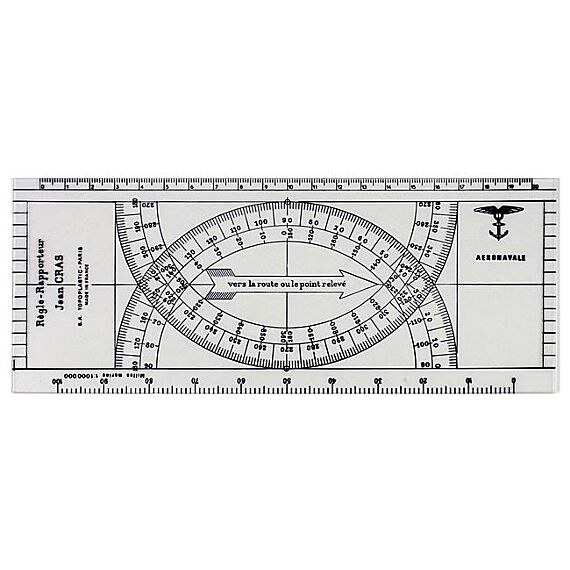
It’s the one used for French navigation exams....takes a bit of getting use to
 
It’s the one used for French navigation exams....takes a bit of getting use to
That's the "regle Cras", I have one deep in the chart table drawer with all the charts above it, never been able to use it.
0724109_103.jpg
 
That's the "regle Cras", I have one deep in the chart table drawer with all the charts above it, never been able to use it.
0724109_103.jpg
I found it counter intuitive…but with a little reading, a bit of YouTube and lots of practice it can be mastered
 
Usually one topic, one author. Bias ensues.
Both approaches have pros and cons. A few years ago, I think it was Nature who analysed the number of errors in Britannica and Wikipedia. I don't think the difference was significant; Britannica actually came out a bit worse. This summary is by no means comprehensive. The bottom line is that I use Wikipedia but unless I have knowledge of the field, I try and cross-check by chasing references. I don't use Britannica simply because I don't have free access to it! But I didn't use it even when I had access to a library with a copy on the shelf. Neither is sufficiently authoritative to be quoted in research; you always try and go to original material.

BritannicaWikipedia
ProArticles written by leading experts in their field.
Strong editorial policy.
Articles often attract experts in a field.
Contrasting viewpoints often expressed.
Can react rapidly to changes in Knowledge.
Base material for a lot of articles derived from an out-of-copyright version of Britannica!.
FREE and easily searched.
ConSlow to respond to new knowledge.
Subject to bias if the field does not have a strong consensus.
No rapid mechanism to correct errors.
Inconvenient to search.
Expensive!.
Can be edited by people without expert knowledge who regurgitate un-authoritative sources.
Some editorial policies deter experts in small fields from contributing (No original research)
Weak editorial policy that is slow to react.
Links to external material often broken.
Differences in viewpoint can lead to edit wars!
 
Longer ago than I thought - 2005. Internet encyclopaedias go head to head - Nature

Of course, Wikipedia has tightened up its editorial policies since then, but it is still weak.
What is positive is that editing and the process of debating inputs are open to view. You don't get that in an edited print collection.

And the material is open to all. I edited two open access journals and was involved in a large open access database. Very important to the dissemination of knowledge to make it easily available, I think.
 
What is positive is that editing and the process of debating inputs are open to view. You don't get that in an edited print collection.

And the material is open to all. I edited two open access journals and was involved in a large open access database. Very important to the dissemination of knowledge to make it easily available, I think.
Certainly. I too edited a major topographic database, which was freely available - these days we'd probably use a Creative Commons license for it, but that didn't exist in 1993 when we first published it. But we put it on the Internet as soon as that was feasible in 1998. And as you say, making the process open is important. I use Wikipedia a lot, but it's as well to be aware of it's weaknesses as well as its strengths.

In fact I just checked on its current status and they have moved it to Creative Commons.
 
Last edited:
Top