
Poignard
Well-Known Member
Notice the total ineffectiveness of the Twister's rudder when going astern.Just pretend you meant it. No one needs to know ;-)
One moves it around more in hope than expectation!


Notice the total ineffectiveness of the Twister's rudder when going astern.Just pretend you meant it. No one needs to know ;-)


lol. Thanks for the tip!My long keeler has no engine, and therefore never really goes astern. My experiences are therefore mostly second hand, as watchful crew. I sail bigger classics whenever invited. Hope to be part of the crew of a certain 57ft gaffer next summer. The owner previously had an 8M. That, he was spectacularly good at. All achieved by having the confidence to go quickly, I think. Many years of experience in parking boats for a living. he just seemed to know exactly how long it would take for the rudder to bite, plus exactly what effect prop walk was going to have. A joy to be crew for, in that respect. All I can suggest is practise. Reverse around an empty anchorage, for instance.


Agree that practise helps understand your boat and how the amount and duration of reverse affect prop walk. I also agree that you need to be definite and commit at the right point. But I still prefer slow and steady using wind or tide to your advantage in confined marina channels. I would like to see a video of a 57ft gaffer doing it quickly, preferably not too near my boat!My long keeler has no engine, and therefore never really goes astern. My experiences are therefore mostly second hand, as watchful crew. I sail bigger classics whenever invited. Hope to be part of the crew of a certain 57ft gaffer next summer. The owner previously had an 8M. That, he was spectacularly good at. All achieved by having the confidence to go quickly, I think. Many years of experience in parking boats for a living. he just seemed to know exactly how long it would take for the rudder to bite, plus exactly what effect prop walk was going to have. A joy to be crew for, in that respect. All I can suggest is practise. Reverse around an empty anchorage,
If the opportunity presents itself I will video it. Quite difficult with a mooring line in your hand, waiting to step off! Besides the slack jawed amazement at the guy’s audacity that is.Agree that practise helps understand your boat and how the amount and duration of reverse affect prop walk. I also agree that you need to be definite and commit at the right point. But I still prefer slow and steady using wind or tide to your advantage in confined marina channels. I would like to see a video of a 57ft gaffer doing it quickly, preferably not too near my boat!

I'm sure you're right. It wasn't something a designer had to think about.Would it be an oversimplification to say these sort of boats are crap at going backwards because when they were designed marinas were not commonplace and boats generally were kept on mid-river moorings?
I find that it is often possible to make that tight turn even if the wind is blowing down the dead end. What is needed is a sufficient amount of room from where you start to the spot where the turn must be made. Also you need to build enough speed (which is scary going down a dead end with wind on your back) to give the boat the inertia required to make the 180 degree turn into the wind. Of course, some marinas are just too tight in relation to the boat's 'turning circle', but making that judgement can only be based on a lot of practice of this manoeuvre in various conditions. Practice will build confidence.The best one can aim for is to get out of the berth, into the middle of the fairway, without touching anything, and from there to make a tight turn towards the exit.
If the wind is blowing towards the dead end so that a turn cannot be made
Here is a picture of a marina:I find that it is often possible to make that tight turn even if the wind is blowing down the dead end. What is needed is a sufficient amount of room from where you start to the spot where the turn must be made. Also you need to build enough speed (which is scary going down a dead end with wind on your back) to give the boat the inertia required to make the 180 degree turn into the wind. Of course, some marinas are just too tight in relation to the boat's 'turning circle', but making that judgement can only be based on a lot of practice of this manoeuvre in various conditions. Practice will build confidence.
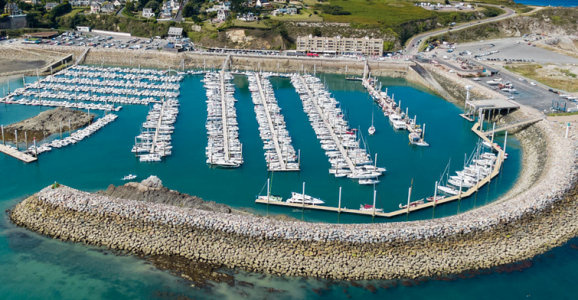

I watched a “very experienced” skipper of a gaffer manoevering onto a fuel berth “with confidence” in the Canaries. He took the pumps clean off the fuel berth with his bowsprit and was going to be impounded for doing so.My long keeler has no engine, and therefore never really goes astern. My experiences are therefore mostly second hand, as watchful crew. I sail bigger classics whenever invited. Hope to be part of the crew of a certain 57ft gaffer next summer. The owner previously had an 8M. That, he was spectacularly good at. All achieved by having the confidence to go quickly, I think. Many years of experience in parking boats for a living. he just seemed to know exactly how long it would take for the rudder to bite, plus exactly what effect prop walk was going to have. A joy to be crew for, in that respect. All I can suggest is practise. Reverse around an empty anchorage, for instance.

All I can say to those who have never done it is that you will never know the joy, relief and sheer pleasure in successfully extracting a long keel boat from such a situation as Poignard illustrates.Here is a picture of a marina:
View attachment 169136
Let's suppose the wind is blowing from the bottom of the picture, ie towards the dead ends.
You are telling me that, having backed my Twister out of her berth, I should then take a run at the dead end and, when I have built up a good speed, perform a high speed turn in a channel two boat lengths or less wide?
View attachment 169138
Yes, seen less drastic cock ups myself. The owner of Kelpie gets given certain latitude is choosing his berth. I daresay that is a big contributor to his success. A berth with access, and an exit planI watched a “very experienced” skipper of a gaffer manoevering onto a fuel berth “with confidence” in the Canaries. He took the pumps clean off the fuel berth with his bowsprit and was going to be impounded for doing so.
Slow is pro.
And that tingling sensation as blood starts to return to one's whitened knuckles . .All I can say to those who have never done it is that you will never know the joy, relief and sheer pleasure in successfully extracting a long keel boat from such a situation as Poignard illustrates.

Those channels do not seem to be uniform in breadth, but basically yes.Let's suppose the wind is blowing from the bottom of the picture, ie towards the dead ends.
You are telling me that, having backed my Twister out of her berth, I should then take a run at the dead end and, when I have built up a good speed, perform a high speed turn in a channel two boat lengths or less wide?

My long keeler has no engine, and therefore never really goes astern. My experiences are therefore mostly second hand, as watchful crew. I sail bigger classics whenever invited. Hope to be part of the crew of a certain 57ft gaffer next summer. The owner previously had an 8M. That, he was spectacularly good at. All achieved by having the confidence to go quickly, I think. Many years of experience in parking boats for a living. he just seemed to know exactly how long it would take for the rudder to bite, plus exactly what effect prop walk was going to have. A joy to be crew for, in that respect. All I can suggest is practise. Reverse around an empty anchorage, for instance.
I can do that one - in a normal long keeled boat.Here is a picture of a marina:
View attachment 169136
Let's suppose the wind is blowing from the bottom of the picture, ie towards the dead ends.
You are telling me that, having backed my Twister out of her berth, I should then take a run at the dead end and, when I have built up a good speed, perform a high speed turn in a channel two boat lengths or less wide?
View attachment 169138