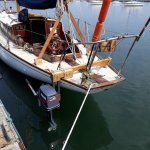
Manoeuvring long keel sailboat out of birth in wind - Any tips?

Thanks to LittleSister for posting on this thread, one of the best contributions I've seen, maybe we should have contribution of the month or something?

To the OP, I find prop walk is far and away the thing that has the most influence over where my boat (Colvic Watson 34) goes in reverse so if I know it's going to be difficult to get the bow through the wind to go the right way down the fairway between the pontoons it's significantly easier to go the wrong way first which allows me to use the prop walk to my advantage to do a 3 point turn to go the right way...
 
some great advice here! For me the key knowledge is that my boat (long keel) will point stern to wind and the bows blow off immediately I get under way leaving a berth. At least I know this is what will happen so I can plan the next steps if I'm going to end up pointing the wrong way. Oh and act like that's exactly what you intended to happen. After all berthing is a spectator sport.
 
In the new marina at Roscoff, yes the one with the nasty cross currents, I watched a small British boat and almost certainly along keel come in. It was a quiet evening and you could hear every word they spoke as they motered slowly down the isle. The laydy of the house was sitting on the foredeck and reported back to the helm that fenders & lines were in place and was there anything else that might be required? To which came the calm reply: "Well, now would be a good time to start calling for help."
 
Perfect
What’s not to applaude with that then ?
Plan was the put the stern port once clear of the mobo on my starboard but once she started arcing to starboard there was no correcting it so I had to let her go and swing the bow through the wind. In light conditions like this it’s ok but with a breeze that could have taken a bit of doing. I’m lucky I have lots of room (time) to manoeuvre.
 
Thanks. Some of the suggestions of using prop walk were what I have attempted in the past, but I've yet to discern any notable effect from prop walk on my boat. Few bits on here to give me thought and read up on though. Many thanks all.
There are also some decent videos on youtube which might help. One of the things I've learned is not to try to steer the rudder, but to steer the bow which, ok, might mean a bit of shuffling but works in conjunction with the wind and any tidal flow. Still a bit of a pain though!
 
In the new marina at Roscoff, yes the one with the nasty cross currents, I watched a small British boat and almost certainly along keel come in. It was a quiet evening and you could hear every word they spoke as they motered slowly down the isle. The laydy of the house was sitting on the foredeck and reported back to the helm that fenders & lines were in place and was there anything else that might be required? To which came the calm reply: "Well, now would be a good time to start calling for help."

That reminds me of an incident (I've recounted here before a while back) when years ago I was arriving at L'Aberwrach single-handed in my then long fin Hurley 22. In principle this was a much more manoeuvrable hull than a long-keeler. It had, however, an outboard in a well which couldn't be turned to direct its thrust. The prop was behind the rudder, so you couldn't kick the stern round using forward engine and the rudder. The outboard exhaust came out of the middle of the prop, so in reverse it mainly just produced froth and little thrust. The upshot being that it could only be steered when moving forward, there was no steering in reverse (it could go in any direction), and it took a long time/distance for reverse to slow and stop forward movement. I kept my boat on a mooring, and I'd had little experience of berthing it in a marina.

There were only a couple of available berths I could see. One was out of the question. I hung around in the river for maybe 5 minutes pondering how I could get into the only possible berth, the other side of a finger aligned with the river. I would have to go in in forward. There was a shoal or some other obstructions close behind it and beyond it, so I would have to make a sharp turn into it, which required speed and wouldn't leave enough length to slow the boat before it arrived in the berth, so I would be dependent on getting a line on a cleat on the end of the finger to stop it crashing into the pontoon. I couldn't think of any Plan B for if, as seemed quite possible, I didn't make the turn or something else went wrong. I would have to deal with that if it happened.

I took a deep breath, gritted my teeth, and went for it. Past the point of no return I suddenly realised that, absorbed as I had been in puzzling out my strategy, I had forgotten to put fenders out, which panicked me even more. I made the sharp turn into the berth, put the motor into reverse, and as I came alongside uncomfortably fast, leapt for the finger to get a line on a cleat. I fell flat on my face on the finger, my shoe having caught on the top guard wire as I went over it, as the boat rushed onwards!

Fortunately, some people on the pontoon must have been watching my rather unconventional approach, and rushed to grab the pulpit to stop the boat before it hit the pontoon too hard, and then held it in place and helped me get some lines on. Them being French, the absence of fenders may well have been considered normal!

The berthing gods had sent help, but were having a good chuckle anyway. :)
 
Last edited:
Apologies if I missed it, but what rig? I had a long keeled ketch for 21 years and in certain conditions would back out of a berth with the mizzen up but scandalised. At a given point I’d release the topping lift and sheet in hard and she’d spin (slowly) head to wind. Otherwise, +1 for a stern spring rigged to slip.
 
Hello,

So, I have a long keel sailboat. Really, there is no directional control astern unless you are doing probably >3 knots, which is a bit much in close quarters for a boat that really takes a while to stop. Especially with so many shiny things close by. I have to back out of my birth and am in the middle of 2 lines of pontoons. There is maybe a 10 meter channel between the sterns. Today, I found myself crabbing out with great difficulty! My stern tends to turn into wind, I believe because the mast and other gear is a pivot forward that has the most windage. Combine that with no wash over the rudder in astern, and no noticeable prop wash, and today, in 15-17 mph winds where the wind was coming almost directly from astern, I just could not get the bow around! Even with a spring, the wind turns the bow around. I go backwards, forwards to throw some wash over the proper and turn a bit, try astern again, but, by the time I'm going ahead again, the bow has already come around! I ended up doing one of those 30 point turns :)

Any hints or tips as to lines etc., to use in getting off the birth in these conditions? Obviously, it makes getting back in a breeze, but, I am sure glad no one was around this am as I pretty much crabbed out about 40m before I managed to get into a space large enough to spin her around!
If in a tight berth, in a long keeler with a pilothouse, the tip I have is to allow one crew to walk her half out into the fairway (then jumping aboard) before turning her. The starboard prop wash only engages at higher speeds than you can get to in a tight fairway so not as useful as some might suggest ( although useful for a mid river mooring with plenty of room ( ie when you do not need it).
 
Well my Twister!! Id just go where it wanted to go. If it went the wrong way, id just go forward. One day I did try and use the tide and wind to reverse probably 50 metrs in to my berth. no idea why, probably cost it just spun round. anyway i Nearly cracked it, but she took over just when I got within throwing the lines. I really just took my time and rather trying to dictate which way just go with the flow. Contessa 32s are a breeze in comparison.

Steveeasy
 
PBO have a recent article on berthing a long keeler in marinas. Reading between the lines, you may be able to refine things in calm and straightforward conditions. But at least for some boats it remains a lottery, and especially in significant wind and tide.100% with Steve easy and recognise what shouldn't even be attempted. Warping and lines are useful but less so single handed.
 
With really difficult berths ... boats ... turn round and berth her stern first.

If its hard to get stern to turn in ... catch a spring from stern to end of pontoon finger and use that to get stern in ... 'bowman' can take headline ashore by stepping of stern and that will help as well..... Unlike departure - they don't have to worry about getting back on board ...
 
I’ve suggested this before but what about a grappling hook on a heaving line for those difficult longkeel docking moments. It’s a bit harsh, but it won’t be your boat the grappling hook is digging in to, and when you explain to the owner of the ‘grappled’ AWB you have a long keel I’m sure his sympathy will outweigh his anger.
 
If in a tight berth, in a long keeler with a pilothouse, the tip I have is to allow one crew to walk her half out into the fairway (then jumping aboard) before turning her. The starboard prop wash only engages at higher speeds than you can get to in a tight fairway so not as useful as some might suggest ( although useful for a mid river mooring with plenty of room ( ie when you do not need it).
Personally I am very much against crew walking along the shore then jumping on board at the last minute.
Much safer to have all crew on board safely prior to casting off (though does depend slightly on freeboard height etc).
And of course, not much use when solo.

Regrettably long keels were optimal for wooden construction and for harbours and anchorages of 100 years ago, with no finger berths and plenty of longshoremen to assist. Not optimal for modern harbours and usage.
 
Personally I am very much against crew walking along the shore then jumping on board at the last minute.
Much safer to have all crew on board safely prior to casting off (though does depend slightly on freeboard height etc).
And of course, not much use when solo.

Regrettably long keels were optimal for wooden construction and for harbours and anchorages of 100 years ago, with no finger berths and plenty of longshoremen to assist. Not optimal for modern harbours and usage.

Even when I'm single handed - I often 'walk' a boat along and then step on ... the factor to avoid is the 'JUMP' .. that can lead to some interesting 'swimming lessons' ....
 
I’ve suggested this before but what about a grappling hook on a heaving line for those difficult longkeel docking moments. It’s a bit harsh, but it won’t be your boat the grappling hook is digging in to, and when you explain to the owner of the ‘grappled’ AWB you have a long keel I’m sure his sympathy will outweigh his anger.
I was in Audierne when a French boat decided to come into the berth alongside me, I moved onto the side deck to offer any assistance required but also mindful of the new teak ( yes teak) cap rails I had recently fitted to the boat and was still trying to regrow the arm and a leg they had cost. Anyway they had just about got their stern about level with my midships when one of the crew produced a massive boathook with a rusty metal end and was just about to hoik it over my cap rail to pull themselves further in. A vey loud non! ensued which elicited a surprised look and another attempt at which risking life and limb I grabbed the boathook and wrestled it from the guy. Needles to say there was only one small fender placed roughly amidships dangling in the water. There ensued a brief and one-sided discussion on respecting other peoples property. Entente cordiale took a backwards step that day.
 
Top