Manoeuvring long keel sailboat out of birth in wind - Any tips?

Those channels do not seem to be uniform in breadth, but basically yes.
Of course, it is your decision whether it is possible or not, based on the situation (wind speed, wind direction, current) and your knowledge of your boat's capabilities.
I do think that making tight turns into the wind under engine is an essential manoeuvre for anyone with a long keeled boat, so well worth practicing. I fully understand that what is possible to achieve with one (long keeled) boat may not be possible with another. Many factors influence this, an example:
I sail a boat that I believe is not unlike the Twister in size and characteristics. I have had it for over 40 years. In 2006 the original 13 hp engine was replaced by a 20 hp Beta. Two handed fixed prop by a three handed feathering. This change made a huge difference to my boat's ability of 'turning on the spot' by using prop walk. Still same boat, same skipper.
So the diameter of the turning circle of your boat, when turning into the wind in the circumstances I suggested in post #93, is less than two boat lengths?

A London cabby would envy that degree of manouverability . . .
 
Last edited:
The last time I came alongside in Inverness, with the really tight 180° turn onto my pontoon, it was 03:00hrs (am) and I was cold. wet and tired after a very arduous sail down from Wick. I've never ever come alongside SO perfectly before, alongside with the fenders merely kissing the pontoon, the lines onto the pontoons within seconds without the boat moving or drifting at all.
03:00 in the darkness without a soul being around to applaud, or even verify. Life's pretty unfair at times. :cry:
 
I can do that one - in a normal long keeled boat.

Back slowly out of the berth and just open the throttle, still in reverse, and she will go backwards upwind, quite reliably
"I began with the stern up-wind ‑ the easy one – and was confounded when the Twister wandered all over the river. To be generous, she remained under what might pass for some sort of control at a drunk’s wedding."

Tom Cunliffe

Going astern with twin, long and fin keels
 
The last time I came alongside in Inverness, with the really tight 180° turn onto my pontoon, it was 03:00hrs (am) and I was cold. wet and tired after a very arduous sail down from Wick. I've never ever come alongside SO perfectly before, alongside with the fenders merely kissing the pontoon, the lines onto the pontoons within seconds without the boat moving or drifting at all.
03:00 in the darkness without a soul being around to applaud, or even verify. Life's pretty unfair at times. :cry:
I remember reversing my Twister into an empty berth very early in the morning when there was no-one around to applaud; or to remark on the fact it was not the berth I had originally intended to enter. 😊
 
So the diameter of the turning circle of your boat, when turning into the wind in the circumstances I suggested in post #93, is less than two boat lengths?
I have not measured it (how do you, actually?)
Also, the space required to make a turn varies with wind speed and direction.
With practice comes a sense of when such a manoeuvre is possible, given the conditions, and when it is better not to try, because the margins are too small.
 
Here is a picture of a marina:

View attachment 169136


Let's suppose the wind is blowing from the bottom of the picture, ie towards the dead ends.


A J109 parked alongside me in there and had quite a job getting out. Some places are just too tight for comfort.
Despite that I find the real killer is tide, if you have bad tide and adverse wind, one error and you are stuffed.

.
 
I have not measured it (how do you, actually?)
Also, the space required to make a turn varies with wind speed and direction.
With practice comes a sense of when such a manoeuvre is possible, given the conditions, and when it is better not to try, because the margins are too small.
Well, all I can say is that after 26 years of owning a Twister, I have a sense that charging down towards a dead end, and trying to make a U-turn into the wind in a channel less than two boat lengths wide [56 feet] is a manouvre unlikely to be attended with success.
 
Last edited:
I agree - wind and tide combined with space restriction are the biggest problem. While both can help in some situations, they can also take over and restrict the apparent amount of space. Without space, turning my boat through 180 degrees in a marina channel to face a F3+ wind is beyond my ability even with a bowthruster. Even taking into account the tighter turn to starboard from prop walk. Warping is not easy with short pontoon fingers.

The first long keel I ever took in or out of a marina was a Halmatic 30 in wind over tide. I remember abandonning any attempt to turn and simply used the tide to ferry glide out of the marina arm.
 
You don’t have to have a long-keeled boat to have certain restrictions when manoeuvring. My 34 fin is generally very easy, especially astern, but with a saildrive and a rudder that only goes about 40 degrees across, turning into the wind is a definite no-no without ample sea-room, quite unlike our old Sadler 29 whose rudder would go to almost 90 degrees. Turning into a finger or box sometimes needs great care to prevent diagonal progress, though reversing out for fifty yards is perfectly easy.
 
"I began with the stern up-wind ‑ the easy one – and was confounded when the Twister wandered all over the river. To be generous, she remained under what might pass for some sort of control at a drunk’s wedding."

Tom Cunliffe

Going astern with twin, long and fin keels

First Mate maintains the trick is lots of fenders and Prayer.

We never can be sure of what JL will do in astern. She has huge windage and weighs close to 17 tons with full tanks and all the cruising gear on board.

Prop walk can be used if appropriate for the manouver. That, unfortunatly, is not always possible. We have been known to 'Wind' her so she points the right way. This requires another two persons.

Using the bow thruster to keep her straight works too.

We often spring off, but when in a finger slot this is of little use.

First Mate is IC steering, berthing and leaving a berth while I deal with warps and fenders.

It is a serious shortcoming in the vessels performance, but its attributes make up for this defect in spades.

IMHO, of course.
 
Well, all I can say is that after 26 years of owning a Twister, I have a sense that charging down a dead end and trying to make a U-turn into the wind in a channel less than two boat lengths wide [56 feet] is a manouver unlikely to be attended with success.
Not disagreeing, my only point is that by practicing, over time the judgment or sense will likely become more accurate. How would you deal with a channel that is two and a half boat lengths wide?
 
My home berth is like that. Berthed bow in. Reverse out gently slipping the stern spring to start the boat turning. Once across the channel and hopefully at about 45 degrees, engage forward and turn to starboard and motor out. Bowthruster ready but not routinely needed. But its made tricky when the tide pushes her back towards the berth, and the wind blows the bow off, despite bowthruster help. Then I have to reverse out which is as Poignard describes and not enjoyable. Not easy to keep midchannel even in a relatively wide channel.I'm not ashamed to say there are days when I decide not to attempt an exit. It would be easier berthed stern in but I prefer bow in for the prevailing winds. I have considered hoisting the mizzen as it will keep or turn the boat head to wind but absolutely no one berths with sails up (in wind) and I can see new problems emerging! Quayside berthing is much easier. I agree that practice helps but can't remove the "fluid dynamics".

As Rotrax, the advantages outweigh the disadvantages - lying head to wind when anchoring, heaving to, self steering onto the wind, tracking off the wind, never slamming etc.
 
Not disagreeing, my only point is that by practicing, over time the judgment or sense will likely become more accurate. How would you deal with a channel that is two and a half boat lengths wide?
OK, let's start with some basic revision;

A turn into wind will require more room than a turn away from it.

So running downwind toward the dead end, and hoping to make a tight U-turn is out of the question.


Asume I have backed out of my marina berth (using Duncan Wells' excellent technique with a bow bridle) and my stern is near the boats on the other side.

If the wind is so light that there is time for my heavy-flywheeled, slow to respond, 10hp BUKH to get me moving ahead, I simply steer towards the exit with joy in my heart.

If the wind is blowing out of the channel into which I have reversed, then I simply wait until the bow is pointing generally towards the exit, and off I go.

If the wind is going to set me towards the dead end, I use a pre-rigged weight on a line, as I described earlier, and wait for the bow to point upwind before moving ahead; recovering the weight as I go (something I can easily do if single-handed with the line led back to the cockpit).

That's about it.

If there is tidal current to contend with, then I have to judge what the effect of that will be and, if it seems best, delay my departure.
 
Last edited:
OK, let's start with some basic revision;

A turn into wind will require more room than a turn away from it.

So running downwind toward the dead end, and hoping to make a tight U-turn is out of the question.


Asume I have backed out of my marina berth (using Duncan Wells' excellent technique with a bow bridle) and my stern is near the boats on the other side.

If the wind is so light that there is time for my heavy-flywheeled, slow to respond, 10hp BUKH to get me moving ahead, I simply steer towards the exit with joy in my heart.

If the wind is blowing out of the channel into which I have reversed, then I simply wait until the bow is pointing generally towards the exit, and off I go.

If the wind is going to set me towards the dead end, I use a pre-rigged weight on a line, as I described earlier, and wait for the bow to point upwind before moving ahead; recovering the weight as I go (something I can easily do if single-handed with the line led back to the cockpit).

That's about it.

If there is tidal current to contend with, then I have to judge what the effect of that will be and, if it seems best, delay my departure.
Our experiences and handling techniques certainly differ. I don't know more about the Twister than what is available at sailboatdata, but my guess would be that engines and possibly propellers on our respective boats explain a fair bit. As mentioned in post #99, I experienced a transformation in handling capability when I upgraded.
The Twister is only slightly smaller than mine over all, but it displaces over one ton more. With only half the power available and 'slow to respond' to that, it is understandable that you are sceptical about my 'tight U-turn technique'.
But it works, within limits of course, on my boat.
 
Last edited:

Manoeuvring long keel sailboat out of birth in wind - Any tips?​

Assuming 'Don't' and 'wait until the wind drops/changes direction' aren't considered acceptable, then use warps to either turn completely, or at least control/direct the stern towards where it needs to go.
Exactly. Warps are not an indication you cannot handle a boat. They’re a valuable tool for the less wieldy craft some of us choose to own. We have a few 40 metre lines (old main halyards) in case we need to attach to more distant objects, or go from an aft pontoon cleat to a bow cleat and back to a cockpit winch, with line to spare. That and lots of fenders. Different difficulties for us, but same end result.
 
So the diameter of the turning circle of your boat, when turning into the wind in the circumstances I suggested in post #93, is less than two boat lengths?

A London cabby would envy that degree of manouverability . . .
(This may be cheating!)

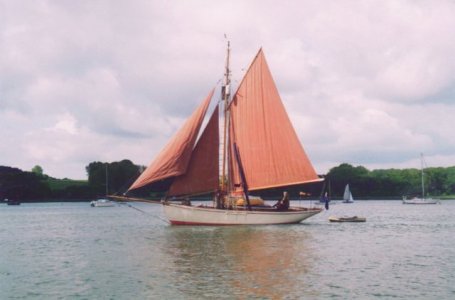
This boat, with long keel, prop offset to port and a 12 ft bowsprit, will turn inside two lengths. Always has done. If you put the tiller hard over to starboard the barn door of a rudder is at 40 degrees (and it would undoubtedly be stalled, if she under way normally, but that doesn’t matter in this manoeuvre) and it will deflect the prop wash almost sideways. If she is stationary to begin with, she will start to pirouette on the spot. Should she creep forward a quick blast of astern will stop her, and round she goes.

Don’t try this to starboard! 😉IMG_0547.jpeg
 
Last edited:
Our experiences and handling techniques certainly differs. I don't know more about the Twister than what is available at sailboatdata, but my guess would be that engines and possibly propellers on our respective boats explains a fair bit. As mentioned in post #99, I experienced a transformation in handling capability when I upgraded.
The Twister is only slightly smaller than mine over all, but it displaces over a ton more. With only half the power available and 'slow to respond' to that, it is understandable that you are sceptical about my 'tight U-turn technique'.
But it works, within limits of course, on my boat.
Then we can disagree agreeably, I hope.
(This may be cheating!)

This boat, with long keel, prop offset to port and a 12 ft bowsprit, will turn inside two lengths. Always has done. If you put the tiller hard over to starboard the barn door of a rudder is at 40 degrees (and undoubtedly be stalled, if under way normally, but that doesn’t matter in this manoeuvre) and it will deflect the prop wash almost sideways. If she is stationary to begin with, she will start to pirouette on the spot.

Don’t try this to starboard! 😉
She's a beauty.

In little or no wind, I can turn my Twister in a little over her own length with the tiller to port and using prop walk but that's a totally different kettle of fish from charging towards the dead end of a narrow marina fairway with the wind behind me, hoping to execute a u-turn. 😳
 
Not sure if anyone has mentioned this but the technique for steering narrowboats in reverse, which also worked on my old Tahitiana (a very heavy long-keeler), is to keep the tiller central while moving in reverse gear, then to turn the boat, put it in neutral; tiller hard over; and give it a brief but hefty blast in forward gear to kick the stern around. Then back into reverse with tiller central to carry on in the new direction. Works best on a boat heavy enough to keep some backwards momentum while you give it a blast of forwards.
 
Top