Mangusta 70 - 80ft (1996 - 2004) Advice

Thx ,
I think you misunderstood my post on trim tabs and the fact they trim both bow up or down .Sorry you felt my initial response made you “ angry “ if I understood your subsequent “ angry imogi .No worries on that from my side btw .It wasn’t my intention.

Anyhow the meat of your post it’s not testing “ spray rails “ that widen out as they go behind the stagnation line .
Its running constant width 2-5 mm
The rails tested are uniform in width .Indeed above a certain width , they used 5 mm in the scale modal in the tank test it generates far too much lift in the “ forefront “ ( read bow ) area resulting in a exaggerated bow high running trim .Not unsurprisingly. So any stern lift if any is masked , negated by the bow lift .

Pitty they didn’t do a 2 mm forwards of the stagnation and 5 mm or better 7 mm ( within the realms of there scale ) rearwards .
Then report on trim / CoG lift .Never mind .

They didn’t report on a gen rise of CoG like the study I posted .You know the whole boat lifting regardless of its trim angle .
Thats not a criticism btw as they weren’t looking at extra wide flat sections positioned X distance down the hull towards the transom.They just looked at trim . They didn’t measure CoG rise never mind .


This .
DF4D90D1-FDAD-44EA-A808-CA16E46E9CBC.jpeg

you see the same strake forwards is a 1/3 rd the width .A fraction so not to push the bow up .
E21867BE-05DE-43BE-9F3B-0ECF903840C4.jpeg


Only read it once but I will re read it to see if there’s any thing more to add .Tnx for posting .
 
Anyone can Google, the challenge was to find something about spray rails that doesn't mention lift but describes their purpose.
Agreed (the key word "lift" eh)
Well your article doesn't say they dont produce "lift" ..
So really until someone can produce an article that states they don't produce lift then one can only sit on the fence .
Now please dont miss understand, but that's all Porto has asked and he has the same right to spout his theory as we all do . ;)
 
Agreed (the key word "lift" eh)
Well your article doesn't say they dont produce "lift" ..
So really until someone can produce an article that states they don't produce lift then one can only sit on the fence .
Now please dont miss understand, but that's all Porto has asked and he has the same right to spout his theory as we all do . ;)
Exactly billskip and any lift at the stern by man sized rails running all the way to the stern is masked by there excessive effect of exaggerated bow lift or trim alteration .

Still waiting for why they don’ t create stern lift in certain circumstances.You know without a study of a piece of Tolberone tacked on the QM2 .
 
Spray rails do not generate lift, and are not designed to do so.
The lift is more helped by the chines at slow planning speeds (lets say sub or around twenty knots), especially in larger boats.
In fast boat the chine is hardly needed. In-fact most fast boats will have very small chines.

Spray rails main purpose is directional stability especially in following seas, the other is to reduce dirty water to the hull.
 
Spray rails do not generate lift, and are not designed to do so.
Ok ...I'm sitting on the fence..
Where did you learn that please? Is it something you believe or have scientific evidence that can be quoted / referred to here ?
Edit...I am referring to the strips that Porto claims create lift.
 
Last edited:
Thx ,
I think you misunderstood my post on trim tabs and the fact they trim both bow up or down .Sorry you felt my initial response made you “ angry “ if I understood your subsequent “ angry imogi .No worries on that from my side btw .It wasn’t my intention.

Anyhow the meat of your post it’s not testing “ spray rails “ that widen out as they go behind the stagnation line .
Its running constant width 2-5 mm
The rails tested are uniform in width .Indeed above a certain width , they used 5 mm in the scale modal in the tank test it generates far too much lift in the “ forefront “ ( read bow ) area resulting in a exaggerated bow high running trim .Not unsurprisingly. So any stern lift if any is masked , negated by the bow lift .

Pitty they didn’t do a 2 mm forwards of the stagnation and 5 mm or better 7 mm ( within the realms of there scale ) rearwards .
Then report on trim / CoG lift .Never mind .

They didn’t report on a gen rise of CoG like the study I posted .You know the whole boat lifting regardless of its trim angle .
Thats not a criticism btw as they weren’t looking at extra wide flat sections positioned X distance down the hull towards the transom.They just looked at trim . They didn’t measure CoG rise never mind .


This .
View attachment 150108

you see the same strake forwards is a 1/3 rd the width .A fraction so not to push the bow up .

View attachment 150109


Only read it once but I will re read it to see if there’s any thing more to add .Tnx for posting .
Ok I have digested this paper that Chris d posted # post 158 and will try to precis .To make it least painful for all .

It does support submerged create rails can create lift .The terminology they use is “ sinkage “ .

The opted for “sinkage “ measured at the bow and stern to work out the trim .
If they used just one point the CoG and measured that like in the paper I published they can’t see trim being just one point .

So a negative “ sinkage “ means lift the hull risers up .A positive number means it’s sank dropped lower as its running .
By measuring both ends of the boat you get the trim changes which is what they amongst other things they were aiming at .
The three things they were looking at .Resistance,basically drag in layman terms , Trim - you all know what is the running attitude.Sinkage , which is inverse of lift what we are interested in .

02996D4A-316A-43BF-9DC2-A1238C076C9F.jpeg02996D4A-316A-43BF-9DC2-A1238C076C9F.jpeg

The black line running horizontally is the control the hull without anything.

It quite clear looking at the RHS graphs “ Sinkage “ that’s it negative meaning the hulls lifting .That’s the net sinkage btw from the two points .

So for take row c .SR - rec - 5x5 means spray rail rectangle 5x 5 mm .You can see the negative sinkage .
Compare this row b the SR rec 2x2 ……the smaller indeed it’s sinks .

As I say “ in particular circumstances “ strakes taken back create lift submerged.


I will come on to the how later .
 
Last edited:
As said ..I'm sitting on the fence...
I can understand what Porto is trying to say, I also understand the disagreement by others.
To my mind the argument here
Is the definition or interpretation of the word "lift" ... imho it's a bit like saying a wire is "live" and others saying it's wrong because the wire is not alive. Porto says if it doesn't "sink" it must "lift".....well there is the problem as I see it, because there is a lot of information out there that use terminology to "support" Porto's theory, and as yet I have not found anything that says it doesn't produce "lift", but then we enter the world of "your wrong, but I can't prove it"
 
I’ve popped on a few times just to marvel at the amount of effort going into arguing this. It’s mental.
"Its mental" reminds me of o discussion I had with patients of a "secure hospital " they said we feel safe in here, we are not locked in, it's you that are locked out.
 
As said ..I'm sitting on the fence...
I can understand what Porto is trying to say, I also understand the disagreement by others.
To my mind the argument here
Is the definition or interpretation of the word "lift" ... imho it's a bit like saying a wire is "live" and others saying it's wrong because the wire is not alive. Porto says if it doesn't "sink" it must "lift".....well there is the problem as I see it, because there is a lot of information out there that use terminology to "support" Porto's theory, and as yet I have not found anything that says it doesn't produce "lift", but then we enter the world of "your wrong, but I can't prove it"
Ok here’s why .
Quoting from a mobo designer .

Designing effective rails isn't an easy thing. You can slap on things that work to some degree, but if you're looking for gains in performance , chine flats and rails need to be well shaped and placed within the performance envelop the Hull.To most designers, spray rails and chine flats, as well as chine placement and shapes themselves are a bit of black magic, most aren't willing to surrender very quickly. Boat designers develop these shapes over time (lots of it) though trial and error (lots of them), so getting much information that is application specific will be difficult. It's a bit like asking an engine builder, to reveal why his engines produce more HP, than other engine builders that are using the same pieces. They'll give you some general answers, but they will not tell you how many hours they put into unshrouding the valve bosses or some other nuance , that gives there boat a performance advantage over the competition.


The specific lift I am interested in and debating is the added lift from the under water sections of lifting strakes , rails strips n a fast planing boat ……in certain circumstances.
 
So here is how pronounced strakes under water taken aft create lift .Raise the stern up .

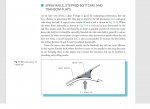
Extract from Chris d s paper linked earlier. Highlighted in red ,

3FBDA986-AFD7-4D83-9841-7D66B96D4E7C.jpeg

Extract from Lars Larrsons book quoted ^

0AC7E3AF-CCFF-4E72-9099-4D392380A7D5.jpeg
So you can see the deflection creates a lifting force ^
So they are tiny at the bow Tolberone size .Too much lift and the thing will be grossly bow high.Also remember they can add resistance or we call it drag .See the graphs in post # 170 .

The top para highlighted in red
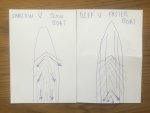
Excuse my back of fag packet sketch .
This is what Lars and his colleagues means with all this angle business re outer edge of strake reducing the dead-rise.
E313AF33-5840-4653-879C-EE5962BFD743.jpeg
So a flat surface creates the most lift .As the deadrise increases AND the strakes become more pronounced , they redirect the water as if it’s a lower deadrise the hatched line I have drawn .

A - makes little difference a shallow typical FB 30- 40 ftr designed to chug along at 18-22 knots .
B -The effective water flow is tricked into moving as if the dead rise is lower = greater lift than without .

Water flow ….that’s the crucial point it has to actually flow over those corners not run completely parallel to the strake .
To achieve this you need three things .A deep V / deadrise .Speed and pronounced underwater strakes .

see here another Porto stretch .
E0893DF8-43CE-45BA-B64B-C45EC5907393.jpeg
On a flat tea tray the water runs straight back parallel to the tray sides ( not illustrated.
Introduce a V a dead rise like a boat ,
What i am illustrating here ^ is the directional flow .Ordinarily in a slow boat shallow V the disruption line is V shaped where the hull hits the water .The spray and water direction is deflected sideways by the energy transferred by the hull whacking it .As the water runs back it parallels up with the keel , chines .It can’t run over any appendages in the rear 1/4.If you put them on the would only add drag .That’s why on theses hulls FB s running 20-26 knots they don’run them back all the way to the transom .
So here no lift = wrong set of circumstances.

Now look at the RHS image ,Significant dead rise say 20 degrees + , significant speed 30-40 knots or for MapishM 100 :).

Look carefully at the arrows see how they don’t , the water flow direction fully parallel up with the chine s hull sides .Due to the force , impact because of the either the speed or dead rise the escaping water once whacked is moving over those strakes ,Strakes pronounced and taken as far back to the transom as the designer wishes .
Often all the way back ,
The lift created by submerged strakes is balance of the three ,1- shape size position or how pronounced.2- speed to whack the water so hard it cant parallel up so ends up running over said strake , 3 deadrise to redirect the water more sideways and thus wash over the submerged strakes .
IN A PARTICULAR SET of CIRCUMSTANCES ………^

From a Naval Architecture forum .I have in the interest of anonymity I have redacted our names .
Showed the same pics of my hull , they are further up .You are all tired I know of seeing my boat .

61E6371F-AA65-42C6-9E1D-80C4CC1DCFE2.jpeg
The references just back up the under lift thing by strikes and steps .

@ PYB
Yes this stuck on the bow in-front of the disruption zone is only designed to deflect spray , Too big and its creates excess drag + over lifts the bow . Spray rail correct term ,Send same size back in a 12 degree deadrise 50 ftr @ 30 tons going 22 knots then you are right it will produce diddly squat under water lift .The beamy flat aft sections can deal with lift .Does nit need any additional.
FC3E68FD-44A0-4D4B-A568-668880C128CF.jpeg


Happy now ?
 
Top