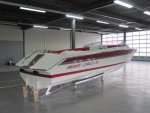
Mangusta 70 - 80ft (1996 - 2004) Advice

You haven’t given any references supporting your point saying that in the submerged part of the hull spray rails create don’t produce lift in certain circumstances.
Porto, I must admit to have stopped reading all the references you posted ages ago, to avoid the risk of losing the will to live.
So, the last thing I want is to keep debating the theoretical side of this, which BTW I'm pretty sure 99.99% of boaters aren't interested in - myself included.

But let me reiterate (and hopefully clarify further) something more empiric/pragmatic I already asked and got no answer:
If rails can contribute to hull lift even when fully submerged, why practically every boatbuilder (Itama included!) do NOT bring them all the way to the transom?

The only noticeable exceptions I can think of based on direct observation (aside from your particular Itama model) are high performance boats.
But when going real fast, possibly up to the 3-digits league, the dynamic lift is strong enough regardless of any trick, that the boat rides with dry chines along the whole length.
And typically, steps are introduced around mid hull, to increase aeration even more than rails alone can do.
So, I guess it makes sense to have rails along the whole boat length for spray deflection and stability, regardless of any additional lift.
Which would be unnecessary anyhow, because drag reduction is the name of the game, not lift.
But these boats have close to nothing to see with even the faster among all the boats which we are now debating.
 
Last edited:
Porto, I must admit to have stopped reading all the references you posted ages ago, to avoid the risk of losing the will to live.
So, the last thing I want is to keep debating the theoretical side of this, which BTW I'm pretty sure 99.99% of boaters aren't interested in - myself included.

But let me reiterate (and hopefully clarify further) something more empiric/pragmatic I already asked and got no answer:
If rails can contribute to hull lift even when fully submerged, why practically every boatbuilder (Itama included!) do NOT bring them all the way to the transom?

The only noticeable exceptions I can think of based on direct observation (aside from your particular Itama model) are high performance boats.
But when going real fast, possibly up to the 3-digits league, the dynamic lift is strong enough regardless of any trick, that the boat rides with dry chines along the whole length.
And typically, steps are introduced around mid hull, to increase aeration even more than rails alone can do.
So, I guess it makes sense to have rails along the whole boat length for spray deflection and stability, regardless of any additional lift.
Which would be unnecessary anyhow, because drag reduction is the name of the game, not lift.
But these boats have close to nothing to see with even the faster among all the boats which we are now debating.
Here
Ray hunt
The Ride - Hunt Yachts

Red my emphasis.
Double red line “ helps it lift the boat “
Blue .Exactly what Sorensen said in the GW link I gave further up ^ .


E6F022D5-55D2-4641-91A3-5286D2EACA10.jpeg
 
I really struggle to see what your point is - if any.
Doesn't the statement (which you aptly avoided to underline)...
"Some [spray rails] are so small and round they do nothing. Others are under water all the time, and also do nothing"
...mean exactly what jfm is saying, in plain English?
 
Last edited:
Porto, I must admit to have stopped reading all the references you posted ages ago, to avoid the risk of losing the will to live.
So, the last thing I want is to keep debating the theoretical side of this, which BTW I'm pretty sure 99.99% of boaters aren't interested in - myself included.

But let me reiterate (and hopefully clarify further) something more empiric/pragmatic I already asked and got no answer:
If rails can contribute to hull lift even when fully submerged, why practically every boatbuilder (Itama included!) do NOT bring them all the way to the transom?

The only noticeable exceptions I can think of based on direct observation (aside from your particular Itama model) are high performance boats.
You do don’t have to look far ;)
” loads-of -pictures “ :)
Bertram 25 - project / loads of pictures

Well well want do we have here folks nestling amongst us .

9B348453-8434-467B-BA66-DD8FA58CB390.jpeg

Renember trim can be adjusted with drive angles for those with variable drives .

Yes I agree not all have them and there shape , size , position , primary intention s vary .

But there are equally plenty of poor running boats .I can’t be the only one to witness this type of thing below .

49F76F48-9838-4B00-BB7C-735594D4D672.jpeg
FFE6C148-BFD2-4CA4-A292-DA85E66E128D.jpeg
^^^^ lack lift @ the stern


01669F50-6970-49F0-9B89-299CAE1C5614.jpeg
strake runs to the transom ( as well as steps ) ……plenty about .


CE3F8D06-EEC3-4CFB-A3E0-6DA7D9C86482.jpeg
Can’t see if they run all the way to the transom, but that’s not the issue .The issue is do they contribute to stern lift to achieve that running angle .Certainly very pronounced.So my € s are they do ….al La Ray hunt design .
 
I'm loving reading this debate but not sure what your arguing about anymore, I think its fairly obvious that spray rails and strakes don't generate lift, at least not the sense that an aircraft wing generates lift, there are no high and low pressures on opposing surfaces.
The term "lifting strake" appears to be used in the same sense that you might describe a "lifting strap" to lift something but the strap itself doesn't generate lift a force applied to it does, thats the water in the case of a planing hull. Any rail or strake merely adjusts the flow to allow the boat to stop displacing water and ride on top of it with the minimum amount of drag.

Be great if someone could explain the physics though :)
 
I really struggle to see what your point is - if any.
Doesn't the statement (which you aptly avoided to underline)...
"Some [spray rails] are so small and round they do nothing. Others are under water all the time, and also do nothing"
...mean exactly what jfm is saying, in plain English?
Some because they are not optimised in shape in size , more cosmetic .That does not conflict with what iam saying or the jist of Ray hunts designs paragraph .

That paper achieved a 40 # increase in lift , they call it rise of CoG , than other wise .
Obviously they tried a variety of shapes , sizes , positions .Never said they all do it .
Always said in “ certain circumstances “

Why call them lifting strips / strakes/ lifting rails the under water sections ?

Indeed there’s a nice article re Hatteres I think 50 something which had a very wet ride .
Owners ( Hat club members ) getting 9issed off .
They have what look like spray rails , 3 in more of less the same places but useless .= too small and un pronounced .

So a few guys DIY bigger one grafting , actually glassing / glueing new ones on . Apparently they can buy ready made spray rails of various lengths , which do turn flat at the under water sections .

Because they just stuck them on ( no real science ) about 1/2 dozen boats all , each man doing his own thing .
Some report less wet ride , some report more lift and fuel efficiency savings .And a couple reported no difference.
It all depends on the speed , shape the deadrise , position and many more variables .I have never said every one = more lift .
Infact they do but a 2% difference is neither hear nor there .
A slow flatter hulled boat sub 25 knoter cruiser heavily reliant on tabs anyhow , like the two ( sorry the 90 degree pics - old images ) then you are right wasting your time .Those two hulls have massive running angle issues beyond adding wider strips taking the upper one back to the transom.

Its one ingredient in Goldilocks pudding .Look at that way rather than saying Goldilocks pudding is never found with raisins .
 
Another reason you don’t always see lifting strakes running all the way back .Or very pronounced.

. Boats with a volumetric Froude number less than 4.0 don't need lifting strakes... for example, a 55-foot boat weighing 60,000 pounds should only need strakes if it will go faster than 42 knots. Location and shape, again, is about finding the balance of the design.

Tend to see them running back to the transom / more pronounced, wider on deeper V more performance orientated hulls .
 
I really struggle to see what your point is - if any.
Doesn't the statement (which you aptly avoided to underline)...
"Some [spray rails] are so small and round they do nothing. Others are under water all the time, and also do nothing"
...mean exactly what jfm is saying, in plain English?
Sadly you’re wasting your time Mapism. He just cherry picks stuff from the internet, that he doesn’t understand. Your quote above answers the argument perfectly (if any answer is needed- this is ultra basic physics)

Porto is displaying ultimate confirmation bias. That Sorensen paper doesn’t support his position one iota, no matter how many times he posts it here. This is may be innocent error- he does not understand what that paper is actually saying. I did explain above but it’s too full to repeat.

I’m down tooled bcz this must be dull as ditchwater for readers. I’m going to contemplate driving a 100mph car at 30mph, and ask google what happens to the other 70.
 
Sadly you’re wasting your time Mapism. He just cherry picks stuff from the internet, that he doesn’t understand. Your quote above answers the argument perfectly (if any answer is needed- this is ultra basic physics)

Porto is displaying ultimate confirmation bias. That Sorensen paper doesn’t support his position one iota, no matter how many times he posts it here. This is may be innocent error- he does not understand what that paper is actually saying. I did explain above but it’s too full to repeat.

I’m down tooled bcz this must be dull as ditchwater for readers. I’m going to contemplate driving a 100mph car at 30mph, and ask google what happens to the other 70.
Classic .go for the man not the ball .
No bias I accept and have said given examples , as does the GW guys Vid where they are ineffective If small and poorly placed in slowish heavy boats ,

No cherry picking whole contents disclosed .Its you “ cherry picking “ against a wall of evidence .

@ Chris this is what we are debating - In certain circumstances strakes ( the rear underwater bits ) create lift that otherwise wouldn’t be there with out them .

In others like shallow deadrise , beamier hulls , not as pronounce or sharp and smaller size strakes , Lower speeds , then any lift is negligible.
But iam talking wider , deeper sided, sharper ,strakes taken all the way back .On deeper deadrise faster hulls .
As in the ray hunt link .

The paper I linked ( my post#111) was to see if any effect they have ,Broadly with a round bottom hull and axe bow in effect a control .They used a axe bow to eliminate conventional chine lift , or and bow rake effect .
So they could solely focus on the strakes, Adding them in different places , different sizes , different L etc etc .Importantly different speeds and indeed wave heights .

in one set of circumstances ( size , shape position etc ) achieved a 40 % rise of the CoG in the hull compared to the same hull running in the same conditions without .They also reduced the running angle because of the stern lift , the wider ones taken further back .


Thats super conclusive proof Because all they did is look at stakes / strips underwater .
For all to read .
 
Last edited:
@ Chris this is what we are debating - In certain circumstances strakes ( the rear underwater bits ) create lift that otherwise wouldn’t be there with out them .
You need to define what you mean by lift in engineering terms? as I understand it the lift (height above the mean water surface? ) would be the same but you might need more horsepower to achieve the same speed without the strakes ignoring any other factors such as weight etc..
But I'm not joining the argument as I'm not pretending I fully understand fluid dynamics at all :confused:
 
You need to define what you mean by lift in engineering terms? as I understand it the lift (height above the mean water surface? ) would be the same but you might need more horsepower to achieve the same speed without the strakes ignoring any other factors such as weight etc..
But I'm not joining the argument as I'm not pretending I fully understand fluid dynamics at all :confused:
It’s the height above the WL , or rise in the CoG above the sea . See post #111 .

In deeper V hulls the V as it parts the sea speeds up the water flow .This faster flow say @ typically 30 knots on our size boats if it passes over theses strakes / strips at it normal diagonal angle , if the strikes are thus shaped and positioned add back lift .

Understanding Hull Design
WHOLE ARTICLE where’s any bias ?
The interesting bit . Saves me re writing it again .
The reason why I add links is because a link or pic in this case below saves me writing and adds credence to what I am saying .
I used to work in a evidence/ research / scientific world .
Papers , books m articles , vid s are todays ways of info disseminating .
I don’t get the criticism by JFM re internet ,This is a Internet forum Duhh! Scrolls wax seals sending men with msgs or pigeons etc .

BB6A99AC-ACF5-465E-8441-756748C52E8F.jpeg
 
Classic .go for the man not the ball .
No bias I accept and have said given examples , as does the GW guys Vid where they are ineffective If small and poorly placed in slowish heavy boats ,

No cherry picking whole contents disclosed .Its you “ cherry picking “ against a wall of evidence .

@ Chris this is what we are debating - In certain circumstances strakes ( the rear underwater bits ) create lift that otherwise wouldn’t be there with out them

In others like shallow deadrise , beamier hulls , not as pronounce or sharp and smaller size strakes , Lower speeds , then any lift is negligible.
But iam talking wider , deeper sided, sharper ,strakes taken all the way back .On deeper deadrise faster hulls .
As in the ray hunt link .

The paper I linked ( my post#111) was to see if any effect they have ,Broadly with a round bottom hull and axe bow in effect a control .They used a axe bow to eliminate conventional chine lift , or and bow rake effect .
So they could solely focus on the strakes, Adding them in different places , different sizes , different L etc etc .Importantly different speeds and indeed wave heights .

in one set of circumstances ( size , shape position etc ) achieved a 40 % rise of the CoG in the hull compared to the same hull running in the same conditions without .They also reduced the running angle because of the stern lift , the wider ones taken further back .
Thats super conclusive proof Because all they did is look at stakes / strips underwater .
For all to read .
Alas the problem here, and in many other threads on this forum, IS the man not the ball.

You précis above of what that “for all to read” scientific paper says is startling in its lack of understanding. As was the shore power power thing - you have form.

You spoil this place (in the eyes of many who have said so to me) by clogging it with downright incorrect information, which you repeat endlessly, flat earth society style, till everyone is exhausted or switches off. You’re just incorrect here as a matter of physics and fluid dynamics, and nothing can change that.

PS I just saw the internet article you posted immediately above. The red underlined part is simply incorrect. Was that ray hunt or another author? Even if it was ray hunt, or King Charles, it’s wrong. I suspect the author actually had in mind (but failed to make clear) the Newtonian lift at the bow that comes as a by product of spray deflection, and that we are not disagreeing on, but it’s not clear what he meant from the text. If the author really did mean lift in the aft submerged part of the hull then he is wrong.

See post 123 for a clear statement by Ray Hunt, agreeing my analysis and 100% disagreeing yours.
 
Last edited:
Alas the problem here, and in many other threads on this forum, IS the man not the ball.

You précis above of what that “for all to read” scientific paper says is startling in its lack of understanding. As was the shore power power thing - you have form.

You spoil this place (in the eyes of many who have said so to me) by clogging it with downright incorrect information, which you repeat endlessly, flat earth society style, till everyone is exhausted or switches off. You’re just incorrect here as a matter of physics and fluid dynamics, and nothing can change that.

PS I just saw the internet article you posted immediately above. The red underlined part is simply incorrect. Was that ray hunt or another author? Even if it was ray hunt, or King Charles, it’s wrong. I suspect the author actually had in mind (but failed to make clear) the Newtonian lift at the bow that comes as a by product of spray deflection, and that we are not disagreeing on, but it’s not clear what he meant from the text. If the author really did mean lift in the aft submerged part of the hull then he is wrong.

See post 123 for a clear statement by Ray Hunt, agreeing my analysis and 100% disagreeing yours.
You are just plane wrong on this , the evidence is there for all to see .
Happy to agree to disagree with you on this . Nothing unusual on forums .

Let's start with some clarification.
Strakes first.
What is the function of the strakes?

They separate the water from the hull and that reduces drag.
The strakes also produces some lift. Strakes with an horizontal face will produce more lift than others. Because of that lift, they also increase transversal longitudinal stability.
They help tracking.
At very high speeds, strakes also somewhat reduce sprays.
This is only important at high speeds. At low planing speeds, the differences in lift and drag are very small.
At slow speeds, strakes = more surface = more drag.
many planing boats don't have very pronounced strakes. This is especially true for slower planing boats.
Now, from a structural point of view, strakes have another function. Wide panels of single skin fiberglass are flexible and in production fiberglass, strakes are used as stiffeners. That is why some production fiberglass boats have strakes. They may not be needed for performance.Some boats have very stiff bottoms , and do not need strakes for stiffness.
A fast boat like Pershings and Itama et al will benefit from strakes to reduce drag.

Chine step and/or spray rail.
At the bow, it deflects sprays. Close to the transom, it provides stability and lift. All along, it separates water.
Same remarks for strakes: no need for slow speed and the ones with an horizontal face will give more lift and better stability.


Ray hunt , you have ingnored the other highlighted bits ,taken your little sentence I did in blue out of context .
Hes saying many used them incorrectly or for reasons I have explained don’t need pronounced .
It prosperous to suggest the WHOLE article supports you.

You have given zero evidence.
 
You are just plane wrong on this , the evidence is there for all to see .
Happy to agree to disagree with you on this . Nothing unusual on forums .

Let's start with some clarification.
Strakes first.
What is the function of the strakes?

They separate the water from the hull and that reduces drag.
The strakes also produces some lift. Strakes with an horizontal face will produce more lift than others. Because of that lift, they also increase transversal longitudinal stability.
They help tracking.
At very high speeds, strakes also somewhat reduce sprays.
This is only important at high speeds. At low planing speeds, the differences in lift and drag are very small.
At slow speeds, strakes = more surface = more drag.
many planing boats don't have very pronounced strakes. This is especially true for slower planing boats.
Now, from a structural point of view, strakes have another function. Wide panels of single skin fiberglass are flexible and in production fiberglass, strakes are used as stiffeners. That is why some production fiberglass boats have strakes. They may not be needed for performance.Some boats have very stiff bottoms , and do not need strakes for stiffness.
A fast boat like Pershings and Itama et al will benefit from strakes to reduce drag.

Chine step and/or spray rail.
At the bow, it deflects sprays. Close to the transom, it provides stability and lift. All along, it separates water.
Same remarks for strakes: no need for slow speed and the ones with an horizontal face will give more lift and better stability.


Ray hunt , you have ingnored the other highlighted bits ,taken your little sentence I did in blue out of context .
Hes saying many used them incorrectly or for reasons I have explained don’t need pronounced .
It prosperous to suggest the WHOLE article supports you.

You have given zero evidence.
I'm switching off here Porto, other than to say that as well as failing to understand the physics here you are mispresenting the Ray Hunt position. I have not just "ignored" everything other than the sentence quoted quote in post 123, but you're talking about stuff that is self-evident ly not on point, in that it is not about submerged spray rails. I have (again self evidently) not taken his sentence quoted in #123, out of context, for it deals head on with submerged rails and represents everything he has to say on that topic (his brevity being entirely commensurate with the simple and self evident nature of the topic). And he agrees 100% with me/Mapism (not that it's a difficult point) and 0% with you.

I'm finding it (as on many previous occasions) pointless carrying on because this is so flaty-earthy, and I'm conscious that this must be dull for others, so l'm downing tools. We can agree to disagree :)
 
Last edited:
Rubbish it’s there for all to see .Again .

You haven’t given any references supporting your point saying that in the submerged part of the hull spray rails create don’t produce lift in certain circumstances.The name itself says a lot often referred to as ……Lifting strips !

I have made multiple points , references from naval architecture papers , and quoted various great and the good in the mobo world .You have brought nothing into this discussion .Anyhow if as said you are ploughing your own furrow .

Happy to leave it here .
Crikey Porto you are like a simplex VHF channel with a stuck button. Always on TX and therefore incapable of RX.
Even though I’ve learned some stuff about spray rails from JFM it is a bit boring.
 
Tunnels named guy at the end .

Lifting Strakes

Totally consistent with every other link …..thus far ;) .

Note the deep V adding lift back paras at the end .Also note the distinct shape + particularly width .

Yes the first sentence says they are useless on most hulls .Thats consistent with the GW vid and the research papers as it all depends on repeating myself …shape , size , position and speed of the thing + much more .As I said I give a balanced view and i am talking about the pics of my boat , Bertram , Montecarlo .
Already explained slow, beamy , low deadrise addition lift is weak .

” in particular circumstances “ is the phase running through my post .Not every strake .

Still waiting for any evidence that they don’t produce lift in a monohull ….large pronounced , wider than normal taken further back .
 
Top