Mangusta 70 - 80ft (1996 - 2004) Advice

I didn’t understand any of your last post Porto but you need this idea(posted before) to make your boat turn without having to slow down ?
63B446C2-E7CF-4615-BF09-CDA8FC6CC96D.jpeg
 
Last edited:
  • Like
Reactions: vas
Hang on lads it’s just an observation not reporting an issue that needs attention
Thinking see saw so what’s UP ?

The steering never really weights up at cruising speeds as the aeration occurs , the tracking power is brilliant cruising .
Sit with hands off the wheel maybe do a minor adjustment using a foot on the bottom of the wheel , just swing a leg Fwds .
Almost makes the autopilot redundant .
I would prefer the tracking power a function of the excessive strakes over a nervous skippy boat .Each to there own .

Maybe at speed the tracking set as powerful as it is can’t be over come anyhow even with unventilated rudders .Or if you wanted a tighter turner the rudders would have to so massive to overcome the “set “the drag would kill knots .

Doing what VAS suggested ( easy btw ) would just add NET drag by increasing the net water flow as well as steerage .

Its that kids beam balance thingy .

The deadrise deep and strakes excessive mean when it heels into a turn there’s a huge righting moment to overcome which as I said I need huge blades if that’s what you want , but a price of drag .
It heels very little obviously turning at speed .

UP s and DOWN s

Pots yes I do need to pull the sticks back AND turn the wheel if they pop up at short notice dead ahead at 28 / 30 knots .
Thats the low / down end side of the see saw .

ChrisH …do you notice on low wide rubber sports cars excessive front tyre scrub while manoeuvring on full lock ? Ackerman effect all cocked up , but only when the tyres are hard over full lock .You just have to live with it .The ups and downs of fat front rubber .
 
Doing what VAS suggested ( easy btw ) would just add NET drag by increasing the net water flow as well as steerage .

Its that kids beam balance thingy .
very much doubt, just read what you typed, so water "smashing" onto a 150X20mm (say, haven't measured it!) vertical "slab" which is the base of the p-bracket, is creating less drag, than a 30-40cm slight gradient towards it :rolleyes: Haven't done fluid dynamics, have a decent understanding of forces and surfaces, that's plain wrong but that's your boat not mine and if you're happy to drop from 30+ knots to 25 to steer, I'm happy. At 7-10kn I'm travelling steering is fine (by the autopilot of course)
 
very much doubt, just read what you typed, so water "smashing" onto a 150X20mm (say, haven't measured it!) vertical "slab" which is the base of the p-bracket, is creating less drag, than a 30-40cm slight gradient towards it :rolleyes: Haven't done fluid dynamics, have a decent understanding of forces and surfaces, that's plain wrong but that's your boat not mine and if you're happy to drop from 30+ knots to 25 to steer, I'm happy. At 7-10kn I'm travelling steering is fine (by the autopilot of course)
NET effect Vas m the aeration of the rudder reducing its water fast flow of the blade sat behind the prop.This total drag is less when summed than the singularity of the protruding edge of the P bracket .

A feathered , faired in , or deep indented P bracket base creating as little drag as could be achieved …..to looses the rudder aeration and thus add more water flow at the upper surface .That rudder now creates more drag than otherwise , slowing the boat .


Thats the kids see saw .

Thats the Q MapishM and my self eluded to is it a bad serious error a cock up , Friday job a fault ? or did he do it deliberately.

Maybe the set the tracking the transverse stability is so great ( combo of deep V + excessive strake size ) , even with a super smooth P bracket base and full water flow it makes not as much difference, or hardly cures it .If so then grab the drag reduction and bank the knot(s) or fuel efficiency with the aeration .To overcome the set such a massive blade out of proportion to get the sharp steering = huge performance loss .

Its unlikely he wouldn’t have tested various rudder combos and P bracket base set ups .
As it’s not difficult is it .Plug and play blades and fair in the bracket base .
 
This is all beyond me and I've only experience of boats up to about 28ft but is it common for a boat's helm to become redundant at 30 knots? That would terrify me! My boat is hugely nimble in the low 30s.
 
Thats the Q MapishM and my self eluded to is it a bad serious error a cock up , Friday job a fault ? or did he do it deliberately.
Ever heard of Occam's razor, Porto?
There's no reason to look for further complications, when there's an easy solution/answer to a problem/question.
Don't do the mistake of overthinking also this matter, as you already did with rails/strakes/spray/lift/however you like to call the things.

IMHO, it's totally obvious that Amati quite simply didn't see the relevance of recessing the bracket, making its upper plate level with the hull - otherwise he would have done that, plain and simple.
But now, hindsight being a great thing, it doesn't take much more than the good old common sense to understand that the disturbed flow may affect to some extent the rudders effectiveness, as the guy in boatdesign forum immediately pointed out after seeing your pics.

Now, how relevant a fairing around the existing plate will be for improving the rudders effectiveness, obviously is anyone's guess.
And the fact that myself, Vas, jfm and probably anyone else on planet Earth would do it if the boat were ours, because even the slightest improvement would be better than nothing, is totally irrelevant.
The only thing that really matters is, are YOU interested to at least try to improve the steerability of your boat?
Maybe considering also this other contribution you just got on the other forum, which would be amusing if it weren't true:
I have to wonder how an insurance assessor would read the line, "did not respond to helm input before the collision".....

This is the only question you should ask yourself, and give an answer to it.
If you will decide to go ahead, I for one will be interested to hear about the results, which I would expect to be at least perceivable.
But if you're happy with your boat and you think it's normal to be able to turn only after slowing down, well, who am I (or anyone else) to argue?
 
Oh, and I meant to say but I forgot, just in case you are wondering.
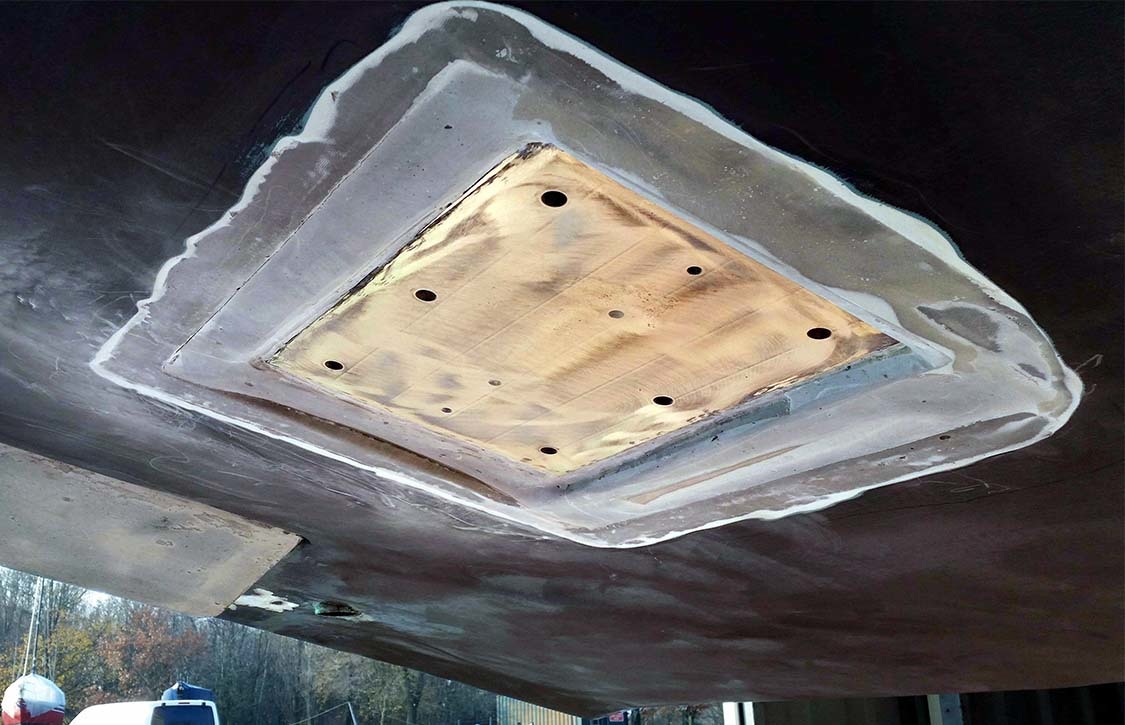
This is a pic I took of a Ferretti which ran aground requiring bracket/shaft/prop replacement, which nicely shows how a proper recess looks like, moulded within the hull for the bracket installation and reinforced with additional lamination layers on the inside.
To my knowledge, everyone and their dog nowadays mount shaft brackets in this way.
And even without knowing for sure, I would bet that the same is true also for Itamas.
VzOiR2Bo_o.jpg
 
Oh, and I meant to say but I forgot, just in case you are wondering.
This is a pic I took of a Ferretti which ran aground requiring bracket/shaft/prop replacement, which nicely shows how a proper recess looks like, moulded within the hull for the bracket installation and reinforced with additional lamination layers on the inside.
To my knowledge, everyone and their dog nowadays mount shaft brackets in this way.
And even without knowing for sure, I would bet that the same is true also for Itamas.
VzOiR2Bo_o.jpg
yep, mine are like that
 
To my knowledge, everyone and their dog nowadays mount shaft brackets in this way.
100% agreed. For decades, builders invariably recess the flat mount of the P bracket into the hull on P boats. Cant think of a builder who doesn't. It's so easy to do - a flat block tacked inside the mould creates the recess.

The insurance angle is interesting, and would worry me. It's now on public indelible record that the boat doesn't steer and is arguably unseaworthy.

Porto's post 205 above gives me a mental image of a USB cable. One end connected to his computer writing posts on here. The other end shoved 15 inches up his back passage, and he just squeezes his torso to write something, anything, regardless of any laws of science/engineering/physics, anytime there is even a hint that Mr Amati isn't God Almarti.
 
Last edited:
yep, mine are like that
M, if you had to do the same job after a grounding, I'm sorry to hear that.
Or do you mean that you just know the bracket mounting plate is flush with he bottom, as you obviously can see without removing anything?
Me, I can't recall of any other occasions when I came across a removed bracket (which is the reason why I took a pic)...
...fingers crossed, touch wood, etc.! :)
 
M, if you had to do the same job after a grounding, I'm sorry to hear that.
Or do you mean that you just know the bracket mounting plate is flush with he bottom, as you obviously can see without removing anything?
Me, I can't recall of any other occasions when I came across a removed bracket (which is the reason why I took a pic)...
...fingers crossed, touch wood, etc.! :)
Yes, I mean you can easily see that they are recessed. Thankfully no grounding!
 
I have noticed yard walking other P brackets recessed .Mine the aberration .
Other Itama using internet images too .

Trying to figure why .
The other forum thus far ( early yet ) figure a extreme performance advantage.
Both systems the rudder aeration at speed and moveable bar .

It does steer but not super responsive.Throttle steering as it’s called is required above 25 knots .No biggie .
Nonsense to talk of insurance, danger , accidents, un sea worthy etc as i thought I made that clear .That line of thought is in the same junk box as not eating a date pie for fear a bad date might kill you
.No Itama one has modded a bracket flaring fwiw.

You guys are just gunning for criticism instead of joining in the debate MapishM requested and I obliged.

I will leave this here now .Wasting my time .
P you know where to look to follow this up .
Cheers Porto .
 
Your throttle response problem has nothing to do with the P-braket and or rudders.
If you renew the bits and peaces around the rudder pump Itama turn okay above the standard average, possibly will become much lighter.
You want faster, do the above and remove the rudders and an Itama will turn on a dime.
You also come from a sterndrive boat, and no shaft boat will ever turn as a stern drive boat.... Is that your comparison?

Pershing with shafts I have that experience with the 37 and 43 turn much worse. I used to think it was bad, and you needed bigger rudders etc
I was speaking with this with a neibouring 43, and after renewing the above this 43 became really easy to handle at speed.

If you are using throttles to turn an Itama 42, I would think the above and possible that your rudders are due for a service. (bushes etc)
You need to remove all to make a good.

This thread has broken all records for all of all drifts ever, a compass does not exist in this one :LOL: :eek:
 
good point W,

actually I also had to rebuild the ram at the rudders end twice to get it going properly.
If Porto has a rudder indicator it would be interesting to see where it points after say half a turn at 10kn, 20 and 30, if it points less at higher speeds I'd also go for an open and rebuilt of the ram (oil leaking through the mid gasket from one side to the other, so you move the wheel, instruction from steering pump is there, goes back and due to forces against moving the rudder, oil leaks through the seal to the other side. No outside leaks to see of, all internal.
 
Your throttle response problem has nothing to do with the P-braket and or rudders.
Well, I did say before that it's impossible to predict how relevant the effect of fairing the bracket plate can be on rudders effectiveness.
But I hope you're not suggesting it was done that way purposedly, because that makes no sense whatsoever.

Now, of course I wouldn't even consider modifying the bracket in order to make it completely flush - as is normal practice nowadays on planing boats.
In fact, aside from being somewhat expensive, that would open a shafts realignment can of worms that it's better to leave well alone.
OTOH, fairing the plate is a fairly easy job, that in the very worst case wouldn't improve much but pretty sure isn't going to hurt.
Did you already check out this contribution in the other forum?
It seems to me that the chap who wrote it, and whose view on this matter is very clear, is not an amateur.

Far from saying that your other suggestions are useless, mind. For all I know, they may well be spot on.
But I can't see how you can say that those exposed brackets are irrelevant, unless you tried fairing them out and checked the result.
And sorry, but I don't buy the idea that since nobody ever thought to do this job, it's not even worth trying.
In fact, you can't rule out the possibility that someone, somewhere already did that and actually improved the rudders response.
But even more importantly, if it would be totally irrelevant, why in any half decent boat nowadays the brackets are completely flush with the bottom?
It's not like that is going to sell more at boat shows, I reckon!
 
I saw this forum BoatDesign forum some aeons ago, but I have not visited some time ago.

For me the story of the P-brackets is just a storm in a tea-cup and I do not agree with the theory especially at the speed the Itama cruises.
There might be some (some) relevance upwards of thirty knots, high thirties.
The only thing P-brackets not flush with the hull is drag, possibly lose to a knot of top end. Possibly not.
This lookss to have been an Amati trait, as all his boats are made that way by the pictures that I have checked.
I sold 42 nr.16, two years ago and it had the same style P-bracket.
Listen Amati has peculiar features of his, where he was hard headed, and where if you told him to change something he would not do it.
He might have thought it might have made his boats weaker who knows. Was his idea correct, probably thinking about it was not.
People have there own ideas, like people here saying that you cannot liveaboard on a 72 Mangusta cause your laptop / IPad will not be covered if you are on the main deck.


Also the Architect that criticizes the bell shape-V and jumps on the shape of the bell-shape V.
The bell shape has a lot of advantages sub fifty knots.
All Magnums are bell shape and even when Micheal Peters was thrusted to improve on the 45 which became the 50 Bestia, 53 the 56 and then 60, and did new from scratch the 80 used the bell shape again.
All top tier large fast large 50 feet have bell shape. The bell shape gives better result to chine running in my experience. Go on a Magnum 53 and see if it does any chine running....
It does not!

I will rest my case that the rudder system is in need of review and the Itama can tell turn how it truly wants. Or you can also upgrade all the system, bigger pump.

Now designers and architects make mistakes I know of a prototype hull test some six months ago and the boat with IPS could not turn.
The first Magellano 74 they had to go back in the drawing board redo the chines, and spray rail, and a chine spray rail.
First Cigarettes by Don Aronow when he changed from Walt Walters they where all spinning like crazy cause they went for an overly Convex design.
This design killed people with those in the business saying Sonny Levi told them immediately what was going to happen.
Or like Sunseekers making big tunnels on with stern mounted engines on V-drives, which always ride bow high and you cannot see a thing on the sport models.

In the end designers have theories of there own, just as Amati like to have P-brackets mounted not flush...
For him his reason was more valid then the other reasons for better or for wrong....
 
This is all beyond me and I've only experience of boats up to about 28ft but is it common for a boat's helm to become redundant at 30 knots? That would terrify me! My boat is hugely nimble in the low 30s.
No. Of course any seaworthy boat with 30+kn capability should steer using the wheel.
 
This lookss to have been an Amati trait, as all his boats are made that way by the pictures that I have checked.
W, did you possibly see if the bracket remained so crudely mounted also in Fer Group Itamas?
Mario Amati (RIP) certainly earned a solid place among Italian boatbuilding personalities (albeit there were others even more remarkable), and I'm well aware that "his" boats are regarded by some fans as even better than those built by FG years later. But comparing his approach and competences to those of FG technical dept. would be laughable.

So, if I should find that FG kept that type of mounting on modern shaft driven Itamas, I'm ready to eat my hat.
Otherwise, sorry but imho that mounting can only be filed under the "design mistakes" category, period.
Not huge mistakes, obviously - no boats will ever sink for that reason alone - but mistakes anyhow.

And since you mentioned some peculiarities of Amati approach, I guess you are already aware of an interview where, back in the early 80s, he proudly declared that he didn't use models and test basins to experiment his hulls, because he preferred to dive to the bottom of a 5m or so seabed, and stay there to watch his boats passing above.
So, when you say that the man was rather peculiar, rest assured that you don't need to convince me!
 
Last edited:
Top