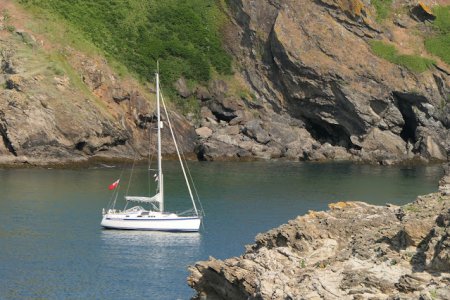
Halberg Rassey 31

Babylon

Well-Known Member
Joined
7 Jan 2008
Messages
4,385
Location
Solent
Visit site
I've recently taken a fancy to the idea of selling my very solid but rather bijou Vancouver 27 (which I've had for almost two decades, know inside out, sail largely single-handed, and would keep me safe and sane as I progress through looming pensioner-hood) and buying a much more 'racier' HR 31.

Differences would be:
  • younger boat conceived to a more modern design philosophy
  • loads more beam as well as more length, so a radical increase in room below (this is good)
  • longer legs and higher pointing ability (this is good)
  • able to better ride through a Channel chop (also good)
  • fractional sloop rig compared to masthead cutter (a big reduction in the amount of standing rigging, and one less sail to fiddle with)
I'd have to get used to sailing with a deeper fin keel and sail-drive compared to a shallower long one with protected shaft that can sit down almost anywhere, a rig that is tweakable but less bullet-proof, and a vessel that would broach if over-pressed whereas the Vanc would just dig her shoulder in and wash down the side-decks, etc.

I'd always wished to cruise further afield than just the Channel etc but a lot of life and work got in the way over the last decade or so, and I'd always assumed that if I upsized I'd stay within brand and go for a Vancouver 32 (would fit my existing pontoon mooring) or V34 (would need a bigger one) but these are big heavy boats which seem less aligned with my needs now, while older examples would need extensive upgrade work which I can't be doing with.

I could just continue to just keep my current (and only boat) which I know so very well, rather than take on a whole new set of unknowns and risk regretting the decision.

So... sell me a HR31 or talk me down from my fancy! What are the arguments either way? What else might I look at?
 
Last edited:
I have a 34, but the 31 is a nice boat that appears to sail well. If it’s anything like mine I don’t think you should be concerned about the likelihood of broaching. It is well ballasted and should be capable of handling any half-decent weather with a much better performance than you are getting now. HR has a very active association with many events in your area.
 
have to say that the two boats are different ! But 'racier' ?? HR's are good quick passage makers ...

I looked at a number of HR Monsuns - which are of the 31 / 32ft range ... nice boats ... I was literally close to signing the bank transfer on one and then the Conqubin 38 came "in view" !!

I would have been happy enough with the HR Monsun ...

I always say that boats are like houses .... you instinctively know when the boat is a YES ... if its not a full-on YES .. then I suggest don't buy as you always then question whether it was a good decision.
 
I've recently taken a fancy to the idea of selling my very solid but rather bijou Vancouver 27 (which I've had for almost two decades, know inside out, sail largely single-handed, and would keep me safe and sane as I progress through looming pensioner-hood) and buying a much more 'racier' HR 31.

Differences would be:
  • younger boat conceived to a more modern design philosophy
  • loads more beam as well as more length, so a radical increase in room below (this is good)
  • longer legs and higher pointing ability (this is good)
  • able to better ride through a Channel chop (also good)
  • fractional sloop rig compared to masthead cutter (a big reduction in the amount of standing rigging, and one less sail to fiddle with)
I'd have to get used to sailing with a deeper fin keel and sail-drive compared to a shallower long one with protected shaft that can sit down almost anywhere, a rig that is tweakable but less bullet-proof, and a vessel that would broach if over-pressed whereas the Vanc would just dig her shoulder in and wash down the side-decks, etc.

I'd always wished to cruise further afield than just the Channel etc but a lot of life and work got in the way over the last decade or so, and I'd always assumed that if I upsized I'd stay within brand and go for a Vancouver 32 (would fit my existing pontoon mooring) or V34 (would need a bigger one) but these are big heavy boats which seem less aligned with my needs now, while older examples would need extensive upgrade work which I can't be doing with.

I could just continue to just keep my current (and only boat) which I know so very well, rather than take on a whole new set of unknowns and risk regretting the decision.

So... sell me a HR31 or talk me down from my fancy! What are the arguments either way? What else might I look at?
Your post seems to be a pretty good summary of your reasons for sticking with what you've got.
 
Your post seems to be a pretty good summary of your reasons for sticking with what you've got.
Except that all the pros for upgrading to the HR 31 look very valid and worthwhile - including much more space and more waterline length to improve both passage times and a bit of comfort.
And the counter arguments, other than a saildrive seal to replace every 7-10 years, are probably imaginary - as the HR 31 is hardly a racy boat that is likely to be tricky to handle, quite the opposite.
 
Are you looking at one of these red-ensign.com/boats/hallberg-rassy-31/ or these hardy.apolloduck.co.uk/boat/hallberg-rassy-310-for-sale/808727 ? If the first then it is very similar to the Vancouver - but better and more capable. However it would not be described as "racy" - but not staid. Much better bet than a Vancouver 32, but at a price premium. £85k is a lot for a 25 year old boat, but that one seems right up there in terms of up to date gear and general condition and will hold its value - because they don't make them like that anymore.

If the latter much the same would apply, but it is more modern in the sense that it has a hull design - keel, rudder etc more like an AWB, but deeper bodied and higher ballast ratio. It was top of my list when I was buying in 2015 but I could not bring myself to pay the HR premium which meant it was nearly double the price for similar spec to the Bavaria 33 I bought (combination of extortionate price for extras on the HR and high delivery/commissioning costs, and the good deal I got on the Bavaria). Not for one minute suggesting the HR is not e better boat, but not enough to justify the premium. What is better is finish, upgraded spec on gear (although mostly the same makers) and better all round performance. Not many around largely because the original price was so high so difficult to find one in the UK and if you do expect £120k+.

If I were in your position and could afford to pay the premium price the 31 would be top. You won't regret it. It is in every way superior to your Vancouver
 
You say you may cruise further afield from your base. In that case a boat built for longer passages makes sense - an HR31 certainly suits. I wouldn't ditch the idea of a cutter or two foresail rig - it is very convenient to be able to switch to a smaller jib and not worry about carrying a part furled genoa in 25-30 knts. I also wouldn't ditch the ability to dig in and keep going without stress and discomfort that comes with a conservative rig and displacement. And an autopilot that will run for hours on end is important plus electric supply to support it and other demands on a 12 hour+ passage. Obviously all these can retrofit to almost any boat. To me the engine size and fuel tank look small on the HR31. Depends if you mainly stay in marinas in which case its no issue.

You sound as if you appreciate quality in design, build and materials. Endless discussion about what that means and the improvements evident in modern production models. But there is to me a quality in HR (and Vancouver) models that is evident in the details and durability of finish. HR teak decks are pretty good but is a replacement built to the same standards?

Space matters - I am past enjoying a lack of standing headroom and toilet contortions.

Its probably down to cost limitations but a Victoria 34 is another solid boat. Or the real alternative is a more modern Hanse/Bavaria etc. which appear to last at least as well as the previous generation of cruisers.

For me there is a lot of benefit in a boat you have fully sorted and adapted to your needs. I think your choice is down to interior space.
 
Helpful replies so far, thanks... you can see why I'm in a bit of a quandary!

The thing that has been getting to me for a long while is the lack of interior space in my current boat. I can live if I need to without sparkling passage speeds and superior pointing ability, and there's huge merit in keeping a tough little boat I know so well that can go almost anywhere, but the lack of space when cruising has become a real factor as I've gotten older - and a Channel crossing at 10hrs is less tiring and safer than one at 12.

So my thinking is that more room down below combined with faster passage times should make single/short-handed coastal and Channel cruising more comfortable and efficient, and so more enjoyable. A 45 gallon tank is plenty (that's easily 24hrs at say 2l/hr) for these waters, including up the Irish Sea etc if I wish to.

@Tranona - I'm thinking of a HR31, probably a MkI rather than MkII or the 310. That 31 in Plymouth looks the business with lots of recent renewals, but why on earth does it need a bow-thruster!?

@John 32i - that looks like an ideal example, with non-teak decks and a relatively young and more powerful engine. Not sure about in-mast furling, would be happy with the usual stack-pack, but not averse to anything that makes life easier as I age!

It'd probably be helpful to get in touch with some 31 owners through the HR association, to find out more at this stage.
 
One word of caution .... Teak Decks .... they must be sound on a boat of that age or you'll spend upwards of 25-30% of the boats value fixing them. Avoid completely if possible.

GET IN-MAST FURLING!!!! .... it's the best piece of equipment an aging sailor can have. Beyond 30ft sails start getting heavier, and hauling them up and down, not to mention securing them, doesn't get any easier with age. The selden system is excellent, had it on both my boats. Can be reefed on practically any point of sail from the cockpit, and once wound in and the ratchet switched on it will never self-deploy.

The boat from @John 32i looks like a no brainer IMO.
 
I think you might find it skittish compared to the Vancouver. "Agile and fun to sail" can become tiring when singlehanding these skegless, short keel designs. Plus you will no doubt be used to leaving the helm to look after itself for pretty long periods, nipping forward to hoist sail between tacks would quicky have you pointing downwind on the gybe.
On longer trips you would rely heavily on the autohelm, I would prefer to carry two and make sure the battery system is in good order.
Few people rejoice over buying into Volvo engines or older sail drives for that matter, teak decks have already been mentioned.

On the upside they are grand below decks and all the systems seem generally well above average.

In your position I would either stick, look for a good Vancouver 32 .........or, a better idea in my view, upgrade the mooring and opt for a Victoria 34 which will sail much more in the manner you are used to.

.
 
I've recently taken a fancy to the idea of selling my very solid but rather bijou Vancouver 27 (which I've had for almost two decades, know inside out, sail largely single-handed, and would keep me safe and sane as I progress through looming pensioner-hood) and buying a much more 'racier' HR 31.

Differences would be:
  • younger boat conceived to a more modern design philosophy
  • loads more beam as well as more length, so a radical increase in room below (this is good)
  • longer legs and higher pointing ability (this is good)
  • able to better ride through a Channel chop (also good)
  • fractional sloop rig compared to masthead cutter (a big reduction in the amount of standing rigging, and one less sail to fiddle with)
I'd have to get used to sailing with a deeper fin keel and sail-drive compared to a shallower long one with protected shaft that can sit down almost anywhere, a rig that is tweakable but less bullet-proof, and a vessel that would broach if over-pressed whereas the Vanc would just dig her shoulder in and wash down the side-decks, etc.

I'd always wished to cruise further afield than just the Channel etc but a lot of life and work got in the way over the last decade or so, and I'd always assumed that if I upsized I'd stay within brand and go for a Vancouver 32 (would fit my existing pontoon mooring) or V34 (would need a bigger one) but these are big heavy boats which seem less aligned with my needs now, while older examples would need extensive upgrade work which I can't be doing with.

I could just continue to just keep my current (and only boat) which I know so very well, rather than take on a whole new set of unknowns and risk regretting the decision.

So... sell me a HR31 or talk me down from my fancy! What are the arguments either way? What else might I look at?
We did something similar seven years ago, and replaced our lovely Vancouver 27 with a Najad 36. Best decision we made!
 
I think you might find it skittish compared to the Vancouver. "Agile and fun to sail" can become tiring when singlehanding these skegless, short keel designs. Plus you will no doubt be used to leaving the helm to look after itself for pretty long periods, nipping forward to hoist sail between tacks would quicky have you pointing downwind on the gybe.
On longer trips you would rely heavily on the autohelm, I would prefer to carry two and make sure the battery system is in good order.
Few people rejoice over buying into Volvo engines or older sail drives for that matter, teak decks have already been mentioned.

On the upside they are grand below decks and all the systems seem generally well above average.

In your position I would either stick, look for a good Vancouver 32 .........or, a better idea in my view, upgrade the mooring and opt for a Victoria 34 which will sail much more in the manner you are used to.

.
Or if OP likes the Hallberg Rassy style and interiors, but wants a "steadier motion" more akin to Vancouver, Victoria etc... there is the earlier Hallberg Rassy 312, which was built until 1993. These have a much longer fin keel than the 31 which followed, a partial skeg for the rudder, and about 10% more displacement (312 = 4.9 tonnes, 31 = 4.5 tonnes). They built/sold nearly 700 of them which would suggest they weren't terrible. Fairly sure they'd make faster passages than a Vancouver 27, in almost any conditions.

You're still up against ~35 year old saildrives and teak decks though.

Hallberg Rassy 312 1990
 
Clearly any description of racyetc depends on what you have - my impression from sailing with one in company a few times is it needs a 3-4 to perform. I guess you are used to vessels which are slow and steady . My suggestion would be careful consider accommodation space as they always seemed cropped but if you like solid wood etc can see appeal - those seats backs weigh a lot for example
 
Belle Ile loRes.JPG

Can only speak for the HR310 (as per avatar and above) I sail her solo, on a "summer swallow" basis - ie full time cruising April-October. Usually migrating from our East Coast berth down to Biscay France/Spain. Sometimes via Scilly or Ireland. She points well. Get's going in 8-10kts of breeze (minimising the need to motor). 'Behaves' in a blow / seaway. It is easy to maintain decent passage making speeds, whilst remaining well fed and comfortable. (Bored during lockdown, I calculated our long term average speed at 5.7kts). In port, or at anchor, I find her an agreeable home from home. Enough room for kit, stores, spares (aft cabin organised as 'garage'). In 'hairy' conditions (we rode out storm Evert anchored off Bryher in 2021) she has a reassuringly solid ambience, as well as a practical layout.

She is small enough that finding a marina berth, after a passage, is not a worry. Plus, in tight marina situations, manoeuvres well under engine. Turning in her own length and reversing as predictably as she goes forward. I have owned her for 15 years. Now that components (pumps, plumbing, tanks, windlass, engine etc) have started to wear, I appreciate Rassy's "everything inside the boat came in through the companionway" ethos. Makes replacements drama free. The support available from the UK agent, Transworld, and the yard in Orust, is also a great benefit. They have an exact record of what was fitted to each hull number and are able to supply/source components. Even advising on how to remove / install - 15 years after I bought the boat......

Versus the HR31? The HR310 has more waterline length than both the HR31 and the HR34, also higher freeboard and beam carried further aft. Which generates a surprising amount of living/stowage space. And a turn of speed which can startle HR34 owners. The HR31 will be more snug than the HR310. Worth bearing in mind, if more space is your main motivation. But, if important to you, the HR31 will have a trad chart table. Also a more 'handmade' style of joinery (louvred locker fronts v's routed vents etc) v’s the 310.

The combination of easy solo-handling and sailing performance which minimises motoring (get's going in the light, points, and is reassuring in a blow); plus her good reliability and ease of maintenance are the ownership highlights, for me.
 
Last edited:
Helpful replies so far, thanks... you can see why I'm in a bit of a quandary!

The thing that has been getting to me for a long while is the lack of interior space in my current boat. I can live if I need to without sparkling passage speeds and superior pointing ability, and there's huge merit in keeping a tough little boat I know so well that can go almost anywhere, but the lack of space when cruising has become a real factor as I've gotten older - and a Channel crossing at 10hrs is less tiring and safer than one at 12.

So my thinking is that more room down below combined with faster passage times should make single/short-handed coastal and Channel cruising more comfortable and efficient, and so more enjoyable. A 45 gallon tank is plenty (that's easily 24hrs at say 2l/hr) for these waters, including up the Irish Sea etc if I wish to.

@Tranona - I'm thinking of a HR31, probably a MkI rather than MkII or the 310. That 31 in Plymouth looks the business with lots of recent renewals, but why on earth does it need a bow-thruster!?

@John 32i - that looks like an ideal example, with non-teak decks and a relatively young and more powerful engine. Not sure about in-mast furling, would be happy with the usual stack-pack, but not averse to anything that makes life easier as I age!

It'd probably be helpful to get in touch with some 31 owners through the HR association, to find out more at this stage.
The one on the East Coast looks the better bet with the larger, better engine and no teak decks plus £35k cheaper! The 20hp engine was standard and is OK for the 4.6 tonnes displacement particularly if it has one of the better folding props. On the subject of displacement the 31 is only a bit lighter than the previous 312 which was 4.9 tonnes - both on the heavy end for their size. As for in mast and bow thrusters - you tend not to appreciate their value until you own a boat with them, and then you would never go back through choice. The Easyreef is an "add-on" system which is not ideal but has clearly been fitted for many years so expect it is sorted and working well. Detractors of both tend never to have owned or even sailed boats fitted with them so are not qualified to judge and best ignored. There are sound reasons why they are popular, particularly for people getting on in years and who sail short or singlehanded.

You may find this useful boats.com/reviews/feisty-passage-maker/
 
Last edited:
I would certainly change from the Vancouver 27. What ever you finally choose would change your attitude to sailing. It will sail faster by about a knot, but if you add a folding propeller by a knot and half. So in a 10 hour day you will sail 10 or 15 miles further. This will certainly extend your cruising expectations.

A larger boat will give you much better living accommodation due to the longer length and wider beam. All compartments of the boat will be more generous, this makes living on the boat more comfortable. This will encourage you take extended sailing holidays, which will be possible in retirement.

I sail a 32ft Fulmar single handed and have extended my sailing range. Typically I do coastal hops of 60 to 90 miles, but my record is 170 miles. It always depends on wind and tide conditions but cruising should be about using them to your benefit rather than having a schedule. When I went round Britain via the top of Shetland, I never chose the next port until I knew the forecast. (Full details are in the link in my signature.) Next year I will sail going round Ireland and in another year heading back to the Western Isles, Orkney, Fair Isle, Shetland before heading for the Caledonian Canal and returning to Pwllheli.

Part of the reason to buy a HR is the build quality and the design requirement of short handed sailing, rather than craming in as many berths as possible. You will get a lot more storage, which means you can carry more stores. I know several HR owners (including John Silver) and they all love their boats. The HR Owners Association is very active.

So,, why are you questioning changing boats? If you can afford to change and already have a berth, it is a no brainer of a decision.
 
One good piece of advice I was given years ago was to choose the designer rather than the boat. The Frers-designed HRs are very different to earlier ones, and, if not racers, have good performance in all weathers. A friend bought a Bav 34 around the time I got my HR and found it troublesome and unrewarding to sail, which is not something you will hear from HR owners.

I don’t believe that a furling main is necessary on a boat of this size unless that owner is physically less able, and the weight aloft will be a liability, especially if there is also a radar on the mast. The 310 is from a later design series with a longer waterline, a little more sail area and a livelier handling which may or may not be desired, but they are likely to be significantly more expensive.
 
Top