Anyone want to design a folding sailing dinghy with me?

For a genuine folding dinghy how about this:-

Small Sailboat by Reverso - Foldable Small Sailboats
Doesnt look like it folds, looks like it bolts together in (5?) sections, so in what sense is it "a genuine folding dinghy"?

OTOH it does look like the sections could be carried for a mile across a rough field, so maybe 5 trips for the hull and another for the rig?

Maybe the OP's dog could be trained to guard the beachside cache. "Stay boy, and KILL. This is worth Mucho Bonio"
 
Yep had a few of those over the years! You are right, but now time to dream I guess :) plus needs to fit through a standard single gate, thanks for your input (y)
A mirror will fit through a standard gate when on its side. Only a crazy person would try to handball one a mile, even on a trolley.

If you’ve sailed dinghies before you will recall the weight and volume of the sails never mind the rest of the stuff.

I wouldn’t dismiss inflatable - plenty of people take dogs on high pressure inflatables without issue. Perhaps something like a drop stitch canoe, with a small sail might work? Maybe you could even rig it like a Hobie mirage.

Decathlon sell something that looks like AI was asked to cross a topper dinghy and a SUP. Too small for a dog + adult I suspect.

A former colleague of mine has what I think was a minicat - it has a mesh trampoline which may or may not be more dog friendly. It claimed 30 minutes assembly. The first time it took 2.5hrs but I think he managed to reduce that but nowhere close to 30 minutes and the pack away time was the same!
 
To save weight, which seems a priority, take the plans of a suitable kit dinghy and replace all the ply with glass covered foam. So building, instead of ply, buy 8' x 4' glass covered foam panels. If you demand a traditional look - wood veneered panels. I assume available in the UK - common place in Oz.

Jonathan
 
Maybe a drone to lift and carry it there and back? Or a motorised all terrain barrow?

Quad bike? Scrambler, with a trailer?
 
What makes the Fliptail special?

"Modern" perhaps lighter DIY take on the Prout Coracle, I suppose. though if you can get a Prout for 100 quid you'd save time, money, and own a classic, all good things to do.

Other similar designs available on't site.

Prouts did an actual 10 foot pointy-bowed gunter rigged daggerboard folding sailing dinghy, (50 quid new to you squire,) called the Seabird which would sail a lot better than a Coracle, but I dunno if there's a modern take on that available.

For a long time I had plans for a Percy W Blandford folding kayak which had a sailing rig drawn, but I never did anything with them and eventually lost them. That would probably have been fairly fast in flat water but maybe a bit crowded and tippy with a dog on board. I thought of maybe adding outriggers to make a trimaran.

Edit: PWB plabs still available apparently from www.clarkcraft.com, including a double folding kayak and a pram dinghy, though yje latter is pretty heavy at 60 pounds, though I suppose you could maybe get that down a bit with differen materials.
this is great thankyou for your time, i'll have a look at clark craft, like the outrigger idea, food for thought
 
To save weight, which seems a priority, take the plans of a suitable kit dinghy and replace all the ply with glass covered foam. So building, instead of ply, buy 8' x 4' glass covered foam panels. If you demand a traditional look - wood veneered panels. I assume available in the UK - common place in Oz.

Jonathan
thats interesting, would save alot of R&D time I guess?
 
Here home built or one of, blue water, multihulls is an industry and DuFLEX/Foam Composite Strips, which are supplied by ATL Composites in Australia are the common building material. The naval architects supply the drawings, Grainger or Schionning. The composite suppliers cut the boards and you glue and tape the vessel. .For builders in Europe, VDL Composites in Germany is a supplier but there must be local suppliers in the UK, as architects like Corby will build yachts using similar techniques, Building a dinghy is a different scale to building a 50' blue water cat - but its difficult to believe that panels smaller than 8' x 4' are not available.

Jonathan
 
.....this sketch shows the kind of thing, maybe? maybe not? lightweight composite floor folds in half, inflatable sides holds beam for central support for windsurfer style main? Fabric transom or slotted in for rudder? left hand of sketch shows how offset dagger board slot could take large wheel (BMX mag wheel?) to counterbalance weight issues? just thoughts obvs......

View attachment 202686
That looks like my Tinker foldaway. Grp hull that folds and hypalon tubes.

Whilst it is light compared with some dinghies and easy for 2 people to carry up a beach, if the sailing rig is added it nearly doubles the weight.
 
All up weight of a RS Aero is under 50kg so getting down to 25 to 30 kg should be possible. International Moths are even lighter and 11' but possibly not quite what you are envisioning
 
Maybe a drone to lift and carry it there and back? Or a motorised all terrain barrow?

Quad bike? Scrambler, with a trailer?
Helium filled fenders?

It is very difficult to get length and full utility without remorselessly adding mass !
But I wish the OP encouragement . Fun winter project

I have an aluminium two part nesting sailing dinghy . And the trick is to build a couple of wheelchair or posh pushchair/chariot wheels into de/attachable units that support the boat then the dinghy weight is relatively irrelevant, it just pulls, pushes or tows along with enough tyre inflation to cushion it.

Go for it
 
The DinghyGo range kind of carries on where the Tinker Tramp/Traveller left off. Their "modern" version of a folding solid floor is high-pressure dropstitch inflatable (same tech as inflatable SUPs), with something of a V forced into it at the bow.

They actually sail pretty well, and are available off the shelf (my shelf in fact, I am not unbiased!) here: DinghyGo

The smallest size (DinghyGo 280) weighs about 40kg total, of which about 1/3 is the rig bits (hull 27kg). Put one in front of you as I'm looking right now, it's difficult to see where you could shave much weight, all the bits add up. Mast, boom, rudder, daggerboard, solid insert for keel, mast support, thwart etc. The hull could only be lighter if you used thinner less durable material.

But it definitely wouldn't be impossible to put the two bags (and an electric pump with a rechargeable battery) in some kind of offroad cart/bike trailer - especially if the wheel position allowed made the weight balanced - and wheel it a mile or so, although it might still be quite knackering...

We also used to make nesting dinghies of course, although that project is currently parked due to me getting too involved with electric outboards!

Ian, Nestaway Boats
 
What makes the Fliptail special?

"Modern" perhaps lighter DIY take on the Prout Coracle, I suppose. though if you can get a Prout for 100 quid you'd save time, money, and own a classic, all good things to do.

Other similar designs available on't site.

Prouts did an actual 10 foot pointy-bowed gunter rigged daggerboard folding sailing dinghy, (50 quid new to you squire,) called the Seabird which would sail a lot better than a Coracle, but I dunno if there's a modern take on that available.

For a long time I had plans for a Percy W Blandford folding kayak which had a sailing rig drawn, but I never did anything with them and eventually lost them. That would probably have been fairly fast in flat water but maybe a bit crowded and tippy with a dog on board. I thought of maybe adding outriggers to make a trimaran.
That looks like an excellent starting point for the OP.


Question for him: does the whole thing have to be able to sail away without leaving e.g. a trolley behind? Because that will create a bit of a compromise. If you want to use a big bike sized wheel you'll have much better off-road ability, but you'll struggle to fit the wheel aboard when sailing. Whereas tiny trolley wheels could be built in to the boat, but are only going to work on smooth surfaces.
 
The DinghyGo range kind of carries on where the Tinker Tramp/Traveller left off. Their "modern" version of a folding solid floor is high-pressure dropstitch inflatable (same tech as inflatable SUPs), with something of a V forced into it at the bow.

They actually sail pretty well, and are available off the shelf (my shelf in fact, I am not unbiased!) here: DinghyGo

The smallest size (DinghyGo 280) weighs about 40kg total, of which about 1/3 is the rig bits (hull 27kg). Put one in front of you as I'm looking right now, it's difficult to see where you could shave much weight, all the bits add up. Mast, boom, rudder, daggerboard, solid insert for keel, mast support, thwart etc. The hull could only be lighter if you used thinner less durable material.

But it definitely wouldn't be impossible to put the two bags (and an electric pump with a rechargeable battery) in some kind of offroad cart/bike trailer - especially if the wheel position allowed made the weight balanced - and wheel it a mile or so, although it might still be quite knackering...

We also used to make nesting dinghies of course, although that project is currently parked due to me getting too involved with electric outboards!

Ian, Nestaway Boats
I've sailed a DinghyGo, they're quite good fun. Impossible to capsize, and very comfortable. However it may hold the record for the lowest performance vessel I have ever sailed 😂.
Friends (family of 4) have one and used it, with an 8hp, as their tender on a 2yr Atlantic circuit. It was pretty decent for that. They didn't sail it as much as they expected because of the faff of removing the engine each time.
 
I've sailed a DinghyGo, they're quite good fun. Impossible to capsize, and very comfortable. However it may hold the record for the lowest performance vessel I have ever sailed 😂.
Friends (family of 4) have one and used it, with an 8hp, as their tender on a 2yr Atlantic circuit. It was pretty decent for that. They didn't sail it as much as they expected because of the faff of removing the engine each time.
Depends on the version to some extent, none of them are going to challenge a Laser :)
Early versions had an unstayed rig and a "multi chamber" mostly flat-bottomed floor at about 3psi... they were OK (see note below).
Current ones have stays and a high pressure dropstitch floor (11psi) forced into a V... they are better.

NOTE The key to sailing a DinghyGo in light airs appears to be heeling it sufficiently to get one tube out of the water. It's still then very stable by 9ft sailing dinghy standards, but with significantly less drag. Back in the days of Beale Park boat show a dinghy sailing instructor managed to embarrass a lot of other small boats by demonstrating this.
 
……

The smallest size (DinghyGo 280) weighs about 40kg total, of which about 1/3 is the rig bits (hull 27kg). Put one in front of you as I'm looking right now, it's difficult to see where you could shave much weight, all the bits add up. Mast, boom, rudder, daggerboard, solid insert for keel, mast support, thwart etc. The hull could only be lighter if you used thinner less durable material.

…..
As was said earlier, that (in bold) is the key point. With carbon fibre and some skills + budget you can reduce the hull weight hugely. But then it is the rest that adds up
- daggerboard, rudder, pintles, tiller etc
- mast, boom, gooseneck, sails, rigging, sheets
- rowlocks and oars
- engine if needed - electric ?
And don’t forget
- trolley (wheel at stern is useless for balance)
- sailing gear
- safety gear - Lifejacket, perhaps VHF etc
- lunch etc
Light weight is generally custom design and/or expensive (carbon, titanium, dyneema etc) for all of the above.
A new carbon Moth is £20k upwards. A fully fitted custom lightweight carbon sailing dinghy certainly £10k plus.

How many places charge launching fees for a 10 foot dinghy? And how much would they cost over a season - or even a decade of use?

Why not put the money saved into a “launching fees” pot. Launching a Mirror or similar from beside the car would get you boating tomorrow :-)
 
That looks like an excellent starting point for the OP.


Question for him: does the whole thing have to be able to sail away without leaving e.g. a trolley behind? Because that will create a bit of a compromise. If you want to use a big bike sized wheel you'll have much better off-road ability, but you'll struggle to fit the wheel aboard when sailing. Whereas tiny trolley wheels could be built in to the boat, but are only going to work on smooth surfaces.
thanks for the input and question, maybe a folding kayak trolley could be left shore side? Ideally it would all go with me so I can land elsewhere? food for thought though, thanks
 
As was said earlier, that (in bold) is the key point. With carbon fibre and some skills + budget you can reduce the hull weight hugely. But then it is the rest that adds up
- daggerboard, rudder, pintles, tiller etc
- mast, boom, gooseneck, sails, rigging, sheets
- rowlocks and oars
- engine if needed - electric ?
And don’t forget
- trolley (wheel at stern is useless for balance)
- sailing gear
- safety gear - Lifejacket, perhaps VHF etc
- lunch etc
Light weight is generally custom design and/or expensive (carbon, titanium, dyneema etc) for all of the above.
A new carbon Moth is £20k upwards. A fully fitted custom lightweight carbon sailing dinghy certainly £10k plus.

How many places charge launching fees for a 10 foot dinghy? And how much would they cost over a season - or even a decade of use?

Why not put the money saved into a “launching fees” pot. Launching a Mirror or similar from beside the car would get you boating tomorrow :-)
thanks for this, great questions, to answer a few.
The Tiwal 3 has a very lightweight boom with the windsurf style rig, maybe an option? No rigging required
Rowlocks etc plastic affairs
No engine required
Lunch will be heavy, no radio as I just want to potter in the shallows poking about slowly
i'm hoping the weight issue can be addressed with a more central wheel for transport, maybe the wheel is large but solid so becomes a dagger board?? Like a flat version of Dysons Ballbarrow? I realise this maybe not aesthetically beautiful but form follows function I guess? like the idea of multi use elements though, maybe two piece mast becomes transport handle etc.
Its not just the launching cost, just don't want to be queueing and parking with all the others, good luck to them, I just want my space away from the crowds, i'm getting old ; )
 
thanks for this, great questions, to answer a few.
The Tiwal 3 has a very lightweight boom with the windsurf style rig, maybe an option? No rigging required
Rowlocks etc plastic affairs
No engine required
Lunch will be heavy, no radio as I just want to potter in the shallows poking about slowly
i'm hoping the weight issue can be addressed with a more central wheel for transport, maybe the wheel is large but solid so becomes a dagger board?? Like a flat version of Dysons Ballbarrow? I realise this maybe not aesthetically beautiful but form follows function I guess? like the idea of multi use elements though, maybe two piece mast becomes transport handle etc.
Its not just the launching cost, just don't want to be queueing and parking with all the others, good luck to them, I just want my space away from the crowds, i'm getting old ; )
Inflatables are much heavier than carbon fibre - the Tiwal 3 is 50kg before add a trolley, sailing gear, lunch etc. Tiwal 3 Small Sailboat - A sailboat that fits in your car's trunk
So probably 70kg or so all in to take on your mile trip.
Even in their marketing photos they have only lugged a few feet from the back of the (large) car.
 
Inflatables are much heavier than carbon fibre - the Tiwal 3 is 50kg before add a trolley, sailing gear, lunch etc. Tiwal 3 Small Sailboat - A sailboat that fits in your car's trunk
So probably 70kg or so all in to take on your mile trip.
Even in their marketing photos they have only lugged a few feet from the back of the (large) car.
....totally agree, it was just the boom they use I was liking, the Tiwal a great boat, but a wet fast craft, opposite end of the spectrum from what I need. Also, they haven't the central counterbalanced wheel which hopefully will help with the weight issue, i'm not going to carrying this, i'm strong but not that strong : )
 
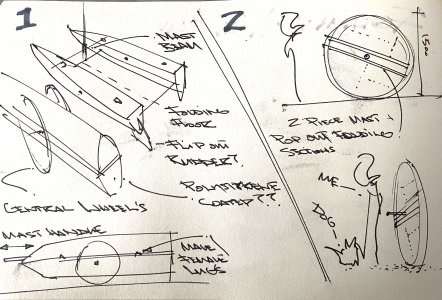
Hey all, wow, thankyou so much for your responses, any feedback is good feedback! So seems weight is the main point raised along with my 1 mile hike! This is probably far too long in reality but still a benchmark i'd like to work towards. Without space tech materials which I doubt will fall into my lap (still here for you Elon, DM me : ) ....so i'm thinking the transport wheel location and size is key, with this in mind i've scribbled some ideas based on feedback so far.
idea 1, using expanded foam of some sort, with a sheath / sock / coating?? two hulls, male & female lugs that stack for transport, folding floor, strengthening beam for mast support, sections of mast slide out of hull for pulling along with the central wheels.
idea 2, No i've not been drinking! So this is very conceptual but maybe the boat is the wheel?? the outer rubber becomes a rubbing strake maybe? the two sections of mast and hulls sections pop up, fold or slide together, flip out to get to 10' LOA? Would need to go on car roof or bike rack I guess, very early stages!!! ...could call it the DiscGo (sorry from a marketing background so have to sit on my hands to not think of such sillyness)
Please give me your thoughts, good and bad......
boat 2.jpg
 
Top