Electric ternatives to gas?

It's definitely possible to replace a gas cooker with an induction hob and electric oven, and it sounds like you have a good plan in mind for creating a custom SS frame to integrate these appliances into a gimbaled frame.
One lesson that some people have learned when making this switch is that it's important to carefully consider the power requirements of the induction hob and electric oven, and ensure that your generator and/or battery bank and inverter can handle the load. Induction hobs can draw a lot of power, and electric ovens can also be power-hungry, so it's important to make sure that your system is sized appropriately.
Another consideration is that induction hobs require a flat surface, and may not be as forgiving as gas when it comes to leveling the boat. You may need to make adjustments to ensure that the induction hob sits level and can function properly.
In terms of choosing the right induction hob and electric oven, it's important to look for models that are specifically designed for marine use, as these will be more durable and able to withstand the challenges of a marine environment. It's also important to choose appliances that fit well into your available space and can be easily installed.
Overall, with careful planning and consideration, it's definitely possible to switch from a gas cooker to an induction hob and electric oven on a boat. Good luck with your project!
Our induction hob is a single ring portable type. Bought about 15 years ago from Aldi. Cost £26. Still going strong.
I have metering installed. The induction hob pulls a maximum of 2kw when set to 2 kW. It doesn't stay at 2kw but pulses up and down so the average load is less. Since they use about 30 less power than a conventional electric cooker I would guess that they average about 30% less than the cooking Watts you select on the hob.
 
Our £80 Vango hob draws exactly the power that the box said it would- 800w per ring, according to my BMS.
It doesn't sound like a lot but we've been using it full time for 18 months with no problems. We cook aboard every night btw, on average eat out maybe once or twice a month for lunch, so it gets a lot of use.
 
Last edited:
We have friends who are Captain and Hostess on a 72ft motorboat. It has 3000w of solar on the top deck. They have all electric cooking and a large American refrigerator and freezer. They still run the generator for several hours per day.
 
Our 8kg composite bottle is off for refill today. A small amount of gas left in it. 7 weeks since we filled it. Full-time liveaboards. Friends are going to the gas refill depot today as they have hired a car to do multiple errands. Cost of refill is less then £10. We use a lot of gas as my wife likes to cook. We use the oven a lot. We are British. We drink lots of tea. It's so cheap using gas in the Caribbean. We have no interest in swapping to electric cooking. It is the norm here to have your bottle refilled rather than exchanged so investing in a good composite refillable bottle is money well spent. We have a Safefill bottle that we refill in the UK, when we are there. We also have an American composite bottle.both can be filled. In the Caribbean French Island they have camping gas on an exchange basis. No refills. Far better to get gas refills in Antigua, Sint Marteen, Grenada, etc where it is cheap as the locals use it as cooking gas.
 
We are almost never alongside, and couldn't possibly have enough PV panels to squander our electricity for cooking. There is no way that I would run a generator to boil a kettle. The gas locker is designed to take two 7kg Calor Butane cylinders, so we always have a full spare. We sail on the West Coast of Scotland, and find getting gas no problem. Indeed, our last two bottles came from Strontian and Doire-Aonar, in Loch Torridon, neither of which have much population. (Deliberate understatement).
 
and don’t need to carry enough gas for an entire season (though can last 3 months with extra spare in bow locker if going to places like Norway where no Camping Gas)
Interesting that you mention Norway, that is exactly why I started carrying sensible sized gas cylinders. In the 80's I was running skippered charters/RYA sailing courses based in Shetland, but mainly spending the summers on the west coast of Norway, changing crews in Bergen. With six people and all meals on board I would set out with two +/-15kg cylinders on the counter.
I only came across CampingGaz with my current boat as it came with a collection in an aft locker that was an explosive risk: the only vent was around the bulkhead joints into the hull. I was also shocked to discover what a rip off CampingGaz was, surely the most expensive way per kg. to buy bottled gas. It took a bit of creative thought but we now carry a sensible sized and priced cylinder on deck and have not found it interfering with sailing or working the boat over a few thousand miles of coastal and ocean sailing.
 
Last edited:
For the mostly Solent pottering we do, going all electric isn't an option, so I'm mulling over what to do. My gas locker's too small for bigger bottles and my wallet (Yorkshire sized) is too small for Camping Gaz. I could probably fit a bigger bottle in a stern locker which is vented overboard already, but it would mean running a pipe - or pipes three or four metres to get to the current connections (almost certainly imperial). A bonus would be that losing the existing locker would make access to the starboard engine a lot easier. Any thoughts on this?
 
For the mostly Solent pottering we do, going all electric isn't an option, so I'm mulling over what to do. My gas locker's too small for bigger bottles and my wallet (Yorkshire sized) is too small for Camping Gaz. I could probably fit a bigger bottle in a stern locker which is vented overboard already, but it would mean running a pipe - or pipes three or four metres to get to the current connections (almost certainly imperial). A bonus would be that losing the existing locker would make access to the starboard engine a lot easier. Any thoughts on this?
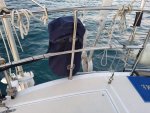
Here is our 8kg covered gas bottle. The bag looks a little deflated as it currently has our US composite bottle inside. This one is a little fatter and shorter. We had the stainless steel cradle made so it would take the US bottle and the taller UK Safefill bottle. We have had this set up for the last ten years. Very happy with itreceived_2364596697036886.jpeg
 
Here is our 8kg covered gas bottle. The bag looks a little deflated as it currently has our US composite bottle inside. This one is a little fatter and shorter. We had the stainless steel cradle made so it would take the US bottle and the taller UK Safefill bottle. We have had this set up for the last ten years. Very happy with itView attachment 151195

I like that arrangement. I was thinking of clamping on the inside though. I only have one rail on my pushpit but I notice that you use an upright, which very likely I can use as well on my own boat. Looks like the stern mount is back on for me. I assume you just fabricated a custom bracket in stainless, as opposed to bought one off the shelf?
 
For the mostly Solent pottering we do, going all electric isn't an option, so I'm mulling over what to do. My gas locker's too small for bigger bottles and my wallet (Yorkshire sized) is too small for Camping Gaz. I could probably fit a bigger bottle in a stern locker which is vented overboard already, but it would mean running a pipe - or pipes three or four metres to get to the current connections (almost certainly imperial). A bonus would be that losing the existing locker would make access to the starboard engine a lot easier. Any thoughts on this?
I suggest a continuous copper pipe run from locker to appliance connection valve. As you are in the UK it may be advisable to get a qualified gas fitter to do the work and certify it to keep insurers etc. happy. The fitter can then replace fittings as required. You could prepare the pipe run in advance for the fitter.
 
I like that arrangement. I was thinking of clamping on the inside though. I only have one rail on my pushpit but I notice that you use an upright, which very likely I can use as well on my own boat. Looks like the stern mount is back on for me. I assume you just fabricated a custom bracket in stainless, as opposed to bought one off the shelf?
Yes, we bought the Safefill bottle and had a mount fabricated to suit that bottle. It just so happened that the American composite bottle also fitted
 
Yes, we bought the Safefill bottle and had a mount fabricated to suit that bottle. It just so happened that the American composite bottle also fitted
Hi Geem, having just replaced a 907 at an eye watering €30, it's time to ditch them I think!
We're carrying Calor bottles too and I'm a bit loath to just get rid of them. Do you have to buy a specific refillable bottle like a Safefill, or can I just use my Calor ones?
 
Hi Geem, having just replaced a 907 at an eye watering €30, it's time to ditch them I think!
We're carrying Calor bottles too and I'm a bit loath to just get rid of them. Do you have to buy a specific refillable bottle like a Safefill, or can I just use my Calor ones?
Whereabouts are you getting 907s? That's less than half what we last paid.
 
Hi Geem, having just replaced a 907 at an eye watering €30, it's time to ditch them I think!
We're carrying Calor bottles too and I'm a bit loath to just get rid of them. Do you have to buy a specific refillable bottle like a Safefill, or can I just use my Calor ones?
You can use your calor bottles if they have the standard left hand thread.
 
Top