Electric ternatives to gas?

But, as per post #1, are you in the "For those who have generator, and/or a big battery bank and inverter, " camp ?

We have a 12kva generator and everywhere we go our engines are running, with alternators capable of running a 2.5kw inverter on their own. Gas would be a huge no-no for me.
Can't argue with any of that but, from OP's profile pic, theirs seems to be a saily boat.

I don't see why choosing electric is "obvious" at all - OP's choice of word. Fossil fuels have 100x - 400x the energy density of batteries - I have 2 camping gas cylinders and don't know how I'd find space for even 100 batteries the same size.

Obviously it's not a totally fair comparison because batteries can be recharged when they're underway (especially if your boat is a trawler) but on my saily boat I prefer not to run the engine more than necessary.

I just regard gas bottles as cheap and convenient - I don't find it a hardship to take the empty gas bottle to the supermarket or chandlery to exchange it, and the price of gas is negligible in terms of the other expenses of keeping a boat.
 
I don't see why choosing electric is "obvious" at all - OP's choice of word. Fossil fuels have 100x - 400x the energy density of batteries
I don't think anyone was suggesting pure electricity was an option. I saw diesel generators (fossil fuel) and batteries which will need topping up with either engine or mains (both mainly fossil fuel). Some additional capacity may be added with renewables, but in gas terms this would be the equivalent of a morning fart next to the stove while boiling the kettle.
 
We are a live-aboard family of 4. We're running an experiment at the moment to see if we can live with an induction hob full-time without shore power.

Our setup:
400Ah LFP batteries @12V
Victron 3kVA inverter
700W of PV
Rutland 1200 wind generator
2×800W Vango 'sizzle' induction plates.

We're in Wellington, NZ and so far (3 weeks) we've only had a couple of days when the batteries didn't get a full charge. However, we're not currently using the watermaker, which takes 100Wh to make 30L.

Underway, we have a Watt and Sea hydro-generator, so should have no problem making enough power.
 
We are a live-aboard family of 4. We're running an experiment at the moment to see if we can live with an induction hob full-time without shore power.

Our setup:
400Ah LFP batteries @12V
Victron 3kVA inverter
700W of PV
Rutland 1200 wind generator
2×800W Vango 'sizzle' induction plates.

We're in Wellington, NZ and so far (3 weeks) we've only had a couple of days when the batteries didn't get a full charge. However, we're not currently using the watermaker, which takes 100Wh to make 30L.

Underway, we have a Watt and Sea hydro-generator, so should have no problem making enough power.
How do you make bread or bake a cake? Are you keeping the gas oven?
 
I don't think anyone was suggesting pure electricity was an option.
Certainly all the major brands at Boot Dûsseldorf were. Most had zero gas options with large arrays of LiPo house batteries, renewables and electric cooking - no generators. Some didn't even have a gas option anymore. One had even replaced the diesel engine.
 
We kept our gas oven/hob. Added Remoska, induction hob, air fryer, toaster.
We don't have a generator. We have a 270Ah LFP battery which charges from 730w of solar (with an extra 200w available if required).

We spent last summer in the Balearics and did not visit a marina once. Lived entirely off sunshine. Our LFP is only big enough to last us about a day without charging but the Balearics are very, very sunny

We recently arrived in the Caribbean and clearly this arrangement isn't going to work quite so well- it's much cloudier here. So I'm adding a DC-DC charger to allow the LFP to be charged by the engine. I'd also like to double the size of the battery bank when I get a chance.

We love cooking with electricity. We can put the Remoska up on deck to avoid pumping heat in to the cabin. It's all just very civilised compared to burning dinosaur squeezings.
 
Certainly all the major brands at Boot Dûsseldorf were. Most had zero gas options with large arrays of LiPo house batteries, renewables and electric cooking - no generators. Some didn't even have a gas option anymore. One had even replaced the diesel engine.
The problem is that although that sounds good it's only sustainable for very short periods so fine for weekenders (who are the vast majority of the market) but not for longer term off grid cruising. OP has a genny though, so their electric cooking will be diesel powered and therefore not an issue.
 
Thanks for all the replies, may of which reflect continuing with the "status quo".
The boat has a 5kVA generator, 500 Ah at a nominal 12V of LiFePO4 batteries, 370 Watts of solar, and 120amp alternator.
A 5kVA inverter charger.
I already use a 2L vacuum kettle (1800W, 240V) most of the time, reverting to gas hob when it gets rough.
We have a microwave oven, and a portable 2 ring induction hob, which I use on top of the gas cooker, when gas is in short supply.
3.9kg propane cylinders have been hard to get for the last 2 years on the West Coast of Scotland.
It's a sailing boat! And we sail most of the time. I use much more diesel on heating and the generator, than I do motoring.
I also think that gas is an unnecessary hazard on a boat.
I've moved to an electric outboard, and got rid of all the petrol on board. Surprisingly, I have to charge the outboard less often than I had to fill the Suzuki 2.5 with fuel, it starts 1st time every time, and doesn't disturb a quiet anchorage on a still night.
From my point of view electric cooking is the way to go.
I don't think the market has caught up with the reality that hydrocarbons are on there way out. There seem to be 2 manufacturers making marine gimbaled cookers; GN Espace and Techimplex. They are both around £5k before the cost of fitting and extras.
Back to the original question.
I'm looking at combining a relatively inexpensive induction hob with an inexpensive electric oven, in a gimbaled package that is usable at sea, in a SS fabricated cage that is safe and practical.
Anyone else thinking along the same lines?
 
Anyone else thinking along the same lines?

Ian, we are keeping some gas just in case but predominately electric. However, you might have a look at this FB group for some ideas from folk who have converted from gas to electric hobs and ovens.

Marine Induction Cooking | Facebook

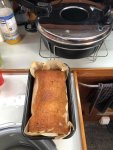
Meanwhile did someone mention baking cakes in a Remoska? Lemon Drizzle cake just cooling after being cooked with sunshine.

Pete
 

Attachments

  • Lemon Drizzle.JPG
    Lemon Drizzle.JPG
    207.5 KB · Views: 14
Last edited:
For those with existing gas and just loosing the small Calor cylinders why not move up to larger cylinders, either stowed on deck or in a bracket on the stern? On my previous boat I took the gas locker lid off to carry a +/- 15kg cylinder that lasts two of us living on board the best part of a season. On my current boat the cylinder is secured on deck.
 
For those with existing gas and just loosing the small Calor cylinders why not move up to larger cylinders, either stowed on deck or in a bracket on the stern? On my previous boat I took the gas locker lid off to carry a +/- 15kg cylinder that lasts two of us living on board the best part of a season. On my current boat the cylinder is secured on deck.
That's what the fishing boats do- strap a big bottle to the top of the wheelhouse.
 
  • Like
Reactions: srm
How do you bake Bread?
In the electric fan oven, 30mins at 180C
And
Thanks for the Facebook link, I'll take a look at it when I get back in Scotland on Wednesday.

The diesel oven will run out of fuel at roughly the same time as my diesel generator!
 
For those with existing gas and just loosing the small Calor cylinders why not move up to larger cylinders, either stowed on deck or in a bracket on the stern? On my previous boat I took the gas locker lid off to carry a +/- 15kg cylinder that lasts two of us living on board the best part of a season. On my current boat the cylinder is secured on deck.
Not exactly the aesthetic look most of us want - plus on deck will get in the way when sailing, and on the stern increases length in marinas, and get in way boarding dinghy.
Going smaller and keeping in the dedicated gas locker is perhaps better for many/most.
 
Not exactly the aesthetic look most of us want - plus on deck will get in the way when sailing, and on the stern increases length in marinas, and get in way boarding dinghy.
Going smaller and keeping in the dedicated gas locker is perhaps better for many/most.
We have an 8kg Safefill bottle in a s/s cradle mounted on the pushpit. It has a sunbrella cover. At first glance it looks like a fender. It doesn't stick out as far as the Windpilot steering or Duogen🙂
 
Not exactly the aesthetic look most of us want - plus on deck will get in the way when sailing, and on the stern increases length in marinas, and get in way boarding dinghy.
Going smaller and keeping in the dedicated gas locker is perhaps better for many/most.
Starting from a negative frame of mind gives negative results. Try thinking creatively, you may surprise yourself.
 
Not exactly the aesthetic look most of us want - plus on deck will get in the way when sailing, and on the stern increases length in marinas, and get in way boarding dinghy.
Going smaller and keeping in the dedicated gas locker is perhaps better for many/most.

I use blue canvas covers to match the other canvas. Mine sit on the aft lazaret lid. Why? The original gas locker was inside the lazaret which was not suitable for gas use, a legacy design. On most modern boats, a gas bottle mounted on the stern rail will not increase the OAL. I am not likely to mount the 6 kg propane on my pulpit, something I was considering for the smaller bottles. I guess I will be stuck with a single bottle sitting on the lazaret hatch. However, I will look at that, see if it is possible without looking stupid and still leaving room for the Monitor.

Sorry for the thread drift.

I certainly think electric power generation and storage is heading towards electric cooking in the future, even in areas that have fewer blue sky days than the Mediterranean.
 
The Calor Gas withdrawal is I suggest a red herring. Swapping to Camping Gaz is simple enough, and probably only add circa £100 per annum to typical running costs. So perhaps a 50 year payback to replacing the cooker etc. Even a cheaper built in option likely to be a 25 plus year payback.
More importantly:
- needing to run generators for cooking will spoil the anchorage - for you and everybody else
- gas cookers rarely fail - but what happens if your generator fails mid Atlantic or similar
Like one of the posters above, we have a portable induction hob (under £50);which we use when on shore power, and Camping Gas when off grid. Works well, and good resilience. https://www.amazon.co.uk/gp/product/B017WBRY7G/ref=ppx_yo_dt_b_search_asin_title?ie=UTF8&psc=1
Thats what we do, a cheaplidl induction in the marina and camping gaz at anchor, just bought two refills, €32 for the two!
 
Starting from a negative frame of mind gives negative results. Try thinking creatively, you may surprise yourself.
Quite the opposite. My positive mindset is that the Calor withdrawal is not the end of the world and if can’t easily fit a bigger alternative just use Camping Gas (plus a portable induction hob for on shore power). Simple and effective. And no huge cost of conversation to alternatives.
I don’t have enough diesel tankage to carry fuel for an entire season, and don’t need to carry enough gas for an entire season (though can last 3 months with extra spare in bow locker if going to places like Norway where no Camping Gas).
The Calor issue only really applies to boats sailing locally to the UK, as wasn’t available elsewhere. Those going internationally have had to plan ahead and carry facilities to connect a variety of cylinders to suit the location, long before the recent Calor announcement.
 
Top