
TiggerToo
Well-Known Member
How do they work?
I was wondering about that when I had to change one that failed...
I was wondering about that when I had to change one that failed...


Two dissimilar metals create a tiny electrical current when heated. This current is used by an electro magnet in the valve to stay open and let the gas flow. Flame goes out, the current stops and so the spring loaded valve shuts.
Are you sure about that? The current produced by a thermocouple is tiny and the hob has no power supply - I would be amazed if the thermocouple was able to generate enough power to operate an electro-mechanical valve. I had always assumed that it was a purely mechanical thing - the bulb of the sensor gets hot and a gas or liquid expands which, in turn, operates a valve.
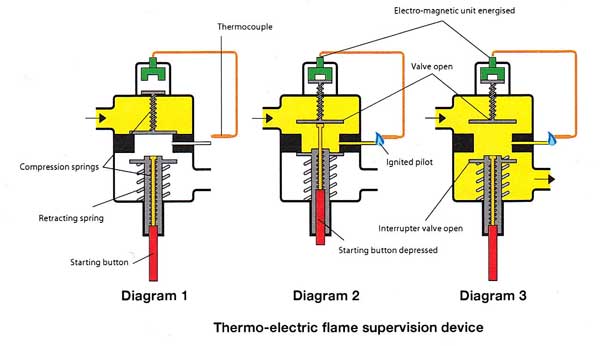

It is right. Doesn't need a power supply, any more than a fridge magnet.

Well, I stand corrected - and very surprised! I would not have believed that a small thermocouple like that could generate enough power to operate a solenoid. I'm not sure that the fridge magnet is relevant - that is a permanent magnet.
Fridge magnet is relevant I think, replace the electromagnetic part with a normal magnet then the valve will stay open, same as using a thermocouple to provide a voltage to the electromagnetic part. No power required, it creates a force to keep the valve open, not to operate a solenoid - the power required to do that is you when you push the knob in.
 But then there would be no flame failure detection. Why would you do that?
Well, I stand corrected - and very surprised! I would not have believed that a small thermocouple like that could generate enough power to operate a solenoid. I'm not sure that the fridge magnet is relevant - that is a permanent magnet.


You wouldn't , it's an example to show how no power is needed to keep the valve open.
There is Power or rather energy conversion. Energy from the heat of the flame creates an electrical current.
It's just a very small holding current, and a bit of googling suggest that it's only up to very small valves, like pilot lights. Full sized burned valves have to use thermopiles or different technology altogether.
I thought that we were talking about "full sized burned (sic) valves" - I'm referring to the flame failure device that keeps the burner on our gas hob working.
That's what we're talking about

So how does that square with JumbleDuck's suggestion that "Full sized burned valves have to use thermopiles or different technology altogether."

So how does that square with JumbleDuck's suggestion that "Full sized burned valves have to use thermopiles or different technology altogether."
