Can someone explain radar to me please...

On the Shell LNG ships running Brunei to Japan ... we had Magnavox Transit ..... originally the two big box units the size of filing cabinets but later changed to the single TV sized unit.
Because we were running the Palawan Passage - it was decided to fit Transit and to provide test data to Magnavox etc.

Its biggest problem was not the accuracy of position - but the timing of sat passes. Over a period of xx days - the sats would bunch up and you could have a series of positions quickly one after another ... then there would be nothing for hours ... over next xx days - the sats would spread out ... and then start bunching up again.
Yes, that was the issue with Transit - fixes were infrequent and came at irregular intervals. The ship I was on had an automated DR system, and e could see a continuous (pen on paper) display of our position; whenever a fix came in there would be a big kink in the line!

Transit was excellent for land survey; by averaging fixes you could get quite high accuracy, and 10m was attainable without too much trouble.
 
Yes, that was the issue with Transit - fixes were infrequent and came at irregular intervals. The ship I was on had an automated DR system, and e could see a continuous (pen on paper) display of our position; whenever a fix came in there would be a big kink in the line!

Transit was excellent for land survey; by averaging fixes you could get quite high accuracy, and 10m was attainable without too much trouble.

Apart from the position fixes - the best use of the unit was for Compass Error !! We soon learnt to input and get the error out in seconds ....
 
Yes, that was the issue with Transit - fixes were infrequent and came at irregular intervals. The ship I was on had an automated DR system, and e could see a continuous (pen on paper) display of our position; whenever a fix came in there would be a big kink in the line!

Transit was excellent for land survey; by averaging fixes you could get quite high accuracy, and 10m was attainable without too much trouble.
The Decca chart plotters, pen on paper, getting their position from the Navigator chain and plotting it out as they trawled along fishing, our chain was 6C in the north of Scotland, oh how the skippers of the fishing boats kept those charts close to their chest, Top Secret where they had found good fishing grounds. :)
On my 17th birthday I was invited on a turbo prop aircraft belonging to the CEO of Tenants Caledonian Breweries, they had an Aviation Decca chart plotter that they used
 
The Decca chart plotters, pen on paper, getting their position from the Navigator chain and plotting it out as they trawled along fishing, our chain was 6C in the north of Scotland, oh how the skippers of the fishing boats kept those charts close to their chest, Top Secret where they had found good fishing grounds. :)
On my 17th birthday I was invited on a turbo prop aircraft belonging to the CEO of Tenants Caledonian Breweries, they had an Aviation Decca chart plotter that they used
The pen on paper display I remember was probably Decca. Unfortunately, I was too busy being very seasick to take all the details in!

The trouble with Decca is that it is repeatable but with relatively low absolute accuracy. If you knew a location in Decca coordinates, you could return to it with good accuracy. But the geographic location of that Decca position was uncertain. Coastlines and other natural phenomena caused the radio waves to be refracted, so the geographic positions calculated from Decca coordinates could be some way from the actual position.

In later life I did a lot of work post-processing navigation data from aerial surveys during the 1980s, before GPS made life much easier. By the time I retired it was possible to get the position of an aircraft with centimetre accuracy by post-processing GPS data; we used it to reduce the need for ground control of photogrammetric surveys.

This thread (Thread 'Decca to Lat Long conversions?' Decca to Lat Long conversions?) is interesting.
 
Last edited:
On the Butt of Lewis there was a Loran receiver that plotted it's position daily, it was a fixed installation on land and it could drift up to 20 miles from it's actual location, was a long time ago that I remember seeing the plot.

Back in the 1970's and 80's The Decca Hi-Fix was used for precise location, but it used a pre surveyed locations for the master and slave transmitters, it was only used for short term work like positioning oil rigs close to shore. After I had left Decca they used to put the Hi-Fix engineers up at our hotel.

Interesting thread you linked, nice seeing an old Mk12 Decca Bowl in post #21, that's what I started out working on
 
Radar is onboard, just waiting on the cable now, which I'm having to buy brand new.
Total price so far for MFD+ radome+ mast mount + cable is £1012. That's with an old chart card, which I might update.
Pretty pleased really. I wasn't sure if I'd be able to do this upgrade on this sort of budget but I've been fairly lucky finding the major components secondhand.
 
The Decca chart plotters, pen on paper, getting their position from the Navigator chain and plotting it out as they trawled along fishing, our chain was 6C in the north of Scotland, oh how the skippers of the fishing boats kept those charts close to their chest, Top Secret where they had found good fishing grounds. :)
On my 17th birthday I was invited on a turbo prop aircraft belonging to the CEO of Tenants Caledonian Breweries, they had an Aviation Decca chart plotter that they used

I still have a Decca Plotting ruler somewhere ....

Having been a navigator with Loran A and C (never liked it) ... Omega (it never caught on) ... and Decca on 'normal ships' ... then Syledis for Seismic when I was with CGG Massy ... I can honestly say that I really loved Decca .... just a shame that GPS put paid to it and Govts decided not to fund it anymore.
Its worth noting that of all the Electronic Postion systems of those times - Decca was one of the few that was trusted and we were not required to double check the position by alternative means ... we actually used to sail 300,000 ton ships up the English Channel with Decca until we had reliable radar based positions ... out into N.Sea and back onto Decca ... Also interesting is that apart from dear old USA .... most busy important ports around the world had Decca coverage ...
It was a real benefit to Europoort Pilots who had the extra 'Brown Lane' box as they called it to plug into the Decca navigator on the bridge of the bigger ships..... as I remember it used a specific red lane and indicated how far to one side of that lane count vessel was ..

The first boat I bought - Alacrity 19 ... I put a NASA Decca navigator on .. which was supposed to give me Lat / Long ... never did get it to work !!
 
I still have a Decca Plotting ruler somewhere ....

Having been a navigator with Loran A and C (never liked it) ... Omega (it never caught on) ... and Decca on 'normal ships' ... then Syledis for Seismic when I was with CGG Massy ... I can honestly say that I really loved Decca .... just a shame that GPS put paid to it and Govts decided not to fund it anymore.
Its worth noting that of all the Electronic Postion systems of those times - Decca was one of the few that was trusted and we were not required to double check the position by alternative means ... we actually used to sail 300,000 ton ships up the English Channel with Decca until we had reliable radar based positions ... out into N.Sea and back onto Decca ... Also interesting is that apart from dear old USA .... most busy important ports around the world had Decca coverage ...
It was a real benefit to Europoort Pilots who had the extra 'Brown Lane' box as they called it to plug into the Decca navigator on the bridge of the bigger ships..... as I remember it used a specific red lane and indicated how far to one side of that lane count vessel was ..

The first boat I bought - Alacrity 19 ... I put a NASA Decca navigator on .. which was supposed to give me Lat / Long ... never did get it to work !!
Ah, Syledis! Sailed with that on a dynamically positioned side stone dropper on the North West Shelf about 43 years ago.
Back to radar , very first one I sailed with - as an 8yo - was on a T3 tanker, lived in the stbd aft corner of the wheelhouse with a curtain around it for daytime use. First one I sailed with in the day job 62 years ago was - believe it or not - true motion. I think it was KH, there was a 'box' on top of the radar, maybe 10" x 4", where you turned dials to input speed and course.
Since then until I retired almost 20 years ago I sailed with most everything. Favourite in the old fashioned days was the big Raytheons.
Now my 23 yo Anritsu screen has died . Only used in anger maybe 5 times but a lifesaver every time - more on that maybe later.
Must say I am a bit confused by what is on offer these days . Tending towards Simrad.
All I want is a stand alone display with relative motion and target tails.
 
Last edited:
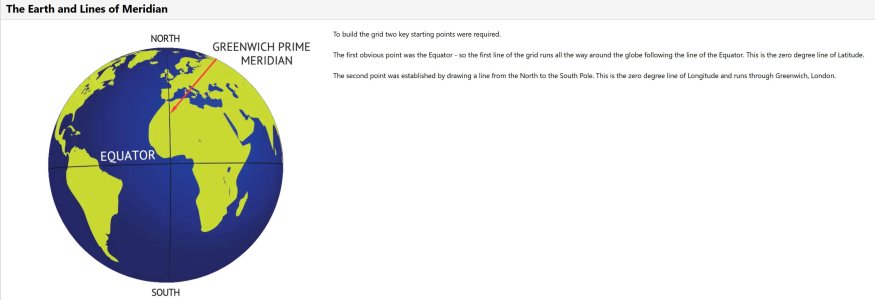
Doing my day skipper course and revising before the test and noticed the prime meridian as shown by the RYA does not run through Greenwich but closer to Plymouth

View attachment 196733
The perils of maps in the hands of graphic designers, who never seem to understand that a map is a representation of reality, not merely a graphic element in the design.
 
My apologies to all ....

Getting old and memory playing tricks.

The radar I was mentioning as Decca - was in fact Kelvin Hughes Situation Display radar .....

With regard to Syledis .... many funny stories about placing the Transponders ....

But to give an idea of the accuracy .... drill rigs have drill templates - not just one 'hole' ..... In North Sea / Gulf of Mexico etc 0 we used to set thjem on the Drill rig towers ... and agreement with Rigs - was if the 'skidded' the tower to change 'hole' - they should tell us ... but too often WE would tell them they had 'skidded' ....
 
My apologies to all ....

Getting old and memory playing tricks.

The radar I was mentioning as Decca - was in fact Kelvin Hughes Situation Display radar .....

With regard to Syledis .... many funny stories about placing the Transponders ....

But to give an idea of the accuracy .... drill rigs have drill templates - not just one 'hole' ..... In North Sea / Gulf of Mexico etc 0 we used to set thjem on the Drill rig towers ... and agreement with Rigs - was if the 'skidded' the tower to change 'hole' - they should tell us ... but too often WE would tell them they had 'skidded' ....
A surveyor I worked with on land crews had done time on oil rigs. He reckoned that a closure error of a millimetre was a cause for concern on an oil rig. That was, of course, for structural integrity and measurement of any settling, not absolute position fixing.
 
A surveyor I worked with on land crews had done time on oil rigs. He reckoned that a closure error of a millimetre was a cause for concern on an oil rig. That was, of course, for structural integrity and measurement of any settling, not absolute position fixing.
Decca Hi-Fix and Pulse/8 were used for more accurate positioning. My old dad was chief surveyor for Decca Survey and later Racal.
 
Me, too, but we used Decca and Transit. That would have been about 1975, before I got into the Polar regions!

I was with CGG in early 1980's ... then had a stint with Western Geo ...

CGG's big advnatge of course was "Starjet" .... being super heated steam for the shot instead of other company's Airguns. Starjet and its earlier less powerful Steam systems had significantly less 'noise' to program out of the data.
 
I left Decca in 1976 and went to a recording company, Grampian Records, to service their recording studio and associated equipment.
I worked for Olympic Studios and Trident Audio (building/installing their mixing consoles) in the late 70s. Just installed a Gobius tank level detector today, cleaning wipes were Isopropyl Alcohol. A familiar smell from cleaning tape heads and getting Mick Jagger's spit out of a Neumann mic.
 
Top