Can someone explain radar to me please...

I was replying to your claims about transmission intervals, nothing else.

You said "Updates every 5 to 15 seconds under way vs. 30 seconds."

That's not true unless you exceed 14 knots or 23 knots.
You're absolutely right, and I was mistaken about the reporting intervals. I shouldn't have trusted memory. Here's a good white paper which clears it up: https://www.cactusnav.com/files/ClassB_SOTDMA_AIS_White_Paper.pdf

Under 14 knots, it's still 30 seconds. Thanks for the correction!
 
Got my hands on the e97 yesterday. Seller was quite happy to let me take it back to my boat to hook it up and have a play around.
Given that the most advanced plotter I'd ever had prior to this was a titchy 5" Garmin from about 2005, it feels pretty amazing. A 9" screen is massive when you've been navigating by phone for years!

I don't have a chart card in it yet so maybe it will grind to a halt once that's installed?

The biggest/only gripe really is the WiFi. I can get it to connect to my phone, but all it will do is mirror, and I seem to have to initiate that from the plotter.
My plan is to be able to check wind data from in my bunk, and I don't think this will really give me that in a useable way.

But given the price, the 0183 compatibility, and the hybrid touch controls, I'm going to buy it anyway. And maybe look at adding WiFi via a separate module?
 
Got my hands on the e97 yesterday. Seller was quite happy to let me take it back to my boat to hook it up and have a play around.
Given that the most advanced plotter I'd ever had prior to this was a titchy 5" Garmin from about 2005, it feels pretty amazing. A 9" screen is massive when you've been navigating by phone for years!

I don't have a chart card in it yet so maybe it will grind to a halt once that's installed?

The biggest/only gripe really is the WiFi. I can get it to connect to my phone, but all it will do is mirror, and I seem to have to initiate that from the plotter.
My plan is to be able to check wind data from in my bunk, and I don't think this will really give me that in a useable way.

But given the price, the 0183 compatibility, and the hybrid touch controls, I'm going to buy it anyway. And maybe look at adding WiFi via a separate module?
The only way to get wind on a phone or tablet is to mirror, even with the Axiom. That assumes you have wind data showing on the plotter itself.
 
The only way to get wind on a phone or tablet is to mirror, even with the Axiom. That assumes you have wind data showing on the plotter itself.
Ok so getting a new Axiom instead at ~3x the price wouldn't actually give me any better WiFi functionality. Good to know.

Any recommendations for a suitable device to get the data from my STNG wind instrument on to my phone? And preferably some of the other data too.
 
Ok so getting a new Axiom instead at ~3x the price wouldn't actually give me any better WiFi functionality. Good to know.

Any recommendations for a suitable device to get the data from my STNG wind instrument on to my phone? And preferably some of the other data too.
There's a lot of different ways, where you want to display it makes a big difference. You could, for instance display the wind data on the plotter and mirror it to your phone/tablet, that doesn't cost a penny. I'm not entirely sure how much data you can display on the e97

If you don't broadcast too much data one of the cheaper devices, such as Quark, might work OK. They can get overwhelmed with too much data though, such as sending busy AIS data.

@Refueler often recommends an inexpensive multiplexor, can't remember if it does WIFI, i'm sure he'll be along soon to remind us what it is (y)
 
There's a lot of different ways, where you want to display it makes a big difference. You could, for instance display the wind data on the plotter and mirror it to your phone/tablet, that doesn't cost a penny. I'm not entirely sure how much data you can display on the e97

If you don't broadcast too much data one of the cheaper devices, such as Quark, might work OK. They can get overwhelmed with too much data though, such as sending busy AIS data.

@Refueler often recommends an inexpensive multiplexor, can't remember if it does WIFI, i'm sure he'll be along soon to remind us what it is (y)
It's really a case of priorities.
Wind is the important bit, to me. If I'm off watch i want to know whether we're sailing efficiently, whether we're risking a gybe, and if those gusts I can hear mean it's time to put my boots on and help put in a reef.

Course, speed, position, I can just look up on Navionics on my phone like I do already.

AIS would be nice, but perhaps that would be tricky, especially since my AIS is 0183.
 
It's really a case of priorities.
Wind is the important bit, to me. If I'm off watch i want to know whether we're sailing efficiently, whether we're risking a gybe, and if those gusts I can hear mean it's time to put my boots on and help put in a reef.

Course, speed, position, I can just look up on Navionics on my phone like I do already.

AIS would be nice, but perhaps that would be tricky, especially since my AIS is 0183.
If you are feeding AIS to the plotter it should go on the STNG network (i think), in which case a STNG or N2K to WIFI device should do the job.
 
The plexors I often mention are as far as I'm aware not capable of STNG ... or N2K ... but can accept older ST..

Yes they do combine all NMEA in to WiFi .. USB and NMEA out streams ...........

Here is the page introducing the NMEA4WIFI unit .,..

Nmea4Wifi - Introduction

From this page - you can search out his other items etc.

Vela Navega Shop

I have absolutely zero connection except that I am a very happy user of his plexors ... I have the NMEA2WiFi and NMEA4WiFi units ....

Edit : One aspect that I should mention ... it has added ability to pick up external WiFi.. such as the Marina and boost it for you to connect ...
 
Last edited:
Aaaand we have chosen our radar, nine pages after starting this thread 😂

RD418D, secondhand from a local marine electronics place. Now would be a good time to tell me if it isn't compatible with my e97 🤔. I've looked it up and it seems to be a match.

I've also found myself a mast mount, so despite earlier having decided to repurpose my wind gen pole, I will bow to the majority view and stick it up the mast.

No cable yet. So far I've spent just over £800 so there's still money left in the kitty...
 
The plexors I often mention are as far as I'm aware not capable of STNG ... or N2K ... but can accept older ST..

Yes they do combine all NMEA in to WiFi .. USB and NMEA out streams ...........

Here is the page introducing the NMEA3WIFI unit .,..

Nmea4Wifi - Introduction

From this page - you can search out his other items etc.

Vela Navega Shop

I have absolutely zero connection except that I am a very happy user of his plexors ... I have the NMEA2WiFi and NMEA4WiFi units ....

Edit : One aspect that I should mention ... it has added ability to pick up external WiFi.. such as the Marina and boost it for you to connect ...
Only had time for a glance Nigel, but this looks like it will do the job with N2K, in which case all the OP needs to connect to it is a STNG to N2K cable.
 
You've been advised to just set the plotter to be showing your wind data, then mirror that -- a perfectly sound way forward.

Raymarine apparently doesn't give you a way to make a TCP or UDP connection over either wifi or Ethernet. Unlike Navico. Don't know about Garmin or Furuno.

So to get your wind data (and other network data) out of your system, you'll need an Actisense W2K-1 or similar NMEA2000 to Wifi gateway.

Or, if you like to fiddle with computers and networking, and if you have an 0183 talker port on your plotter, you can connect that to a Raspberry Pi or any kind of PC with a cheap 0183 to USB adapter, and set that up as a wifi server. I'm not sure what 0183 sentences the E9 can convert from N2K. With the Navico plotters you get more or less everything except AIS.

Or you could always buy an old wind instrument display (but something which can read your network data) and install it over your bunk. A friend of mine has a B&G 3 7 installed like that.
 
You're talking about MARPA (Mini Automatic Radar Plotting AID) or ARPA (Automatic Radar Plotting Aid), which I've mentioned in almost every post.

This is nothing new; commercial radars started to get this function in the 1980's and I had one on a yacht already in 1999 (Raytheon Pathfinder).

It's a very useful system, since it doesn't rely on the target broadcasting anything. HOWEVER, it depends on having accurate heading and other data from your own boat (as I wrote before). And in general doesn't work nearly as well as it does on ships because of the poor bearing discrimination of our little radars. Still, very useful.

But there are cases when you need to have the skill to use a radar display.
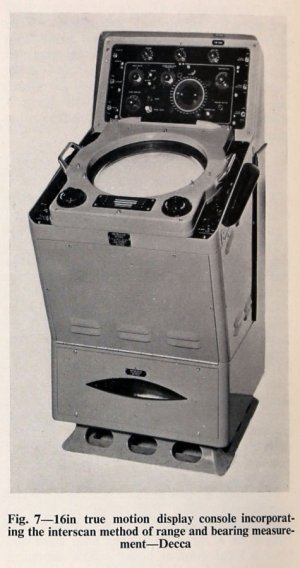
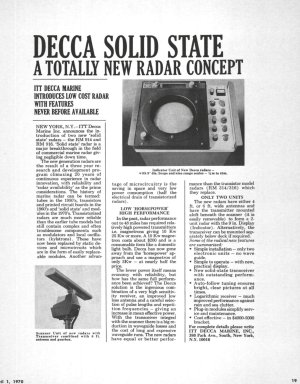
Decca Radar were implementing anti collision radars with true and relative motion of vessels in the early 1970's ( introduced in 1969 with the Transar series of radars), I was on one of their training courses for installing/servicing/repairing them in 1973 at Decca Radar HQ in Croydon. They were not small items and certainly not for small boats.
On that course I built my first computer that could add, subtract, and store the result for display
 
Decca Radar were implementing anti collision radars with true and relative motion of vessels in the early 1970's ( introduced in 1969 with the Transar series of radars), I was on one of their training courses for installing/servicing/repairing them in 1973 at Decca Radar HQ in Croydon. They were not small items and certainly not for small boats.
On that course I built my first computer that could add, subtract, and store the result for display
I stand corrected! 1970's! It's hard to conceive that we actually even used computers in the 1970's, even for those of us who were already conscious during that decade.
 
I stand corrected! 1970's! It's hard to conceive that we actually even used computers in the 1970's, even for those of us who were already conscious during that decade.
We still had valves in a lot of the navigation gear, like the Decca Mk 5, and Mk 12 Navigators, the Mk21 Navigator had just come out and that was all solid state with a nixxy tube to display the channel number. Even the Decca 101 radar still had vacuum state technology in them.
The Transar series was succeeded by the RM914 and RM916

Transar series with 16" display, the rest of the radar was in other big boxes connected by waveguide up to the scanner up top somewhere
DeccaRadar1.jpg

RM914/916 (RM = Relative Motion)
DeccaRM914.jpg
 
Decca ..... when I was Officer with Shell in the 70's .... we had some of our ships equipped with test units of the latest 'True Motion' Decca ... sorry - I cannot remember the name or ID ... but it was a great idea - that fell apart in use ...

Basically it was a large TV daylight view screen ... the actual radar was a small unit right in the bottom of the casing ... with a camera over it. The image was then displayed on the users screen.
It was True Motion but with a twist - own ship would stay centred - but a trail left behind as the background scrolled at ships speed ... targets would similarly leave trails on the screen. This is where it fell apart .... as the units were supplied and installed without training in this strange display. Users would assume the trail to be like a regular plot giving CPA - which it most definitely was not ! ... and act accordingly ... with some near disastrous results ...

It was a unit that you either understood and loved .. or hated every bit of it !!
 
Don't know that one, by 1976 I was out the door, served my time as a trainee and as the cut back in the fishing fleet bit deep we went from 4 engineers and a storeperson in an office at Scrabster, to one guy working from home.

Could be a modification of the RM series which showed the relative motions of vessels as a track on the screen, it could extrapolate the selected target's course and give an anti collision warning.

I was 17 when I started with Decca, but I had already been doing a service engineer's course at the local tech college as a way of filling in my time while looking for work, I had the highest marks recorded at the college with straight 100% in the City & Guilds course I was doing, I remember being a bit of a tearaway but 20 odd years later speaking with the son of a friend that was doing an electronics course he said that I was held up as a shining example of diligent work :D

50 odd years later contemplating what radar to compliment our boat, we have a Simrad Go9 on the upper helm and a Garmin on the lower, both using Navionics charts.
 
I stand corrected! 1970's! It's hard to conceive that we actually even used computers in the 1970's, even for those of us who were already conscious during that decade.
In about 1975 I was on a seismic survey vessel in the North Sea. It had a Transit satellite navigation system - Motorola, I think. It was the size of a filing cabinet, and about once a watch it needed to be rebooted, which entailed keying in a string of hexadecimal numbers using toggle switches. It gave positions accurate to about 50m a few times an hour, depending on when satellites passed. By 1983, Transit systems were available for yachts, in a much smaller (shoe box sized) package, but at a price beyond most yachtspeople's budget. I had the enviable task of visiting the London Boat Show in 1982 to purchase one for use in our field work in Svalbard! That had an averaging function that allowed positions to be determined at about 10m accuracy, provided you were stationary for 24 hours or so.
 
In about 1975 I was on a seismic survey vessel in the North Sea. It had a Transit satellite navigation system - Motorola, I think. It was the size of a filing cabinet, and about once a watch it needed to be rebooted, which entailed keying in a string of hexadecimal numbers using toggle switches. It gave positions accurate to about 50m a few times an hour, depending on when satellites passed. By 1983, Transit systems were available for yachts, in a much smaller (shoe box sized) package, but at a price beyond most yachtspeople's budget. I had the enviable task of visiting the London Boat Show in 1982 to purchase one for use in our field work in Svalbard! That had an averaging function that allowed positions to be determined at about 10m accuracy, provided you were stationary for 24 hours or so.

On the Shell LNG ships running Brunei to Japan ... we had Magnavox Transit ..... originally the two big box units the size of filing cabinets but later changed to the single TV sized unit.
Because we were running the Palawan Passage - it was decided to fit Transit and to provide test data to Magnavox etc.

Its biggest problem was not the accuracy of position - but the timing of sat passes. Over a period of xx days - the sats would bunch up and you could have a series of positions quickly one after another ... then there would be nothing for hours ... over next xx days - the sats would spread out ... and then start bunching up again.
 
Top