
can I use two rope as a simple auto pilot?

jym940215

New Member
Joined
6 Jun 2020
Messages
3
Visit site
Hello everyone, I am recently interested in buying a sailboat and sail cross the ocean, due to limited budget, I am probably going to have a sail boat that was made in the 80s, and I am worried that the autopliot in a older boat could go off for no reason(I watched a lot of youTube video that it could happen), so I have a question, if my auto pilot go off for any reason, is it possiable to use two flexiable rope to make the steering wheel hold in one place like this:
and I am wondering I can place the steering wheel like this and leave the boat sailing? is it safe(in the ocean)? Thanks!
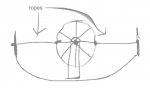

Screen Shot 2020-06-06 at 9.35.20 PM.png
 
Hello everyone, I am recently interested in buying a sailboat and sail cross the ocean, due to limited budget, I am probably going to have a sail boat that was made in the 80s, and I am worried that the autopliot in a older boat could go off for no reason(I watched a lot of youTube video that it could happen), so I have a question, if my auto pilot go off for any reason, is it possiable to use two flexiable rope to make the steering wheel hold in one place like this:
and I am wondering I can place the steering wheel like this and leave the boat sailing? is it safe(in the ocean)? Thanks!


View attachment 91911
Please explain how that arrangement turns the wheel, an autopilot steers to maintain direction or course.

If it was so simple, I think it would have been invented four thousand years ago.
 
What you need is windvane steering. They come up for sale second hand sometimes.

It sounds like you need more experience in coastal sailing before embarking on a big crossing. You'll encounter problems and you'll need to know how to address them.
 
You could use that, but in prepping the boat for an ocean crossing need to consider robust systems that are not going to fail.

How many crew will be onboard?
 
As above, get a lot of experience before attempting an ocean crossing. You'll learn a lot about balancing the helm and the restoring forces need to keep a boat on course.
The scheme in your sketch won't work, if the lines are rope, the wheel won't turn. If the lines are made of an elastic material the loads will be balanced and just centre the wheel, the boat will probably go around in circles.
 
Holding the wheel still isn't enough to keep the boat in a straight line. It it were that simple we wouldn't spend thousands on autopilots. The boat is constantly subject to the forces of waves and wind which will throw it off course. On most boats you'll only get a few minutes before you start veering off course, but it depends on the type of boat, the sea conditions, and what point of sail you are on.

Tbh it sounds like you have a fair bit to learn before you're going to be ready to cross an ocean. But don't let that put you off. You've got to start somewhere. Read, watch, ask questions, be open minded and remember thousands of people have done this before you and they are worth seeking out and listening to.
 
Winds, currents and waves would be turning the boat in all directions. You need a mechanism to turn the wheel/rudder to steer back to course. Electric autopilots, wind vanes and "sheet to tiller" can auto steer. Learn and practice before you go out in the open sea.
 
What you need is windvane steering. They come up for sale second hand sometimes.

I agree despite a limited budget I would say a Windvane steering system is essential for ocean cruising and pretty handy for shorter passages too. They free you from the tyranny of the tiller/wheel. During my 5 years of bluewater cruising I met several boats who relying on electric autopilots had them fail on them and arrived in port stressed and tired after hand steering for days. Singlehanded I could trust my windvane and an added advantage of course is that they don't use any electric power. I saw too many cruising boots that had to run engines or generators to keep their batteries charged.
 
To be fair he asked about steering the boat with ropes on the wheel, not if you think he is capable of sailing a boat. I'm sure he will discover that for himself when he gets a boat?
I would suggest jym940215 watches some youtube videos about wind steering and how it works.
 
Let's not forget Chay Blythe set off on the Golden Globe having not sailed before.

However as a general rule of thumb yes I agree that it's best to get some experience first.

Regarding using ropes to steer yes it's possible. There are various ways but the easiest is to rig an inner stay and bend on a staysail or storm gib. With a bit of surgical hose attached to the tiller and by backing the staysail you can rig a self steering system to maintain a course from a beat to a beam reach with some success. Google will tell you more.
 
If your budget is limited and you really do want to cross oceans a boat with a long keel (for directional stability and well protected rudder) and a tiller (less expensive and more self-steering options available) would be most people's choice...
 
I agree despite a limited budget I would say a Windvane steering system is essential for ocean cruising and pretty handy for shorter passages too. They free you from the tyranny of the tiller/wheel. During my 5 years of bluewater cruising I met several boats who relying on electric autopilots had them fail on them and arrived in port stressed and tired after hand steering for days. Singlehanded I could trust my windvane and an added advantage of course is that they don't use any electric power. I saw too many cruising boots that had to run engines or generators to keep their batteries charged.
On the ARC I was on wind vanes were on a very small minority of boats, so not “essential”. And it appeared that they had higher percentage failure rates than the electronic autopilots, which seemed to be amazingly reliable these days (but not entirely so, so if I were doing an ARC I would probably take a spare ram drive). Hydro generator sorted the autopilot power consumption.
But certainly would prefer not to rely on a couple of fixed ropes downwind in big waves at 8+ knots.
 
Let's not forget Chay Blythe set off on the Golden Globe having not sailed before.

However as a general rule of thumb yes I agree that it's best to get some experience first.

Regarding using ropes to steer yes it's possible. There are various ways but the easiest is to rig an inner stay and bend on a staysail or storm gib. With a bit of surgical hose attached to the tiller and by backing the staysail you can rig a self steering system to maintain a course from a beat to a beam reach with some success. Google will tell you more.
I bet there are hundreds of yachtsmen with all the gear and courses under their belts but when it come to it they don’t have what it takes to set off in a small boat across an ocean,if he is intelligent enough and has the confidence he will most likely go and find out a lot in just a few days .Its quite learnable sailing and navigating what is not is courage and confidence.
 
What you need is windvane steering. They come up for sale second hand sometimes.

It sounds like you need more experience in coastal sailing before embarking on a big crossing. You'll encounter problems and you'll need to know how to address them.
Thanks for your kindness, I do need many cosatal sailing practice, and I was just picturing potentional scenarios that could happen, my plan is to buy a boat after the pandemic and do some coastal sailing before I can do a ocean crossing seriously.
 
If your budget is limited and you really do want to cross oceans a boat with a long keel (for directional stability and well protected rudder) and a tiller (less expensive and more self-steering options available) would be most people's choice...
Thanks for your advice!
 
I think the OP is asking about emergency steering options in the case of failure of auto pilot. The concept is to lock the steering in one place and hope that the balance of the sails and hull shape will keep it on one course for useful periods of time. Many wheel steered boats will have lock or inherent stiffness in the system that rudder and wheel will not be knocked by waves. If not then the rope arrangement will be OK. However you need to lock the wheel or tiller then watch the boat over a period of time and often need to adjust the helm slightly to get the course you want. The rope arrangement in your diagram does not allow for small adjustments. On a tiller you can use a bungy one side and a small tackle on the other side to give fine adjustment near cente. In a similar way you may be able to attach bungy and tackle to the top spoke of the wheel. As said there are arrangements to take the load of a sail sheet fed to the tackle to change the tille rsetting with change of sheet load and so wind load/direction.
However as said if I was doing a long ocean passage I would be looking for spare autopilot and alternative power sources for back up. ol'will
 
Top