Bodge of the day

Wow back in the seventies , our college taught us how to remember the colour code , it was so racist you would not use it today but I never forgot.
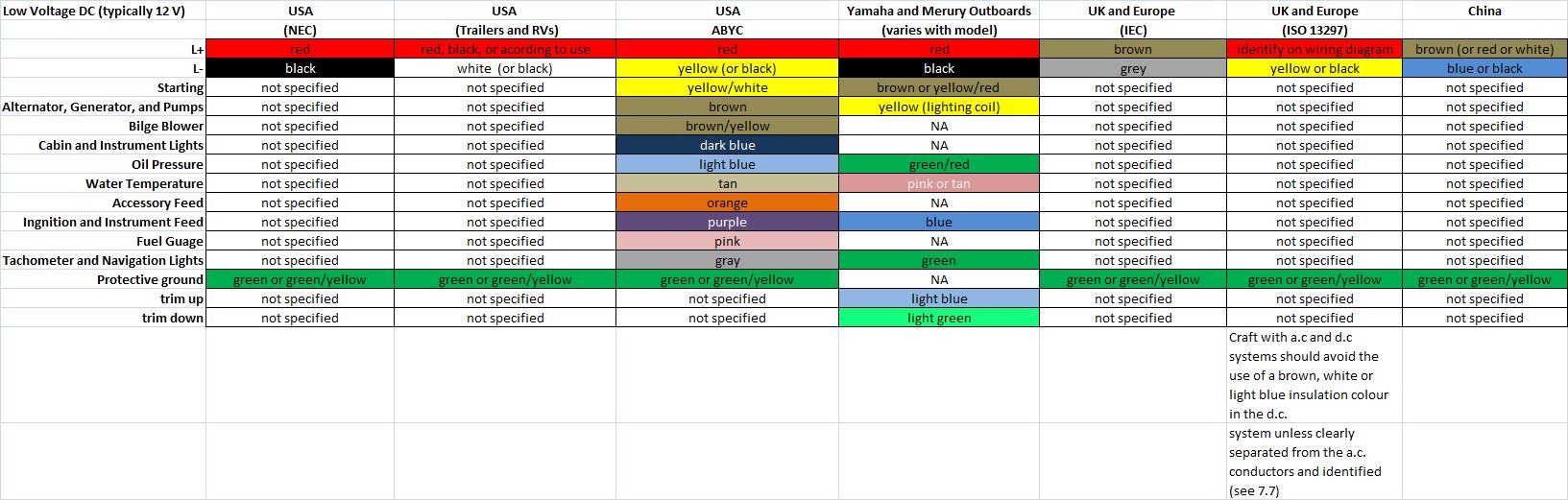
Interestingly, the color code varies with the country.

If there are errors, please point them out. Yes, it is sort of USA-centric. Given current politics, I feel like I should apologize for that, but the target audience was US buyers of primarily Chinese imports through Amazon. Brown and blue is a shock to US buyers accustomed from birth to black and red (12V) or black and white (120V). And yes, ABCY is red and yellow, and curiously, US caravans (RVs) are different from boat color codes. Go figure. Sometimes the best you can do is label the ends of wires. In fact, if the wiring is systematic, with a consistent ground practice, it is not too confusing.

As a result, I NEVER believe anything based on the wire color.

4b.%20master%20DC.jpg
 
Interestingly, the color code varies with the country.

If there are errors, please point them out. Yes, it is sort of USA-centric. Given current politics, I feel like I should apologize for that, but the target audience was US buyers of primarily Chinese imports through Amazon. Brown and blue is a shock to US buyers accustomed from birth to black and red (12V) or black and white (120V). And yes, ABCY is red and yellow, and curiously, US caravans (RVs) are different from boat color codes. Go figure. Sometimes the best you can do is label the ends of wires. In fact, if the wiring is systematic, with a consistent ground practice, it is not too confusing.

As a result, I NEVER believe anything based on the wire color.

4b.%20master%20DC.jpg
The mnemonic is for the resistor colour code, not cabling.
 
That'd mean you had to buy different colours of wire.
I have thought of just differentiating them by sliding different colour sections of drinking straw over them,
If I'd actually done it, would I be in with a chance at todays title spot?
 
When I recently upgraded the solar panels on our new boat, I reused the existing cable run, and was a bit disappointed to see no voltage registering on the MPPT.
So I took off the red and black wires and checked them. There's my voltage: -32v.
At some point in the run, the colours had been swapped.
That previous owner has a lot to answer for.
 
When I recently upgraded the solar panels on our new boat, I reused the existing cable run, and was a bit disappointed to see no voltage registering on the MPPT.
So I took off the red and black wires and checked them. There's my voltage: -32v.
At some point in the run, the colours had been swapped.
That previous owner has a lot to answer for.
First, ask why you did not check the voltage of the wires before connecting them. This should be done EVERY TIME, and not doing so is also careless. I recently changed out all of the wall outlets in my daughters house, and about 20% had the polarity reversed. Never assume.
 
First, ask why you did not check the voltage of the wires before connecting them. This should be done EVERY TIME, and not doing so is also careless. I recently changed out all of the wall outlets in my daughters house, and about 20% had the polarity reversed. Never assume.
Because I had previously been running a different solar panel on that run. I merely disconnected the old panel and installed a new one. So the voltage was coming from the panel directly. I had no reason to assume that anything was wrong.

But yes, I now take nothing for granted on this boat.

Another good example, not related to wiring: we were told by the previous owner that we would need a new mainsail. Helpfully, we found a neat sketch on graph paper, tucked in with the other documents. It had the boat name, and make and model, and the sketch showed the dimensions of the sail in mm, plus the positions of the four battens. How useful.

One of the sail lofts we had contacted for a quote flagged up that the dimensions we'd sent them- from that sketch- didn't match the dimensions they had on file for this model of boat. So we dragged the old sail out and took it to the beach to measure it. Sure enough, the sketch was completely wrong. Even the number of battens was wrong.

I still have no idea where that sketch came from or what it has to do with our boat. We wouldn't have gone as far as ordering a sail based solely on that, of course, but it's left me questioning pretty much everything that the previous owner told us.
 
I see so many bodge jobs, it's a miracle we don't see more boat fires. I hate choc blocks and Scotchloks, but note the brown wire wrapped around the red one in the choc block. Look closely at the Scotchlok to the right of it too.

View attachment 196960
Are you sure that wasn't my boat with the previous owner? It's taking ages a while but I am slowly replacing the choc blocks, and multi -y connections plus adding some order to colour and polarity convention 🙂
 
Because I had previously been running a different solar panel on that run. I merely disconnected the old panel and installed a new one. So the voltage was coming from the panel directly. I had no reason to assume that anything was wrong.

But yes, I now take nothing for granted on this boat.

Another good example, not related to wiring: we were told by the previous owner that we would need a new mainsail. Helpfully, we found a neat sketch on graph paper, tucked in with the other documents. It had the boat name, and make and model, and the sketch showed the dimensions of the sail in mm, plus the positions of the four battens. How useful.

One of the sail lofts we had contacted for a quote flagged up that the dimensions we'd sent them- from that sketch- didn't match the dimensions they had on file for this model of boat. So we dragged the old sail out and took it to the beach to measure it. Sure enough, the sketch was completely wrong. Even the number of battens was wrong.

I still have no idea where that sketch came from or what it has to do with our boat. We wouldn't have gone as far as ordering a sail based solely on that, of course, but it's left me questioning pretty much everything that the previous owner told us.

If we start a PO thread, the tales will get a LOT taller than this thread so far!

a. When you disconnected the old panel I bet the wires were reversed. You're going to check anyway. But it would have caught my eye. One way the PO could have gotten turned around is if the panels were Chinese and had brown and blue wires. He connected the panel end backwards, not knowing, and then, like you, figured the other end out when he got to it. The point of the post 28 chart was that you should trust nothing. Verify.

b. I would guess the PO got his measurements from someone else who didn't know. I would also not go by a prior sail. Too hard to get the stretch right, and the sail maker will want to make his own allowances for stretch, based on the cloth he will use. You measure, at least twice, using a non-stretch 100' tape, between defined points. The last time I got a new sail we laid it on top of the old sail and it was quite different. Stretched on the spar it was spot on. And batten numbers, lengths, and locations are sailmaker calls. My new sail had one fewer battens and all different lengths ... and it is perfect.
 
Installing a new kitchen in my house in Scotland, I had to take down the lath and plaster wall where the gas cooker had been, sitting behind the lath was an unterminated 1.5 twin and earth, putting a meter on it, it was live :oops: also the cooker switch and socket was held in with old newspaper.
I know the previous owner had not done any renovations in the kitchen since he bought the house in 1974, so that wire has been sitting there since before then.
 
Top