
Stemar
Well-Known Member
Lidl's malt is drinkable, but I wouldn't call it fineFollowing on from another thread - But will the malt be from LIDL ?

Lidl's malt is drinkable, but I wouldn't call it fineFollowing on from another thread - But will the malt be from LIDL ?

Well, that's one use for bioethanol! Seriously, why do people advertise things for use with bioethanol? Ethanol is ethanol; the heater doesn't know whether it originated from fermentation or from a chemical plant at an oil refinery. The stuff that comes out the end is all the same - good old C2H5OH, the same as in beer, wine, spirits etc. It's an ETHANOL heater; the "BIO" bit is marketing! I don't have any problems with bioethanol, but it's the fuel that should be marketed as such; devices that use ethanol are agnostic about its source!One of these days I'll have a boat with a proper stove. I'll anchor off in Ballachulish surrounded by snow capped Lochaber mountains and the Pap of Glencoe. The stove'll be on , it'll be toasty in the cabin and I'll be supping a fine malt.
I'd be far more concerned about producing poisonous exhaust gases than water vapour. There's no way that you can safely burn any fossil fuel in a stove without a flue.

Few if any cookers have flues.....so indeed all these devices without flues that combust carry a CO risk. Provided there is a source of ventilation the risk is low, but that negates the heating effect.
Flued devices also require air 1) for combustion 2) to enable flow of fumes through and out of the device, so free air ventilation is also required for them.
Manufacturers instructions should tell you how much ventilation is required.

'Storage radiators'. In theory, heat using slightly lower cost electricity overnight, then blow out the 'stored' heat during the day. Our first house had them. Cost a fortune to run and the house was cold after about 1100.As Vyv and Alfie point out some yachts, many (?) have a gas fired hob, toaster and oven without any demand for ventilation (deaths have been low, or unreported). I suspect when its cold people will drop in the washboards. I confess one cold night we made up a casserole - enjoyed with red wine, hot shower (gas flued boiler) 8 hours sleep - to awake to a toasty interior - we forgot to turn the oven off.
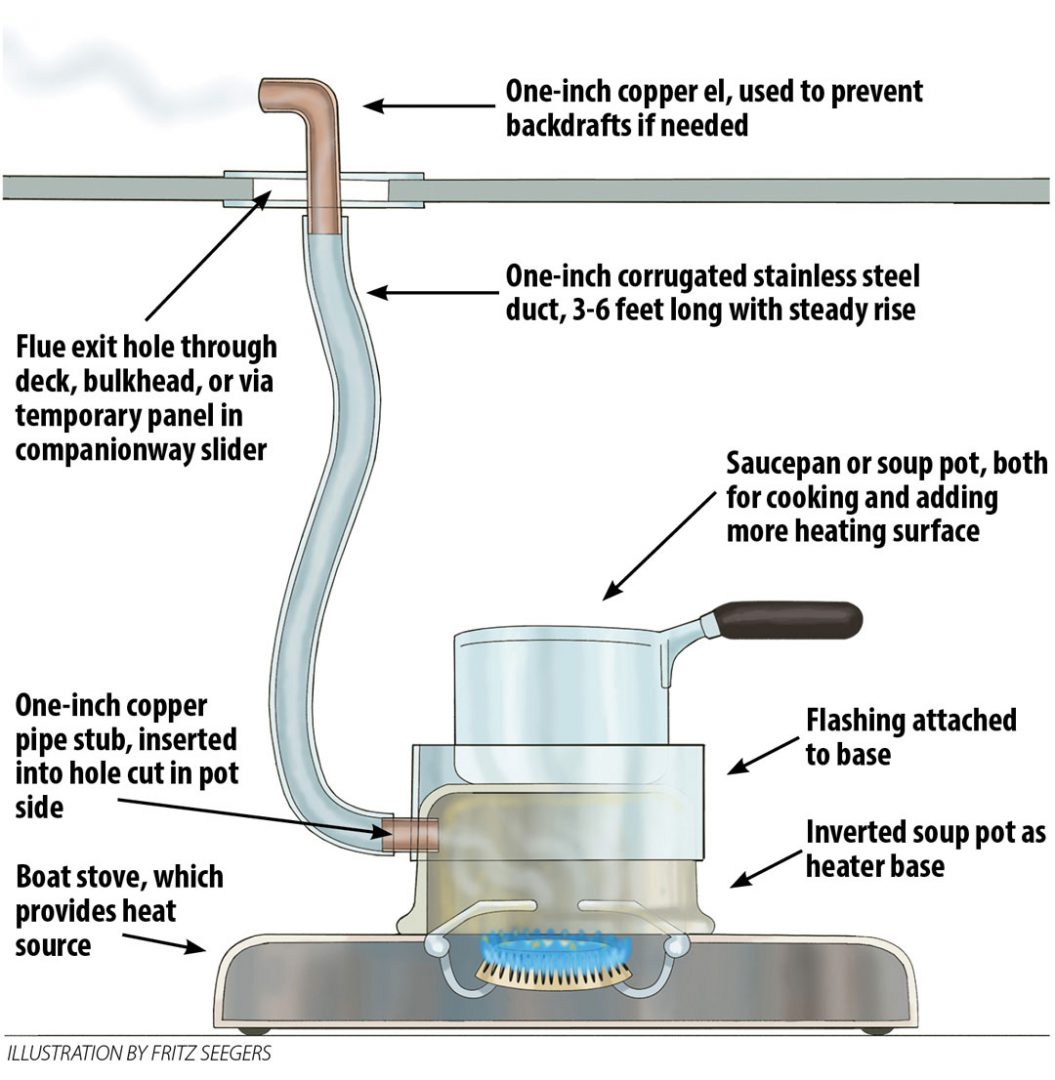
I recall an old idea was to light up one of the hobs, place an inverted terra cotta flower pot on top and convert the hob into a radiant heater.
Better: decades ago there were storage heaters full of olivine (shipped in bulk 3,000t at a time) based bricks (some made in Scotland it was big business) with coils of wire wound through the bricks. Whatever happened to them? At the back of my mind is the idea there was a special, low, overnight electricity rate??. Olivine, or magnesium silicates have a high thermal capacity - but in the absence of an olivine brick - any old, or new, brick would provide thermal mass on a stove top (or even in the oven). The basic heat source need not be electricity and instead of olivine or a house brick a magnesia of MagChrome brick would do.
I do admit a brick (or 2), olivine or not, is not very attractive - or not as attractive as a blazing log fire
Jonathan
'Storage radiators'. In theory, heat using slightly lower cost electricity overnight, then blow out the 'stored' heat during the day. Our first house had them. Cost a fortune to run and the house was cold after about 1100.

Our first home had no gas supply, and we had storage heaters. They a) were inefficient and b) expensive. The contrast in cost and efficiency with gas heating was so great that when we applied to the bank for a loan to install them, the bank rang me to ask if we'd be better off with gas! Sadly, the village I lived in didn't have a gas supply at that distant time.'Storage radiators'. In theory, heat using slightly lower cost electricity overnight, then blow out the 'stored' heat during the day. Our first house had them. Cost a fortune to run and the house was cold after about 1100.
In rural areas without a gas supply, the choices were oil, LPG and storage heaters. The capital cost of the former two was much higher than that of storage heaters, so many opted for them, as we did. I lived in a large village on a main trunk road not far from Cambridge (I cycled to work in Cambridge) and that had no gas supply until about 1985, so it wasn't an uncommon choice for a lot of "dormitory" villages.There was obviously a very convincing argument in favour of storage heaters, 10s of thousands were sold
But, it seems, like too many things - good marketing with little substance
Our first house had coal fires, one of which heated the water, and the second gas central heating - both around the peak of usage of storage heaters (which we never had).
Jonathan
There was obviously a very convincing argument in favour of storage heaters, 10s of thousands were sold
But, it seems, like too many things - good marketing with little substance
Our first house had coal fires, one of which heated the water, and the second gas central heating - both around the peak of usage of storage heaters (which we never had).
Jonathan
Our rural house in North Wales although on an A road trunk route still has no piped gas supply. We were on oil for 50 years, still the cheapest and best. Now on oil in France. No new constructions can have oil fired boilers but the fuel will available for decadesMuch to my surprise - if you use google and search 'storage heaters' you will find they are, just?, alive and kicking.
I knew of them from the early 70s when they were big business. Oddly I lived in central Scotland and every reasonable town had a (coal) gas tank or even a gas works, surrounding villages had piped gas and coal was in constant supply -totally different to your background.
Jonathan

... Burning gas ... causes ... nitric oxide and nitrogen dioxide, collectively known as NOx, which can irritate the lungs. ... can also emit carbon monoxide, particulate matter and even formaldehyde. ... deleterious health impacts, and can affect the respiratory and cardiovascular systems.
... research shows gas stoves emit toxic compounds even when not in use. ... benzene, a carcinogen. ... benzene in 99% of samples it took in homes ... xylene, toluene and ethylbenzene ... respiratory issues and may cause cancer as well.
... new asthma study ... real public health challenge ....
how much pollution ...
A lot. ... gas stoves can emit as much benzene as a cigarette, ... akin to secondhand smoke ... the same level of benzene ... stove that’s off in your house as ... a smoker in it ...
 .
. 


