Fuel Burn relative to Speed

Irish Rover

Well-Known Member
Joined
5 Feb 2017
Messages
8,728
Location
Türkiye
Visit site
I've had my engines serviced relatively recently and my bottom cleaned and painted. I've been experimenting with fuel burn at various speeds up to around 12/14 kts (my top is around 24kts). My boat is a 43' catamaran and I have 2 x Yanmar 8lv320 engines.
At min speed of 3.5kts each engine burns around 1 lph. If I increase to 7kts they each use 4 lph. If I go to 14kts they burn around 16/18 lph each. So rule of thumb - when I double my speed the fuel burn increases by a factor of 4.
 
I've had my engines serviced relatively recently and my bottom cleaned and painted. I've been experimenting with fuel burn at various speeds up to around 12/14 kts (my top is around 24kts). My boat is a 43' catamaran and I have 2 x Yanmar 8lv320 engines.
At min speed of 3.5kts each engine burns around 1 lph. If I increase to 7kts they each use 4 lph. If I go to 14kts they burn around 16/18 lph each. So rule of thumb - when I double my speed the fuel burn increases by a factor of 4.
Distance covered in that time also increases!
 
I've had my engines serviced relatively recently and my bottom cleaned and painted. I've been experimenting with fuel burn at various speeds up to around 12/14 kts (my top is around 24kts). My boat is a 43' catamaran and I have 2 x Yanmar 8lv320 engines.
At min speed of 3.5kts each engine burns around 1 lph. If I increase to 7kts they each use 4 lph. If I go to 14kts they burn around 16/18 lph each. So rule of thumb - when I double my speed the fuel burn increases by a factor of 4.
I know very little about Cats but comparing your fuel consumption at those speeds with let’s say, my boat, I believe it is very good. Hell, I would’ve never thought a Cat that size could go as fast as 24knots under power , that is impressive 👏👏👏👏
 
I always felt that it would be nice to be able to compute fuel consumption and work it into whatever the tide and sea was doing. With my 2-blade folding prop I don’t think my consumption followed a simple rule or curve in all conditions. Against a head sea, the engine would spend more time trying to recover lost momentum each time a wave checked us and I got the impression that it could actually be more economical, and possibly more comfortable, to motor much harder and keep speed up.
 
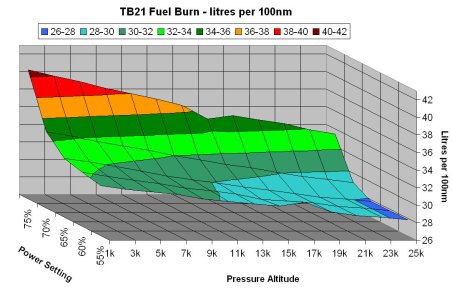
Being a nerd, I loaded published fuel burn figures for a light aircraft I used to fly into Excel to plot a curve to find optimum power vs altitude. Quite pretty it was too ..

TB21 Fuel Burn.jpg
 
Distance covered in that time also increases!

Yeah, if I double the speed I double the distance per hour. I didn't think I needed to explain that.

But it also means that the cost of a trip of a given distance only doubles, rather than quadruples.

E.g. to go 14nm it takes -
4 hours and 8 litres at 3.5 knots,
2 hours and 16 litres at 7 knots.
1 hour and 34 litres at 14 knots.
 
But it also means that the cost of a trip of a given distance only doubles, rather than quadruples.

E.g. to go 14nm it takes -
4 hours and 8 litres at 3.5 knots,
2 hours and 16 litres at 7 knots.
1 hour and 34 litres at 14 knots.

mmmmm nice - but thoughts of waves / swell / curent / drag all seem to come into mind .... as the speed increases - the design of hull shape entry etc takes more effect etc.

If life was so simple !!
 
But it also means that the cost of a trip of a given distance only doubles, rather than quadruples.

E.g. to go 14nm it takes -
4 hours and 8 litres at 3.5 knots,
2 hours and 16 litres at 7 knots.
1 hour and 34 litres at 14 knots.
I am not clear what point the OP was making!
 
mmmmm nice - but thoughts of waves / swell / curent / drag all seem to come into mind .... as the speed increases - the design of hull shape entry etc takes more effect etc.

If life was so simple !!
I've tested in different conditions and the rule of thumb seems to hold good - double the speed and fuel burn increases by 4. In any kind of rough conditions 7 kts is too slow for my boat and I need to increase the speed anyway
 
I am a fan of the figures in the boat tests in MB&Y. They make interesting reading and vary hugely in terms of the hull shape: planing, semi D, etc.. Obviously, I hear you say. The l/nm V speed being the most informative.
When in displacement mode a, say 40ft, hull, the mpg will double just going from 7 - 9.5kts. Hull speed reached at 7 and bulldozing water thereafter - unless up on the plane later.
Equally a high speed hull like a big RIB might do the same mpg at 6 knots and 28 as it is designed to plane. Also, a lower mpg at say 20kts as although the fuel burn per hour is lower, the speed has dropped and the hull is being less efficient.

It's the nerd in me. I find it fascinating how the hydrodynamics work.
 
. . . At min speed of 3.5kts each engine burns around 1 lph. If I increase to 7kts they each use 4 lph. If I go to 14kts they burn around 16/18 lph each. So rule of thumb - when I double my speed the fuel burn increases by a factor of 4.

That's amazing. Who would have thought :rolleyes:
 
Top