Best spotting scope/camera for shore-based photo/video of sailing and shipping?

Greenheart

Well-Known Member
Joined
29 Dec 2010
Messages
10,388
Visit site
Thinking of spoiling myself at Christmas. I may be ashore just looking at boats next summer. Not sure yet if that'll be cheaper than having a boat of my own.

I've occasionally attempted to align not-very-powerful spotting scopes in front of my phone's camera lens. Limited in success because modern phones have multiple lenses, so as one zooms in, the lens changes and the scope is no longer aligned. It's also diabolically difficult to keep it still enough to get a good pic.
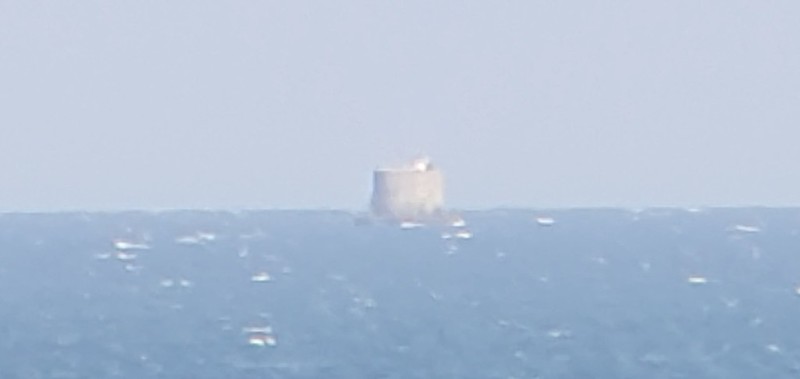
54167430814_b03e8ff406_c.jpg

Nab Tower, from Whitecliff Bay approximately 5.5 nautical miles away. Could do better, I hope.

The obvious answer (I thought) was to buy a hopefully not-too-wallet-busting compact camera that could be securely attached to a decent basic scope...

...and that may yet be a good solution, although from what I've read, the sensitivity and capability of phone camera lenses is now stunning considering their size, in fact some comparisons suggest a dedicated camera doesn't give superior results.

Nevertheless, what I think I'd like, is to find a compact camera with a bright screen that isn't too tiny, and mate it fairly permanently to a good quality spotting scope with as much magnification as possible, and keep them in a padded hard case that I'd happily make myself. And I'd include space for a folding tripod, because I don't want any more terrible extended shaky videos of barely glimpsed boats two miles away. We usually spend time on the Isle of Wight and the views from the high downs are superb, but attempts to capture distant items of interest are usually discouraging.

I can't tell whether I will get better images from a lower-quality (cheaper) scope with a bigger objective lens, or by spending the same money on a smaller scope of better-quality reputation. Even the relatively affordable Celestron brand offers very differently priced models of the same size...so I'm a bit stumped.

I'm also wary of spending far more than is necessary to reach a good basic standard...I suspect diminishing returns apply in photographic kit. The prices rise very quickly from unsettlingly cheap to fearsomely expensive.

I can see it would be easy to spend £200 on a tripod alone, and that might be money very well spent. But ideally, I'd like to keep the total well under £1,000.

Any advice or recommendations? Is a conventional camera with a very big lens better than a spotting scope? Thanks for reading. ;)
 
Last edited:
Any advice or recommendations? Is a conventional camera with a very big lens better than a spotting scope? Thanks for reading. ;)

A conventional camera will be better but the reach you are looking for will be eye-wateringly expensive .....

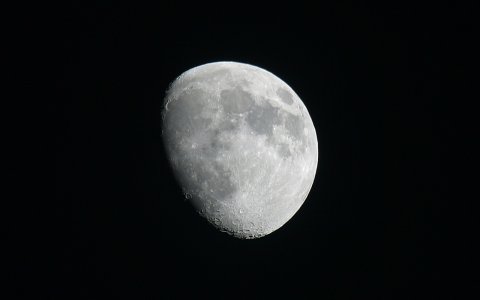
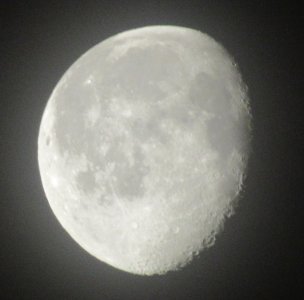
1000017827.jpg
Taken from my front garden with Canon D60, a 70-200 f2.8 lens and a 2x teleconverter, making it 640mm f5,6 in total due to the camera crop factor. A very sturdy tripod was also used.

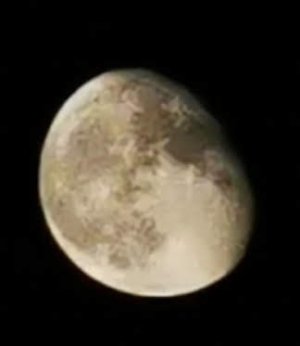
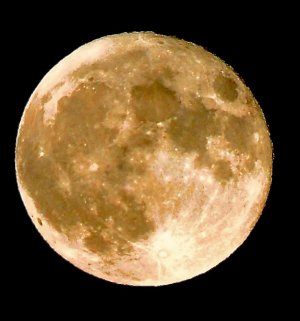
This one was from a mobile phone with teleconverter ....

1000016782.jpg

The phone would have been better if attached firmly to a suitable telescope. Digiscoping is quite a hobby these days, so maybe look at some YouTube coontent on the subject ....


Being old school I used to use a 560mm lens and x2 converter on either film (35mm) or digi (Sony).

"hull down' pics were fun.

In theory it works but in practice it is very, very hard to keep the thing steady, especially on a boat!
 
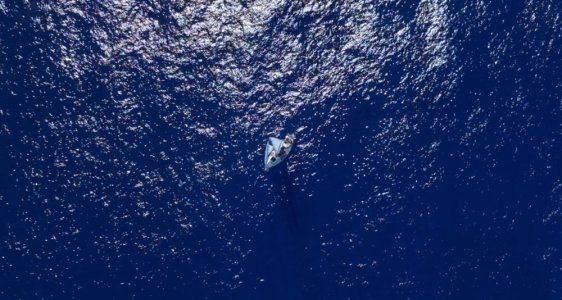
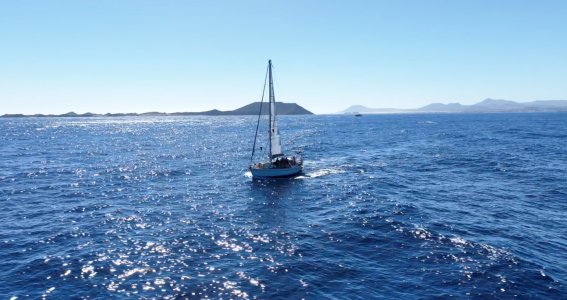
You may have to check local regulations, but wouldn't a drone be a decent option? Instead of big optics, just get the camera closer to the target.
Gives you the option of taking pictures from less common angles as well.
IMG_1587.jpeg
IMG_1588.jpeg
(From a recent drone shoot of us sailing in the Canaries. Shame the winds were super-light that day)
 
Your best bet is probably some sort of super-zoom/bridge camera. The more modern ones have built-in image stabilization so you won't need a tripod. Don't expect good results when photographing distant objects except in the most perfect conditions. Moisture and atmospheric turbulence/heat haze at the surface can make the subject appear blurred.
 
Have a look at secondhand DSLR cameras and lenses you should get quite a decent pair for £1000

I got fed up with lugging a bag with DSLR and lenses around and replaced with a fairly compact Panasonic DMC-TZ235. 20x optical zoom and 40x intelligent zoom. Only drawback is screen rather than viewfinder.
 
I got fed up with lugging a bag with DSLR and lenses around and replaced with a fairly compact Panasonic DMC-TZ235. 20x optical zoom and 40x intelligent zoom. Only drawback is screen rather than viewfinder.
I use both, a Nikon DSLR and a Lumix M43 which fits in my pocket with a couple of lenses but for distance work as the OP requests it's a DSLR every day.
 
Your best bet is probably some sort of super-zoom/bridge camera. The more modern ones have built-in image stabilization so you won't need a tripod. Don't expect good results when photographing distant objects except in the most perfect conditions. Moisture and atmospheric turbulence/heat haze at the surface can make the subject appear blurred.

Yes. A lot are appearing used on Facebook Marketplace. Not huge zooms but some pretty late cameras are now appearing for peanuts, a side effect of the improvement in smart phone photography.

.
 
The obvious answer (I thought) was to buy a hopefully not-too-wallet-busting compact camera that could be securely attached to a decent basic scope...

In my experience 'non wallet busting' compacts aren't too good at distance. I thing they're designed for close to medium range social snapshots. The better compacts soon approach £ four-figures and a DSLR would be cheaper and more versatile.
 
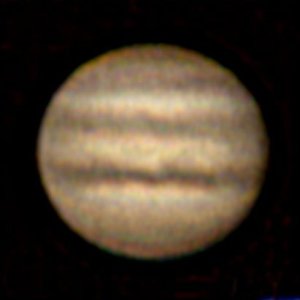
Jupiter.jpg

From my back garden, Nikon D5600 DSLR on a Meade f10 10" LX200 telescope at prime focus.
Just too heavy to be properly portable, getting a good solid tripod makes one hang of a difference, on a light tripod the gentle breeze can shake your camera, the higher the zoom level the more stable you want your mounting.

"Cost effective" lenses can be fine until you are using them at the extreme end of the zoom when a lot of them go soft in focus and contrast, My Sigma 50-500 zoom lens cost a good bit more than the camera but at max zoom it is soft so I tend to avoid using it at that setting.
 
Yes. A lot are appearing used on Facebook Marketplace. Not huge zooms but some pretty late cameras are now appearing for peanuts, a side effect of the improvement in smart phone photography.

.

New ones with a high zoom range (typically about 60x) are available in the £500 range, which is within the OPs budget. Go for one with a viewfinder as framing a shot using the back screen and any significant amount of magnification is frustratingly difficult. Plus with a viewfinder you can actually see what you're pointing at even if the sun has the temerity to come out. I think a lot of modern bridge cameras support saving as RAW, which is an obvious benefit.
 
The greatest challenge, IMO, is the haze and fog. Below is an exceptionally clear day, for most areas, and notice that everything in the distance is gray. I would start by looking at distant objects in a well-supported binocular and deciding if they are clear enough to merit preservation. In my expereince, that is seldom the case.

Stargazing is different. You are not looking through as much air, and the haze is mostly in the lower layers.

And of course, a good tripod. No lens works if there is motion. The longer the lens, the more serious the problem.

img_1588-jpeg.186013
 
Gentlemen, thank you for your responses. I should have predicted I would immediately be at sea in the turbid waters of my ignorance.

Given that for my purposes, my phone (a top Samsung from 2019) captures very fair images for almost any situation at close range, I would be shopping purely for something that can do what the phone (or the phone plus a scope) cannot.

For instance, the five-mile Nab Tower pic in my opening post was caught by pointing the Samsung through my excellent but not extraordinary Bynolyt 50mm binoculars, balanced on a fence post - so, 7x optical, increased (but doubtfully enhanced) by the phone's 10x digital zoom. I realise how inferior digital enlargement of distant objects tends to be. Obviously I am hoping to gain magnification, and precision at high magnification.

Having started the thread last night, I found what seems to me to be the pleasingly single-purpose bridge Nikon P950 and P1000...and I was ready to order one, when I found a video that compared the images captured at up to three nautical miles, by the P1000 and a Samsung S23 Ultra smartphone from last year...


...and it is dazzling how competent (in fact, how superior) the phone is, up to 10x zoom. It's also staggering that any recognisable image is produced at what the phone calls '100x zoom', given that the digital enlargement must be eeking out detail captured by a tiny lens.

The wonderful precision of the Nikon's pictures at 125x zoom is undeniable and certainly does make it tempting, although I'd be in for a bigger-than-intended bill (and need a bigger than expected case) when I've acquired a good tripod. What I wonder is whether I'll need a new phone anyway by next year, and just how good a picture that Samsung S23 might take, looking through my binoculars!

I found comments made in favour of the slightly newer, significantly smaller and less costly Nikon P950 compared with the P1000. Is that likely to be a consequence of the P950's advances (it's only 18 months more recent) or is it only better if one considers that it is smaller and a lot lighter? 83x zoom seems like a lot less power than the P1000's 125x, if all I would be buying it for, is distance shots.

All your thoughts and suggestions are welcome, thank you.
.
 
There isn't much love among serious photographers for the Nikon P1000, but it's appealing to me.

I read somewhere that it's like a huge spotting scope with just a phone camera's sensor...not remotely subtle, but usefully powerful in the right conditions. That's more or less what I've been trying or planning to put together. I know the P1000 is massive and surprisingly inadequate in poor light, but when I'd like to capture something very distant on bright coastal walks, it may be worth the cost and the weight of the whopping tripod I'll need.

The drone idea is a nice alternative, although the cost for something that could have simply flown five miles to the Nab Tower, then back, appears to be at least double what the Nikon costs. :sneaky:

.
 
The drone idea is a nice alternative, although the cost for something that could have simply flown five miles to the Nab Tower, then back, appears to be at least double what the Nikon costs. :sneaky:
5 miles and back seems to be right at the edge of how far you could go with a DJI Mini 4k. Obviously on a calm-ish day. That seems to sell for about 1/3 of a Coolpix P1000.

Seems like a decent option for casual marine photography. DJI claims it can deal with winds up to F5. I'm sort of tempted to upgrade our ancient Mavic Pro, if just for the better image quality.
 
Top