Beginning to think we need a bigger boat

Some very valuable comments, thank you all. I am worried about the growing costs once above 40ft. It feels 36-38ft is a sweet spot for a couple. When we chartered Jeanneau 434 it felt way too big for our needs. Have not thought about Bennateau or Bavaria thunking they are more on the light displacement side. And there is probably nothing wrong with sail drives I just don't feel comfortable with the idea of a hole of that size in the bottom. Happy to be corrected.
 
Some very valuable comments, thank you all. I am worried about the growing costs once above 40ft. It feels 36-38ft is a sweet spot for a couple. When we chartered Jeanneau 434 it felt way too big for our needs. Have not thought about Bennateau or Bavaria thunking they are more on the light displacement side. And there is probably nothing wrong with sail drives I just don't feel comfortable with the idea of a hole of that size in the bottom. Happy to be corrected.
I was worried a bit about that but apart from antifouling I haven’t seen a marked difference as everything on deck is so substantial above 40 feet that nothing seems to break and down below its a bit time consuming maintaining plumbing and electrics but nothing costs much there.
 
When we chartered Jeanneau 434 it felt way too big for our needs. Have not thought about Bennateau
Jeanneau is part of Groupe Beneteau and neither these nor Bavaria are light by modern standards, they were just ahead of the game with manufacturing processes.
 
I was worried a bit about that but apart from antifouling I haven’t seen a marked difference as everything on deck is so substantial above 40 feet that nothing seems to break and down below its a bit time consuming maintaining plumbing and electrics but nothing costs much there.
That has been my experience, so far.
 
Some very valuable comments, thank you all. I am worried about the growing costs once above 40ft. It feels 36-38ft is a sweet spot for a couple. When we chartered Jeanneau 434 it felt way too big for our needs. Have not thought about Bennateau or Bavaria thunking they are more on the light displacement side. And there is probably nothing wrong with sail drives I just don't feel comfortable with the idea of a hole of that size in the bottom. Happy to be corrected.
I wouldn't go too mad on the "heavy" bit. Once you get to about 40ft, the production cruisers are plenty heave enough and the security and comfort come more with the size. Also remember that a heavy boat goes slower.

Were I in your shoes, I would look for something like a Bavaria 38 or 39 (39 is a really nice boat). Bavaria are measured from bow to rudder post, so a 38 is actually about 40ft, and the 39 is actually about 41ft. The one I would go for is a mid-2000's Bavaria 39. Bavaias also don't suffer from osmosis (like 1970s/80/90s boats), as they used a isophalic resin in the gelcoat.
 
Right, so from what you are saying it seems I might be limiting myself with the size then. What about the ballast ratio ? All the newer ones you've mentioned are around 30%. Wouldn't >40% be better?
 
Some very valuable comments, thank you all. I am worried about the growing costs once above 40ft. It feels 36-38ft is a sweet spot for a couple. When we chartered Jeanneau 434 it felt way too big for our needs. Have not thought about Bennateau or Bavaria thunking they are more on the light displacement side. And there is probably nothing wrong with sail drives I just don't feel comfortable with the idea of a hole of that size in the bottom. Happy to be corrected.


If you are prepared to go a little smaller these are designed for the job you have in mind:

HALLBERG-RASSY 34 - sailboatdata

https://www.yachtworld.co.uk/yacht/1991-hallberg--rassy-34-9045368/

As long as you don't mind a tiller or linear galley and decide you can live with a saildrive (which I admit looks a bit dodgy in this example).

Tiller ,lead ballast, high ratio, spray screen, Rassy quality and 30 grand to play with, lovely.

.
 
Right, so from what you are saying it seems I might be limiting myself with the size then. What about the ballast ratio ? All the newer ones you've mentioned are around 30%. Wouldn't >40% be better?
Ballast ratios on their own are misleading. It all depends on how low the ballast is and the lower ratios of modern designs reflect the greater draft and shape of the keel. Simple example is the corsair linked to earlier which has a ballast ratio of 42%, but its draft is only 5' and if you look at the keel most of the weight is high up - the casting is wide at the top than at the bottom.
sailboatdata.com/sailboat/corsair-36-westerly/

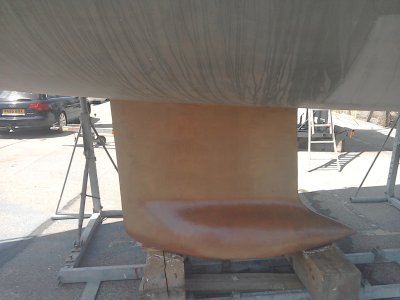
Compare this with most more modern boats of the same size and similar displacement which typically have 6' draft and bulbed keels with the weight at the bottom. Generally speaking the stability is much the same partly because of the lower ballast and partly because the modern hull form has greater form stability. You can get modern boats with lower draft (if this is important) and stability is achieved by large bulbs. Compare the keel shape with the photo of the shallow draft (1.5m) Bavaria 33 I had with the Corsair. Ballast ratio is just under 30%.
 

Attachments

  • IMG_20200623_150038.jpg
    IMG_20200623_150038.jpg
    650.9 KB · Views: 5
Some very valuable comments, thank you all. I am worried about the growing costs once above 40ft. It feels 36-38ft is a sweet spot for a couple. When we chartered Jeanneau 434 it felt way too big for our needs. Have not thought about Bennateau or Bavaria thunking they are more on the light displacement side. And there is probably nothing wrong with sail drives I just don't feel comfortable with the idea of a hole of that size in the bottom. Happy to be corrected.
Been there done that .... had a Bavaria 36 from 1999, was a great boat for a couple, and did reasonably well in 20-30knots of wind, never felt unsafe .... but if you want to go longer and further, which you eventually will, then they are physically too small for all the modern comforts we have come to expect in the 21st century.

I am currently looking for a 40-45ft replacement.

As for saildrives, the hole is plugged with a very heavy-duty diaphram which is very well sealed .... it is thicker and subject to way smaller loads, and less distortion and vibration than a vehicle tyre - but most people will happily drive a family car along a motorway with the expectation that the tyres won't fail unless you run something nasty over - which isn't going to happen to a saildrive diaphram if the installation is as it was when the boat left the factory.

... and shaft drives can and do leak and pop-out - even jamming the rudder in the process.

I have been helping some friends fix their new-to-them boat and have a few questions on how best to proceed.

Their prop shaft slid out of the coupling but luckily the rudder stopped it from falling all the way out of the boat.
Shaft fell out of coupling - Cruisers & Sailing Forums

I would personally say there isn't a statistically valid reason to choose shaft over saildrive or vice-versa, they are just different and the choice is down to personal preference.
 
Ballast ratios on their own are misleading. It all depends on how low the ballast is and the lower ratios of modern designs reflect the greater draft and shape of the keel. Simple example is the corsair linked to earlier which has a ballast ratio of 42%, but its draft is only 5' and if you look at the keel most of the weight is high up - the casting is wide at the top than at the bottom.
sailboatdata.com/sailboat/corsair-36-westerly/

Compare this with most more modern boats of the same size and similar displacement which typically have 6' draft and bulbed keels with the weight at the bottom. Generally speaking the stability is much the same partly because of the lower ballast and partly because the modern hull form has greater form stability. You can get modern boats with lower draft (if this is important) and stability is achieved by large bulbs. Compare the keel shape with the photo of the shallow draft (1.5m) Bavaria 33 I had with the Corsair. Ballast ratio is just under 30%.


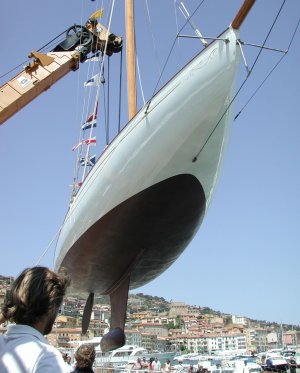
Ah, yes, modern yachts like this one - 125 years old. Owned by Doug Peterson I think?IMG_1777.jpeg
 
Last edited:
I knew there wouldn't be a simple answer ;) Feels like I can scrap my original plan and look at the boats I ignored previously before committing to anything.
 
I wouldn't underestimate the cost / complexity jump when you go up in size from mid 30s to mid 40s, especially when it comes to maintenance.

And then, consider the handling aspect of a 40+ foot boat as a couple. Both in terms of the pure loads on sheets etc when the breeze picks up, and also in berthing etc. You can muscle a 30 something around in a way that you cannot when you get to 40 foot.
There is, I think, a danger in the way a lot of "what boat" threads run, in that the OP will talk about one aspect of another boat that they like, in this case heavy weather "reassurance" but maybe slightly lose sight of how much of ownership actually is that particular aspect.

Think of it this way, a 40 something foot boat might be less stressful when you're out in 25+ kts, but it's more stressful when you approach a marina in that much breeze. Or need to reef etc.

With any boat feature, in this case size, there's no such thing as a free lunch. What you gain in one way, you lose in another.
 
As Tranona says, the ballast ratio is only part of the story. Most modern boats, as well as often having bulbed keels, also gave much higher form buoyancy from their shape than would an old wine glass section hull.

Flaming is quite right too to make the point about loads; like cost, loads increase by cube factors with increasing length. It’s why I consider 35 to 37 ft to be the sweet spot for sailing as a couple.
 
I wouldn't underestimate the cost / complexity jump when you go up in size from mid 30s to mid 40s, especially when it comes to maintenance.

And then, consider the handling aspect of a 40+ foot boat as a couple. Both in terms of the pure loads on sheets etc when the breeze picks up, and also in berthing etc. You can muscle a 30 something around in a way that you cannot when you get to 40 foot.
There is, I think, a danger in the way a lot of "what boat" threads run, in that the OP will talk about one aspect of another boat that they like, in this case heavy weather "reassurance" but maybe slightly lose sight of how much of ownership actually is that particular aspect.

Think of it this way, a 40 something foot boat might be less stressful when you're out in 25+ kts, but it's more stressful when you approach a marina in that much breeze. Or need to reef etc.

With any boat feature, in this case size, there's no such thing as a free lunch. What you gain in one way, you lose in another.
I’m intrigued at the cost jump that you think happens between the two sizes. What sort of things are you thinking about?

Regarding marinas, you are right that you tend to need bigger berths to turn into but you are generally allocated bigger berths - and the wind will turn a bigger boat more slowly.

Reefing is in my experience easier in a larger boat because the gear is sturdier, ropes thicker so easier to handle and most importantly its a much more stable platform in rough seas. More rope to pull through so getting friction and leads right is more important.
 
I’m intrigued at the cost jump that you think happens between the two sizes.
Many marinas, despite charging by the metre, have a stepped charging system so each metre costs more over if the boat is over 12m and so there's a jump in cost. sails, chain and ropes are based on area rather than length and so go up exponentially with size, and similar with paint. These aren't an issue with over 40' specifically but do rise disproportionately with boat length.
But the important one is probably sails and ropes, where the power can make holding a line impossible. While this can be mitigated with tooling like winches, I certainly wouldn't want to take a headsail on a 45' boat down by myself but can easily manage on my 36'. Winch or windlass failure is manageable on a 36' too whereas on a 45' it might be a different story if not fully crewed. Obviously there's no hard cut-off, but bigger boats do come with bigger boat issues.
 
Ah, yes, modern yachts like this one - 125 years old. Owved by Doug Peterson I think?View attachment 169330

Defying all sorts of resistance and prejudice, in 1899 the English designer Charles Sibbick designed, and then built in his yard at Cowes, a yacht according to the Godinet rule (Jauge Nationale Française) for taking part in competitions on the other side of the Channel.

Bona Fide

The fin is a lot longer than it looks in that photo ... BONA FIDE 1890 .... and it also has a relatively wide transom .... imagine if Sibbick had had access to carbon fiber ;) :ROFLMAO: :ROFLMAO: :ROFLMAO:

..... but she was indeed ahead of her time, hence the resistance and prejudice? The idea was right, and she was fast, but there wasn't much in the way of accomodation by modern standards - not your average AWB by a long shot, but Sibbick was right to get the weight down low - but even today there is resistance, over a century later. Just proves how set in their ways the sailing community is.
 
I’m intrigued at the cost jump that you think happens between the two sizes. What sort of things are you thinking about?

Regarding marinas, you are right that you tend to need bigger berths to turn into but you are generally allocated bigger berths - and the wind will turn a bigger boat more slowly.

Reefing is in my experience easier in a larger boat because the gear is sturdier, ropes thicker so easier to handle and most importantly its a much more stable platform in rough seas. More rope to pull through so getting friction and leads right is more important.
Berthing costs. Replacement gear costs - at the most basic loads are bigger and need to move further so ropes are thicker and longer. Anything that wears out will be costlier to replace, decide you want a new fender, it's the bigger more expensive one and you'll need more of them, the new sail is considerably more expensive... Etc etc.

I've helmed a LOT of different boats into marina berths. From 20 something trailer sailers, through 30 footers, 35 foot cruisers, 40 foot cruiser racers, 50 foot charter tubs.... Sure some stand out, but in general the bigger you go, the more stressful it gets. Not because the boat is necessarily harder to predict, or harder to park, but because your get of of jail card gets smaller. In a 30 something foot boat, someone jumping off and pushing on the toerail is often enough to stop an "unplanned interaction with the pontoon". As the boat gets bigger and heavier that gets less possible, and also a lot less advisable. And of course the consequences of mistakes are a lot higher.... I've been around the block, I have every confidence that I can park just about anything so this aspect would not be something I would personally fret over, but I got the impression from the OP that they're a bit newer to this, so may not have had an opportunity to do much parking of larger boats.

Re the reefing, I'm not saying it's hard. But that there's more rope to pull and more load. What might be a bit of pulling and then couple of swings on a winch handle on a 30 footer can be 30s to a minute of grinding on a 40 footer.
 
If you are prepared to go a little smaller these are designed for the job you have in mind:

HALLBERG-RASSY 34 - sailboatdata

https://www.yachtworld.co.uk/yacht/1991-hallberg--rassy-34-9045368/

As long as you don't mind a tiller or linear galley and decide you can live with a saildrive (which I admit looks a bit dodgy in this example).

Tiller ,lead ballast, high ratio, spray screen, Rassy quality and 30 grand to play with, lovely.

.
Only the early 34s had a linear galley. They also had a flat stern without a boarding platform but with a larger lazarette locker. Most from the mid '90s had a conventional layout which I read somewhere corrected an imbalance in the early ones, which still make satisfactory boats. Ballast is around 40% but with next to no form stability, which means that they may heel initially but then are steady and hold their sail better than many other boats of that size. We cruised on ours mostly as a couple but with occasional guests and found the size quite adequate, with the advantage that generous HMs would sometimes slot us into the <10m band for charging.
 
Top