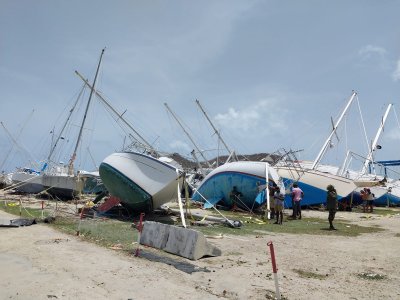
Anybody here know much about travel hoists?

Sea Change

Well-Known Member
Joined
13 Feb 2014
Messages
2,368
Visit site
I'm asking this in relation to the recovery of my boat which fell over during hurricane Beryl.

Can a travel hoist lift and lower each side independently? I am assuming they can, to at least a limited degree, to account for any gradient in the yard and to get boats exactly level.

Would it be reasonable to expect a yard to be able to use its travel hoist to lift and right a fin keel yacht?

Things are starting to get a bit ugly with relations between the boat owners, the yard, and the salvage contractor, so it would be nice to get some objective input on what's technically feasible.

Thanks!
 
I'm asking this in relation to the recovery of my boat which fell over during hurricane Beryl.

Can a travel hoist lift and lower each side independently? I am assuming they can, to at least a limited degree, to account for any gradient in the yard and to get boats exactly level.

Would it be reasonable to expect a yard to be able to use its travel hoist to lift and right a fin keel yacht?......

I'd say a big no to that. You're right about fine adjustment of level, but that's a hull already suspended more-or-less level. Picking up a fallen boat is going to put all the load on one side of the hoist, it isn't designed for that.

Lifting with a crane is the way to go. Even that won't be easy, needs careful planning and extreme care.
 
The short answer is yes it should be possible (I used to own a 64 tone Wise TH) but that assumes that it has four independent hydraulic motors (one for each belt end) a half-decent operator and crew, and long enough belts.

Basically you set the belt eyes on one side lower than on the other side, take up the slack and do a 'Lift followed by roll' either in one go or more likely bit by bit.
HTH.

Edit. Having seen pen berth's post (we crossed over) I would agree with him if the hoist is close to the limit - but otherwise we did it as almost routine in spinning around hulls in mould to make certain jobs easier. Each motor has it own cut out anyway (pressure relief) and, as you become more vertical the loads will balance anyway. All assuming adequate access and manoeuvring space etc.
 
Last edited:
While it will lift the hull it won't be able to get in position with the mast up. Even with the mast off it depends on the span of the hoist frame. Our club hoist has variable span because it is closed ended like this one wisehandling.com/slipwayhoists but would still not be wide enough to get round a mast, or probably a big boat on its side with a keel sticking out.
 
The real answer to your question is it depends on the detailed design

Having designed lifting equipment in my early life I have seen both types.

We have one at our club that is hand powered lifting, and all four hoists can be operated independent, but some electrically may only operate in unison. some hydraulic do have separate lift motors and can if the operating valves can operate independently
 
Travel Lift Specs
150 ton
32 ft (9.75m)beam
16 ft (5.4m)draft
130 ft (40m)length

My boat specs
8.5t
4m beam
1.7m draft
12m length


My mast was already unstepped during the lift out.
The boat was positioned where it is by this same hoist, and no other boats were subsequently placed nearby.
 
While it will lift the hull it won't be able to get in position with the mast up. Even with the mast off it depends on the span of the hoist frame. Our club hoist has variable span because it is closed ended like this one wisehandling.com/slipwayhoists but would still not be wide enough to get round a mast, or probably a big boat on its side with a keel sticking out.
unless the boat is pretty small, Tranona has the issue right. Getting a 4 leg lift astride the boat even without mast is going to be a limiting factor
 
And particularly with a row of boats concertined on their sides. Need a clear space each side for the hoist wheels. That space is now likely occupied by other boats.
In my particular case, these problems do not apply. No mast, no nearby boats, and the hoist is rated to lift over seventeen times the weight of my boat.
 
So you wouldn't be demanding specialist equipment and charging me $9,700US?

Of course they want paid for their work. The time and effort to recover your boat will be more than the price for a lift and launch, plus mast step, by a significant amount, even if they use the travel hoist. You may not like it, but its income for the yard.
 
With the keel attached, would it matter? Is there enough friction in the strops to stop the weight of the keel swinging it vertical regardless of what the lift does?
 
Our local hoist has independent control of each point of hoist and can right boat ... it all depends on skill of operator and setting of slings.

5w6ejhLl.jpg


Here they are using the long slings ... but shortened - they can right a fallen boat.
 
Of course they want paid for their work. The time and effort to recover your boat will be more than the price for a lift and launch, plus mast step, by a significant amount, even if they use the travel hoist. You may not like it, but its income for the yard.
Your 'significant amount' is, in this case, twenty times the ordinary rate.

Anyway, having established that the yard's hoist can almost certainly accomplish this task, I'll explain what's actually going on.

The yard gave a contract to a BVI based salvage company, who immediately mobilised and have sent various vessels, equipment, and personnel down, no doubt at great cost.

Meanwhile, we were all told that all salvage operations would be done by said company, and that we were to contact them for a quote. No work would proceed until we had accepted the quote and paid in full.

The yard is one of the few who accept boats without insurance. Consequently, many of the boats are either entirely or inadequately insured. Every other boat owner I have spoken to says they cannot or will not be paying the quoted prices, which have been calculated on a standard rate of $250/ft (seemingly regardless of the type of boat or its particular circumstances) plus $100/ft for mast removal. There is an additional $50/ft if you want your rig coiled up and kept on deck. So that's a total of $16,000 for a 40ft boat.

Even those who do have insurance are very worried that their insurers will refuse to pay out on these costs, or that the level of costs quoted will make every boat in the yard economically a write off, especially as many have major repairs needed.

My hunch is that the salvage company assumed that everybody's insurance would pay up no matter the cost, because they got away with this previously after Irma and Maria. But times have changed, many insurers exclude named storms and many of us in that yard have no insurance at all.

The yard are now pressuring us to seek, accept, and pay salvage quotes, and warning that any delays will lead to increased prices, because the team is already on site and no doubt clocking up a five figure sum daily just by being there.

It would have been far, far more sensible for the salvage guys to send a few surveyors down first, and then there would have been time for discussions and for insurance companies to respond in a reasonable time. And we could have got quotes from different operators.

My own plan is to sit on my hands until the salvage guys have left, and then ask the yard to lift the boat. I'm in no hurry. We're still at the start of hurricane season and the boat is safer where it is than it would be back on stands.
 
Top