
LONG_KEELER
Well-Known Member
Just another offshore cutting edge yacht. Keel looks solid.
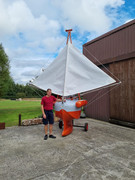



The wheels mght help if you go aground.
Especially if there are pedals.


Is the new keel attachment mechanism discussed in the audio file? I was hoping to see and read a little more. The photos give the impression of absolute minimal design.Well, they pressed on with the project... And I thought that was an X2 I saw in HYS last week...
Farr X2
Although they have said absolutely nothing about the causes of the accident, the details they have released about the "new bib and braces approach" to the keel attachment mechanism tell something of a story.
Not sure I'd be signing up to a fastnet campaign in one of them just yet though.....

Love it, although I hope you is going to be escorted by an offsore lifeboat, like wot I am buildin. The rig looks good for downwind, but the one I'm planning to use is the old Lateen rig, which puts out a lot of sail area if you only have 20ft alloy scaffolding poles donated by a local builder, (Alas he only gave me 2 and will need 4 for the Latten and A frame mast. The OP's sails should have a couple of see through panels in them, as it's always nice to see who is going to run you down, although the bow wave of anything bigger than around 100ft will push a barrel to one side. It will be good to see this boat under sail.Just another offshore cutting edge yacht. Keel looks solid.
Fun though, isn't it? ?I liked this comment in the article:-
“until it’s fully investigated we are at best speculating and at worst mindlessly gossiping”

I've lost count of how many sailors have been killed by bolt on keels. Some idiot designers use stainless steel with a fatigue life of fork all and shear strength of even less. Others fail to follow the well proven, "Belt und Braces", so they don't glass the bolt on job as a back up, or fit sensible backing plates that don't rot.I haven't had the time to listen to the audio file. If you click into the comments on the post with the 3 pictures there are other pictures of the way that they have seated the bolts in the fin, with (if I'm understanding it correctly) some cross bolts. There is also a large backing pad over the bolt holes on the inside of the boat that was not there in the pictures of hull 1. I'm pretty sure that the way the bolts are seated in the fin is new, no evidence of those cross bolts in the earlier pictures.
So from that it's a little hard to tell if they think the bolts pulled out of the fin, or out of the boat....

I do not think I would like the idea of towing a lump of keel under the boat, smashing the hull, as the boat slowed from 30kts to zero in 25 yds.Someone on a recent thread suggested that boats of this type should have a back--up safety chain to keep the keel attached to the boat in the event of an incident like this. Such an adaptation would at least keep the boat upright. If this idea wouldn't work, perhaps offshore racing boats should compulsorily be fitted with hydrostatically released liferafts.
Here we go again, from the usual suspects.I've lost count of how many sailors have been killed by bolt on keels. ……….
Just for the record, it is completely and utterly unacceptable when keels fall off raceboats too.Here we go again, from the usual suspects.
Please supply an itemised and referenced list of accidents involving (a) CRUISING YACHTS (not extreme racers), which have (b) not been modified since build, (c) have lost a bolt on keel, and (d) this resulted in fatalities
I could add (e) not been grounded repeatedly without proper survey and repair, but suspect that is not necessary.
Clearly Chheky Rafiki was a very sad case - but hardly representative as a much used racer / cruiser with a number of exceptional factors and contributory causes (which better not to reopen here).
With millions of boats sailing there are always going to be sad accidents - arguably (though I admit I don’t don’t have accurate statistics, so not presenting as defined fact) more due to drink, dinghies, gybes and booms/ main sheets rather than other factors, with keels way down the bottom of the statistical causes list.
And sadly all sorts of boats have been lost at sea - fortunately only a tiny, indeed minuscule percentage, but lots of boats with long keels included.
OK thanks, I missed the comments. It almost looks as though the bolts pulled out of the fin on the failure and they have now added those cross pins to increase the area of contact. From their responses I understood that the fin pulls into a tapered socket? But that failed last time so there seems little difference.I haven't had the time to listen to the audio file. If you click into the comments on the post with the 3 pictures there are other pictures of the way that they have seated the bolts in the fin, with (if I'm understanding it correctly) some cross bolts. There is also a large backing pad over the bolt holes on the inside of the boat that was not there in the pictures of hull 1. I'm pretty sure that the way the bolts are seated in the fin is new, no evidence of those cross bolts in the earlier pictures.
So from that it's a little hard to tell if they think the bolts pulled out of the fin, or out of the boat....

"Fram" was built by Colin Archer and she was widely reported to be an appalling sea-boat - rolled like a pig! Mind, the design specification was to be able to stand up to anything Arctic Pack Ice could throw at her! But Colin Archer is not the same as "Good sea boat"; it's "Built to do what the designer intended it to".I would have to go to my tomes but I think Teddy hit the rocks and the same with motessier,but Hiscock does mention
a Colinin Archer pitch poling with the loss of one crew
Farr X2R
OK thanks, I missed the comments. It almost looks as though the bolts pulled out of the fin on the failure and they have now added those cross pins to increase the area of contact. From their responses I understood that the fin pulls into a tapered socket? But that failed last time so there seems little difference.
FromI
I've lost count of how many sailors have been killed by bolt on keels. Some idiot designers use stainless steel with a fatigue life of fork all and shear strength of even less. Others fail to follow the well proven, "Belt und Braces", so they don't glass the bolt on job as a back up, or fit sensible backing plates that don't rot.
PS: I do use stainless, but only for non critical jobs. Hot dipped galvanised steel bolts, or expensive stainless purchased directly from the factory shop with all the certificates cross checked is nearly as good, athough it does not shine and looks just like hot dipped steel. I sheared a 12mm stainless bolt when I was hand tightening many moons ago, and I had a duff, (End of rod not annealed), Norseman fitting fatigue crack in only 6 months, so I've a bit of an old timers attitude problem towards shiny stainless.
Your right but difficult to separate the two,apparently the Colin archer lifeboat could tow smaller fishing boats off a leeshore"Fram" was built by Colin Archer and she was widely reported to be an appalling sea-boat - rolled like a pig! Mind, the design specification was to be able to stand up to anything Arctic Pack Ice could throw at her! But Colin Archer is not the same as "Good sea boat"; it's "Built to do what the designer intended it to".
I think the point is that Colin Archer was brilliant at producing boats that met, or over-met the design brief. If Shackleton had had the use of her, they'd all have sailed out of the Weddell Sea; sadly Endurance didn't endure! But if the design brief included stuff like "pressure from sea ice must lift her, not crush her", Archer met that, but incompatible stuff like "sea kindly" and even "sails better than a log" went by the board! I'm pleased that I've seen her at Oslo - but also very pleased that I never had to sail on her!Your right but difficult to separate the two,apparently the Colin archer lifeboat could tow smaller fishing boats off a leeshore


