smithy
Well-Known Member
If you live in anywhere near Inverness why don't you try Gael Force £6.95m for 10mm

Easy. Two ways.
1. Set the first anchor at short scope. Lay the second from a tender, link the rodes near the boat, and then ease back.
2. Set the first anchor. Motor over to the spot for the second and lower it, with a removable extension long enough to reach back to the boat at full scope. Set both. Then shorten up, joint the rodes, remove the extension, and ease back.
It takes as long to explain as it does to do. I have done this MANY times when using my boat as a test platfor for anchor testing (I would drag anchors toward the transom, using the twin anchors to hold the boat and pulling with winches and purchase.

I can see a time when connecting as a single rode is useful and I have done it once. We were in a very busy anchorage. Lots of ribs running about quite close to us prior to the blow arriving. Setting up my rode set anchor meant hauling rode in and getting the anchor set. As we rode to the line it would break surface for quite a long way causing me some concern that a passing dinghy would hit it. I shackled the line through the main chain and let more chain out. This kept more of the rode below the surface apart from in the larger gusts. It wasn't ideal as I couldn't adjust the rode and I have never done it since but it alleviated some concern. It was an unusual situation in an anchorage with way too many boat for my liking but we didn't have many options at the time. In the end the big blow gave us no more than 40kts. Less than predictedThin water and I agree on many things but I'm not very enthusiastic on have two anchors set on one rode. If you have any reason you need to move quickly (a yacht ahead of you is dragging) and or the wind veers and a yacht ahead of you swings over the junction of your two rodes and there will be other situations - then you have problems. Because of the way the two rodes act and then they become one rode there is no way a yacht ahead of you will have any idea how your rodes are interconnected. He may arrive at night and conditions may change during the night.
The second factor is that if you have laid the first rode it is very difficult to lift that rode, its heavy, to allow you to connect a second rode. 6mm might be satisfactory but 8mm is almost impossible. If it were the end of a rode you might lift it - but picking it up in the middle is a Herculean task. I suspect 10mm would be impossible. You can, of course, retreive the first rode until you reach the point at which you want to attach the second rode - but its now getting difficult and a bit of a faff. I'd not want to join 2 rodes from a dinghy.
Anchoring has to be simple and as risk free as possible - or you will not do it.
The only reason to have two rodes is to control or manage a veering wind. Thinwater's solution will not manage veering as well as two rode - as you will still veer on the single/common rode. If you are afraid your anchor will drag in a steady wind - then you have the wrong ground tackle. Change the ground tackle - do not overcomplicate and set a second anchor. If the holding is mud and poor - set your Fortress. If there is weed - move. If you are suffering snatch loads, deploy more chain or use a better snubber. If there is no room aft to deploy more chain - again set a better snubber, from the transom along the side deck - and then you do not need to drop back as you have a deck length snubber - at least.
If you deploy two separate rodes you can deploy one rode conventionally using your windlass. The yacht is now secure. You can leave your yacht safely and deploy your second rode from a dinghy, easier if the second anchor is aluminium and the rode mixed (so lighter). The two rodes can be retrieved from the yacht simply by motoring forward slowly retrieving all chain and simultaneously taking in the second rode. You do not need to worry about disconnecting the two rode - they do not join - and you can lift the primary anchor keeping the second rode cleated to a bow cleat - sufficient slack but it does not foul the prop.
It all has to be simple.
Jonathan
I can see a time when connecting as a single rode is useful and I have done it once. We were in a very busy anchorage. Lots of ribs running about quite close to us prior to the blow arriving. Setting up my rode set anchor meant hauling rode in and getting the anchor set. As we rode to the line it would break surface for quite a long way causing me some concern that a passing dinghy would hit it. I shackled the line through the main chain and let more chain out. This kept more of the rode below the surface apart from in the larger gusts. It wasn't ideal as I couldn't adjust the rode and I have never done it since but it alleviated some concern. It was an unusual situation in an anchorage with way too many boat for my liking but we didn't have many options at the time. In the end the big blow gave us no more than 40kts. Less than predicted

If I was buying chain now in anticipation of owning the boat for 20 years I would most definitely be buying Cromox, assuming I had the spare cash.At £700 for galvanising after 5 years why not consider the stainless steel chains available? What would the payback be?
I don't nor didn't have the foresight to look forward to owning the same yacht for 20 years, we are now at 20+ years. I certainly would not have had the foresight to option 6mm Cromox and might be regretting having bought 8mm when 6mm would had been more than adequate.If I was buying chain now in anticipation of owning the boat for 20 years I would most definitely be buying Cromox, assuming I had the spare cash.
Yes, it's always easier with hindsight. Having always used 8 mm galvanised since buying the boat in 1994 I have certainly spent the cost of Cromox on replacement chain and regalvanising. At that time the suggestion of going to 6 mm would have been unthinkable, even though at grade 50 or 60 it would have been sufficient. I have bought two windlasses in that time, so not really an issue.I don't nor didn't have the foresight to look forward to owning the same yacht for 20 years, we are now at 20+ years. I certainly would not have had the foresight to option 6mm Cromox and might be regretting having bought 8mm when 6mm would had been more than adequate.
I'd want to match up chain and anchor, maybe even windlass (Lighthouse?) - which increases the cost.
Jonathan
If you can stomach the price it will outlive you. If you can down size it will obviously be cheaper but you will need a new windlass or new gypsy - and a decent snubber.Very useful. I'm about to do a fitout, I'll buy Cromox chain.
Yes, it's always easier with hindsight. Having always used 8 mm galvanised since buying the boat in 1994 I have certainly spent the cost of Cromox on replacement chain and regalvanising. At that time the suggestion of going to 6 mm would have been unthinkable, even though at grade 50 or 60 it would have been sufficient. I have bought two windlasses in that time, so not really an issue.
Separate matter, we just had Izi on board bringing me a Boomerang. We sail tomorrow, so looking forward to trying it. Very interesting man.
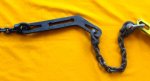
 . It depends where your windlass is and how long your anchor shank might be - but more links the better. When the boomerang self rights the anchor - the anchor then swings, like a pendulum, more links gives the anchor time to settle down. When you have connected it all up its worth sitting on the bow and retrieving the anchor by hand, just drop the anchor a few metres and then haul up - and you will see how the boomerang works (and find out if you have connected it properly). You and I have the same windlass - which is so fast on retrieval that the self righting is so quick you cannot see what is happening. I made a vid of the boomerang in action and had to make it with hand retrieval so that the concept could actually be seen. You should have borrowed a Viking anchor - they are really good - and you could fit one (unlike us where the roll bar denies application). His snubber hook is also a neat piece of design and the bridle plate - even better
Yes, he talked us through all the development stages, although no detail on the latest anchor. Very interesting discussion and he is clearly grateful for your considerable input.I'll be interested in your comment on the Boomerang, short arm forward. Its designed round use of 2 x 3/8th" shackles (bow through the Boomerang slot) so should fit your 8mm chain with ease. I modified the design for my Boomerang and use Omega links - which are lower profile that 3/8th" shackles. Finding Omegas that are galvanised is a challenge.
View attachment 142748
A few links, an odd number, between boomerang and anchor is recommended - some very intelligent person made that recommendation (nothing to do with me).
He is interesting and good company - its fascinating that it took someone with out an investment in anchors to realise the savings in weight that could be made by use of HT steels. The move he has made and is making should have been done by Manson or Lewmar. The Viking anchor is almost as light as a Fortress. He had the ideas -and enough confidence to take the concept to market. He has two battles - one overcoming the idea that anchors have to be heavy and two Putin. However Putin forced a re-think on location and this might result in a better anchor (I'm reticent on this latter - but it should be another eye opener).
Jonathan
I'm not into brownie points - but thanks. I wish to have had the opportunity to talk with like minded people - ground tackle is not very popular as a topic here. Its a long way to go from here to the Med for and evening chin wag.Yes, he talked us through all the development stages, although no detail on the latest anchor. Very interesting discussion and he is clearly grateful for your considerable input.
Vyv,Yes, it's always easier with hindsight. Having always used 8 mm galvanised since buying the boat in 1994 I have certainly spent the cost of Cromox on replacement chain and regalvanising. At that time the suggestion of going to 6 mm would have been unthinkable, even though at grade 50 or 60 it would have been sufficient. I have bought two windlasses in that time, so not really an issue.
Separate matter, we just had Izi on board bringing me a Boomerang. We sail tomorrow, so looking forward to trying it. Very interesting man.
Yes this possible glitch had occurred to me. We are on passage at the moment aiming to round Cape Malea while the lighter weather lasts. After that we have time to experiment.Vyv,
If I recall correctly you have a slotted bow roller. It depends on the size of the slot, width and depth, and thickness of the plate from which the boomerang is made but the Boomerang may fall into the slot and not articulate, roll over, as designed. I simply don't have a fix for this. If you make the Boomerang from thicker plate the Boomerang then becomes more of a hinderance to the setting of the anchor.
I forgot to mention when the Boomerang is installed correctly and under tension it should lie vertically, not on its side. When you set your anchor it will then lie in the same orientation and be forced into the seabed in a vertical aspect (offering a little extra resistance to veering).
Jonathan
I hope you are not disappointed.
Jonathan

Vyv,
If I recall correctly you have a slotted bow roller. It depends on the size of the slot, width and depth, and thickness of the plate from which the boomerang is made but the Boomerang may fall into the slot and not articulate, roll over, as designed. I simply don't have a fix for this. If you make the Boomerang from thicker plate the Boomerang then becomes more of a hinderance to the setting of the anchor.
I forgot to mention when the Boomerang is installed correctly and under tension it should lie vertically, not on its side. When you set your anchor it will then lie in the same orientation and be forced into the seabed in a vertical aspect (offering a little extra resistance to veering).
Jonathan
I hope you are not disappointed.
Jonathan


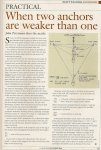
Yup, obvious school trig. Also in every rigging handbook.
