Neeves
Well-Known Member
Prompted by a recent thread.
The reason to over specify some items of kit is simply because the 'expert' does not know how the kit might be used. Commonly the question being asked implies an absence and a thirst for knowledge - all very healthy. There is thus a tendency to treat the recipient of advise, especially when you know no other, as less cautious than oneself.
I would not suggest people use G40 chain rather than G30 (unless there is a negligible difference in price) as over the last decade G30, correctly sized seems perfectly adequate - but I do recommend G209a shackles - because shackles do fail. The Crosby G209a shackles are grossly over specified (at 10t for a 3/8th" shackle instead of 6t for a 'standard" shackle) but there is nothing 'in between' and the 6t shackles do fail.
You will find and see lots of errors, some are amusing - and might introduce some levity, and some are serious.
I offer 2 here - now there is no intention to troll the manufacturers of the equipment - sadly if you are going to show errors you have to show the kit.
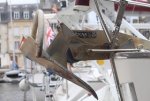
The first one is of a Rocna on a British yacht in Hornfleur. There appeared to be some sort of rally of UK boats, maybe a crossing en masse, and I particularly picked out the offending example. I spoke to the owner and he advised the toe had been caught under something large and unyielding, he tightened up his rode - but then he suffered a big swell (maybe from a passing ferry) and the snatch load went from benign to catastrophic. Frankly I would have said the damage was impossible and that the toe of a Rocna was indestructible. He also bent his shackles, I was surprised he did not bend his bow roller. He did retreive his anchor, obviously, and claimed it worked as well now as previous.
It merits note that Rocna have been Proof Tested, and the test is conducted in much the same way as he retrieved his anchor - and it passed Proof Testing. The snatch load must have been huge (much more than a snatch load at anchor).
I actually have a couple more pictures of 'bent' anchors, Bugel - but I cannot decide if they are made bent or were bent in use. Bugel come in many shapes and forms.
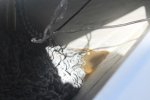
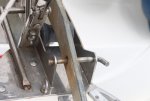
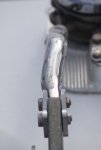
The second image was taken in the Med, in Italy. The vessel is an Italian government work boat, fisheries I recall. One might assume a modicum of knowledge and some professinalism. They had obviously struggled to attach the Oscalutti bent link (anchor righter) to the anchor and had come up with a novel and complicated answer (they had to make up the 2 plates). They really found an answer that Vyv has been endeavouring to remove here - Vyv recommends use of a few links of chain between swivel and anchor. The Oacaluttie device did not like the answer - and it has bent. I did not bother to introduce them to my Boomerang - you cannot tell some experts anything (arrogant lot . )
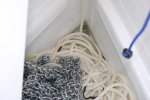
We had had the bitter and of our, then 8mm, rode attached inside our locker with a stainless steel shackle - attached to a 10mm 'U' bolt. We were anchoring in 10m of water. The solenoid locked open and all the rode auto deployed - there was a resounding bang from the chain locker when we reached the rode end and the chain monentarily stopped and the end rushed over the bow roller like a snake going down a rabbit hole. It did cross my mind to catch the tail of the disappearing snake - but I was fortunately - too slow. The stainless shackle had simply failed and was a bit undersized, at 8mm. We had 50m of chain and an anchor neatly deployed in a long line across a muddy seabed 10m deep. We did have a spare rode, which we deployed, with anchor and then spent the rest of the next day trawling across the anchorage with a 'wire' grapnel (common and called reef anchors in Oz). . We caught the rode and then discovered we could not lift it from the dinghy - 2 people in a 3 man dinghy and catching the middle of 50m of 8mm chain - the dinghy would sink . We had not had the presence of mind to think this through. We had to drop our 'find' with grapnel attached and rely on the, luckily, floating line, return to the cat, lift our second anchor rode, motor over to the the primary rode, or the floating line - and retrieve, a winch initially and then by hand - until we could feed the bitter end through the windlass.
The bitter end is now secured with rope, multiple loops through the last few links.
Now I have never considered myself an expert (in anything) it would be arrogant to make such a claim. Most knowledge is but a fraction of what is available - we are all (I hope) constantly learning. But you cannot account for 'errors', in our case stupidity. So wherever possible you over explain and over specify (hoping the over specification is not financially onerous).
If anyone would like to add to the slight levity of the thread - you are most welcome
Take care, stay safe
Jonathan
The reason to over specify some items of kit is simply because the 'expert' does not know how the kit might be used. Commonly the question being asked implies an absence and a thirst for knowledge - all very healthy. There is thus a tendency to treat the recipient of advise, especially when you know no other, as less cautious than oneself.
I would not suggest people use G40 chain rather than G30 (unless there is a negligible difference in price) as over the last decade G30, correctly sized seems perfectly adequate - but I do recommend G209a shackles - because shackles do fail. The Crosby G209a shackles are grossly over specified (at 10t for a 3/8th" shackle instead of 6t for a 'standard" shackle) but there is nothing 'in between' and the 6t shackles do fail.
You will find and see lots of errors, some are amusing - and might introduce some levity, and some are serious.
I offer 2 here - now there is no intention to troll the manufacturers of the equipment - sadly if you are going to show errors you have to show the kit.
The first one is of a Rocna on a British yacht in Hornfleur. There appeared to be some sort of rally of UK boats, maybe a crossing en masse, and I particularly picked out the offending example. I spoke to the owner and he advised the toe had been caught under something large and unyielding, he tightened up his rode - but then he suffered a big swell (maybe from a passing ferry) and the snatch load went from benign to catastrophic. Frankly I would have said the damage was impossible and that the toe of a Rocna was indestructible. He also bent his shackles, I was surprised he did not bend his bow roller. He did retreive his anchor, obviously, and claimed it worked as well now as previous.
It merits note that Rocna have been Proof Tested, and the test is conducted in much the same way as he retrieved his anchor - and it passed Proof Testing. The snatch load must have been huge (much more than a snatch load at anchor).
I actually have a couple more pictures of 'bent' anchors, Bugel - but I cannot decide if they are made bent or were bent in use. Bugel come in many shapes and forms.
The second image was taken in the Med, in Italy. The vessel is an Italian government work boat, fisheries I recall. One might assume a modicum of knowledge and some professinalism. They had obviously struggled to attach the Oscalutti bent link (anchor righter) to the anchor and had come up with a novel and complicated answer (they had to make up the 2 plates). They really found an answer that Vyv has been endeavouring to remove here - Vyv recommends use of a few links of chain between swivel and anchor. The Oacaluttie device did not like the answer - and it has bent. I did not bother to introduce them to my Boomerang - you cannot tell some experts anything
(arrogant lot . )We had had the bitter and of our, then 8mm, rode attached inside our locker with a stainless steel shackle - attached to a 10mm 'U' bolt. We were anchoring in 10m of water. The solenoid locked open and all the rode auto deployed - there was a resounding bang from the chain locker when we reached the rode end and the chain monentarily stopped and the end rushed over the bow roller like a snake going down a rabbit hole. It did cross my mind to catch the tail of the disappearing snake - but I was fortunately - too slow. The stainless shackle had simply failed and was a bit undersized, at 8mm. We had 50m of chain and an anchor neatly deployed in a long line across a muddy seabed 10m deep. We did have a spare rode, which we deployed, with anchor and then spent the rest of the next day trawling across the anchorage with a 'wire' grapnel (common and called reef anchors in Oz). . We caught the rode and then discovered we could not lift it from the dinghy - 2 people in a 3 man dinghy and catching the middle of 50m of 8mm chain - the dinghy would sink
. We had not had the presence of mind to think this through. We had to drop our 'find' with grapnel attached and rely on the, luckily, floating line, return to the cat, lift our second anchor rode, motor over to the the primary rode, or the floating line - and retrieve, a winch initially and then by hand - until we could feed the bitter end through the windlass.The bitter end is now secured with rope, multiple loops through the last few links.
Now I have never considered myself an expert (in anything) it would be arrogant to make such a claim. Most knowledge is but a fraction of what is available - we are all (I hope) constantly learning. But you cannot account for 'errors', in our case stupidity. So wherever possible you over explain and over specify (hoping the over specification is not financially onerous).
If anyone would like to add to the slight levity of the thread - you are most welcome
Take care, stay safe
Jonathan