Anchoring accidents

It came up on another thread - there is always an issue of how to secure an anchor at sea, stop it wobbling on the bow roller or in the extreme ensure that if the windlass clutch slips you do not deploy you anchor and rode (not secured at the bitter end) in a convenient 1,000m deep bit of seabed - where no amount of trawling with an Australian reef anchor will offer any chance of success.

There are lots of ways to secure - I really cannot suggest this is very sensible. Peter Smith went out of his way to design a bullet proof shank - and then an owner drills a big hole in it. Just an old bit of rope tied to the shackle and, say, a bow horn cleat would have been as safe and more sensible.

View attachment 120559

Stay safe, take care

Jonathan

Such an arrangement came with my boat. 60lbs CQR with just such a hole in the shank… nice drop nose pin…?
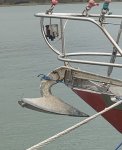
0BABF755-118E-4E93-9CF0-8C6D07E57D44.jpeg
 
There are lots of ways to secure - I really cannot suggest this is very sensible. Peter Smith went out of his way to design a bullet proof shank - and then an owner drills a big hole in it. Just an old bit of rope tied to the shackle and, say, a bow horn cleat would have been as safe and more sensible.
My CQR has a similar hole. I don't use it, partly because it's in the wrong place for me (secondhand anchor) and partly because it looks like a good way of knocking off the galvanising. I had mine re-dipped when I got it, and the only area with significant rust was around that hole.
 
It's not a matter of being the thread police; its worry that people might take potentially dangerous advice from enthusiastic but unqualified amateurs.


In the main we are all enthusiastic, but unqualified amateurs are you proposing that you are qualified to police the rest of us with your comments?

If that is the case we had all better stop offering advice.

Ink
 
In the main we are all enthusiastic, but unqualified amateurs are you proposing that you are qualified to police the rest of us with your comments?
Police? Good heavens no, and anyway how could I possibly do that? I may just ask the occasional question when advice or its evidential basis are unclear to me. As of course you are welcome to do whenever anything I write seems unclear. I don't feel "disrespected" or flounce off in a huff when people ask me questions or point out my mistakes.

Are you familiar with the Dunning-Kruger effect, by the way? It seems particularly germane to anchor threads.
 
Are you familiar with the Dunning-Kruger effect, by the way? It seems particularly germane to anchor threads.

It may indeed be, but nonetheless I trust your reference to it is tongue-in-cheek! The Wikipedia introduction contains the revealing snippet: "Outside psychology, non-professionals often invoke the Dunning-Kruger effect to insult people", and the original paper was 'awarded' the coveted ig-nobel prize...
 
It may indeed be, but nonetheless I trust your reference to it is tongue-in-cheek!
It is unfortunately the case that the untrained often don't realise how hard it is to read technical documents correctly. It's well known, for example, that what can appear to have one clear meaning to a lay person can have quite another one to a lawyer who understands the context and legal language. Similarly, people with no technical training often simply do not realize the extent of their misunderstanding when they read engineering papers and reports. Which is fine, until they try to use their "understanding" to advise others. See also: "housemaid's knee" (note boating relevance).

As a general guide, the better educated someone is in a field the more they know their own limitations. For example, I spent years of my life doing tensile testing (and designing the equipment needed to do it) which is why I wouldn't just slap a load cell on an anchor rode and presume that my results were reliable, meaningful or useful. Professor Knox, on the other hand, knew what he was doing.

As an inverse example, back in the days when Rocnas were new and exciting there was one enthusiastic proponent of them here whose prolific postings on the subject ultimately revealed that he thought "yield stress" and "ultimate tensile strength" were the same thing, causing himself and others no end of confusion.

The Wikipedia introduction contains the revealing snippet: "Outside psychology, non-professionals often invoke the Dunning-Kruger effect to insult people", and the original paper was 'awarded' the coveted ig-nobel prize...
The problem with Dunning-Kruger is that like most of psychology (and here I go, Dunning-Krugering myself ...) it's a statement of the plain bleedin' obvious backed up by very poor experimental design. Nevertheless it's a useful name for a phenomenon which many of us can recognise.
 
Last edited:
But getting back on track.

The three expensive items in the anchoring wardrobe are the windlass (when did you last service it? - yes I have the pictures - but they will come later), the chain and the anchor. Servicing a windlass is relatively easy - but can be a real faff.

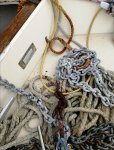
When did you last empty the chain or anchor locker to find what might be lurking at the bottom.

These are two anchor lockers, not unique, that were in, or part of, yachts at the Sydney Boat show a couple of years ago (I'm fair and being critical in home waters). One looks to have been newly commissioned (from the white of the rope and the shiny chain) the other must be a recent yacht that an owner has leant to the importer/distributor specifically for the show.

If the locker was more heavily, or differently laden - would you notice the water in the bottom? If its a new yacht you might, as owner of a yacht importing business want, to instil faith in your expertise (and have the rope neatly coiled so that it is not a source of water and rather than continuously wet and allowing the chain to sit, festering, on top of a sodden mattress).

People complain about the life of chain - I'm not entirely surprised that chain life is something about which to whinge - though whether the complaints are fair - that's a different question

The inattention to detail is appalling, in my view - even a less than gifted amateur could do better. :)


View attachment 120547


View attachment 120548

Take care, stay safe

Jonathan
Here's what I found in mine a few months ago.

Screenshot_20210813_165817.jpg
Cut off the last 1.5 metres and resecured the bitter end. Unblocked the locker drains and put in a support to keep the chain off the base. And when practical I hose the locker out with fresh water. The spare end is keeping the lid on the rabbit hutch.......

I wouldn't have done that if I hadn't read these threads.
 
Supertramp

Its not entirely clear from your picture but the 'white' on your chain looks like white rust which is Zinc Hydroxide (google 'white rust'). Its 'the same' as rust except its the zinc dissolving away rather than the steel. The causes are the same - damp and the damp is exascerbated by the rope (despite what JD suggests is good practice).

I'm not clear if white rust actually develops from the galvanised alloy layer, which are Fe/Zn alloys or only from the pure zinc on the 'outside' of the links. But when you buy chain it has pure zinc on the outside and even if its only the pure zinc converting to a soft white powder you are losing some of the coating you bought. Most will know that when chain is galvanised the chain at removal from the zinc bath is skin or spun to remove zinc, it stops the chain fusing into one mass and reduces the amount of pure zinc coating. Pure zinc is soft - and wears, or abrades, quite quickly - but whilst ist is there it is part of the protective coating. Removing the zinc reduces the costs to the galvaniser - and fresh zinc does make the chain look pretty and shiny

A perforated base will allow the chain to 'drip dry', washing the chain with fresh water will remove the salt and separating the rope from the chain will separate the damp rope from the chain. Airing the locker will allow the washed chain to dry. I would not follow JDs practice - as that will result in Supertramps example. But if you use little chain or are rich - maybe does not matter

I note the comment on not coiling rope - keep it stuffed in a milk crate - better than stuffing in a bag as the bag will also be a source of dampness. Personally we coil rope as when we deploy our second rode which is mixed we have never suffered an issue with coiled rope. After use I religiously coil the rope round the inside perimeter of the milk crate and then drop the chain not the hole in the doughnut created by the coil. The end of the chain and shackle are always on the top. If we are deploying from a dinghy I can pick the complete rode up, carry down the side deck and locate in the aft of the dinghy - try do that with a loose mass of unclosed rope. When deploying the rope flows freely. It does need to be coiled neatly from the outset.

The other lesson, from earlier photos - check the drain hole. If you have a puddle of water - it will evaporate and then condense on the locker 'roof' and walls and provide a constant flow of water over your chain.
 
It is unfortunately the case that the untrained often don't realise how hard it is to read technical documents correctly. It's well known, for example, that what can appear to have one clear meaning to a lay person can have quite another one to a lawyer who understands the context and legal language. Similarly, people with no technical training often simply do not realize the extent of their misunderstanding when they read engineering papers and reports. Which is fine, until they try to use their "understanding" to advise others. See also: "housemaid's knee" (note boating relevance).

As a general guide, the better educated someone is in a field the more they know their own limitations. For example, I spent years of my life doing tensile testing (and designing the equipment needed to do it) which is why I wouldn't just slap a load cell on an anchor rode and presume that my results were reliable, meaningful or useful. Professor Knox, on the other hand, knew what he was doing.

As an inverse example, back in the days when Rocnas were new and exciting there was one enthusiastic proponent of them here whose prolific postings on the subject ultimately revealed that he thought "yield stress" and "ultimate tensile strength" were the same thing, causing himself and others no end of confusion.


The problem with Dunning-Kruger is that like most of psychology (and here I go, Dunning-Krugering myself ...) it's a statement of the plain bleedin' obvious backed up by very poor experimental design. Nevertheless it's a useful name for a phenomenon which many of us can recognise.

Two factors

I learnt my use of a load cell having been invited to spectate a Classification Society conducting holding capacity tests in Australia. If the usage is good enough for the likes of RINA or Lloyds its good enough for me. My invitation to spectate was misleading and in the end I was actually there as labour, pairs of hands. I was also privy to all the test protocols when Fortress tested in Chesapeake Bay - and knew exactly how the tests were conducted and how the data collected - and was give access to all the raw data. I think JDs implication of his expertise are misplaced - if you are so good - get out there and do it. My testing of chain, shackles etc are conducted to standard industry practice by NATA approved facilities.

Prof Knox was not quite the hero you mention. He derived hold data using different rodes, with textiles of different elasticities, which he documented (that's how I know he used different textiles). He then used these results to derive scaling factors for a range of anchors. The results are sadly, but not unexpectedly - useless and grossly misleading.

John Knox and I exchanged notes and tests results and when we tested dog-bone things - we came to the identical results - so if the suggestion is that Neeves does not know how to use a load cell - then neither did the Professor (nor Classification Societies).

I have mentioned before the constant criticism is uncalled for and misplaced. If you don't like something but 'know' the answer - forget the innuendo - make recommendations - otherwise its all talk and no trousers.

Jonathan
 
How to anchor, according to Eric Hiscock in 1947…


Hiscock is assuming that we are anchoring under sail, without using an engine, and that we are anchoring with either a fisherman or a CQR. He devotes a couple of pages to mooring, ie lying to two anchors with a single chain or warp coming aboard, because with a Fisherman there is a real risk of the chain or warp wrapping itself round the upper fluke and tripping the anchor in such a way that you have to recover your anchor and start again - just veering more chain or warp won’t help. Don’t ask me how I know this.

His advice about dropping plenty of chain straight away when anchoring with sternway, using a CQR, is correct and is what I have done for decades when anchoring with a CQR. You need to get the anchor to bite, and this is a good way to do that.
 
Last edited:
Here we go again. :unsure:
Indeed so. I am somewhat surprised that the OP has apparently not been cautioned by the Mods about his use of the dog-whistle term "expert".

Richard
Think of it as weary recognition rather than negativity. "Here we go again", basically.

I wonder how these forum members are justifying their original posts and hope they may re-consider not bullying members in the future who have queries about anchors. I note that JD cannot resist expressing his so superior knowledge - without suggesting how things can be done better - basically he continues his negativity and continues to act as the Forum's thought police.

Despite the bullies - the thread seems to enjoy some interest

and yes - I hope some members are squirming and are taking note.

I'll have more pictures later.

Jonathan
 
How to anchor, according to Eric Hiscock in 1947:


I'm not too sure about running ones yacht ashore :)

Different times, different practices.

Strangely - when we are on passage and seek shelter due to an adverse wind we will anchor and my next task is to take our spare rode and a spare anchor (appropriate for the seabed) out of the locker and store ready on our foredeck - just in case. Maybe a modern interpretation of Hiscock - having the anchor ready.

Our practice will undoubtedly initiate comments about our using anchors that are too small or a lack of confidence. To me its good seamanship - I don't know whether there is an old beer can about to be collected by the toe of my anchor (neither do you) and if it collects the beer can/water logged piece of wood/old towel/bit of seaweed,/oyster shell - your anchor will drag. Mind you after years of doing this - we have never used the second anchor for this reason - but have deployed it to reduce veering, by anchoring in a 'V'.

Jonathan
 
I edited my post and added some comments of my own to Hiscock. Running ashore rather than have an expensive collision seems like good advice in places where the banks are mud or sand. I’ve only done it once - to turn short round in Faversham where the creek is very narrow and steep to, I put the bows ashore and let the tide do the work.

I started sailing and cruising in engineless boats and carried on in boats that had feeble and unreliable engines and it’s been my long habit to keep a kedge, originally a Fisherman, latterly a CQR*, lashed on deck near the mast with its warp coiled and stopped to the shank and the bitter end led round the bow roller and belayed. It’s much quicker to run up the deck, cut the stopping and lashings and kick it over the side than to faff around trying to drop the bower anchor. This has got me out of trouble a couple of times, and I have been staggered at just how much load you can put on a CQR kedge and warp…

* YMMV. Whatever you have.
 
I thought I might use one of JDs innuendos to illustrate a point.

He referred to someone who did not know Yield from specification or Ultimate Tensile Strength, I think he might have been referring to young Craig Smith, son of Peter Smith (who developed the Rocna and more recently, Vulcan). Craig was the mouth piece for Rocna in the early days - so a professional (???). If young Craig was referring to Bis 80, I'm too young to remember the early days, then yield of Bis 80 and tensile strength are very, very similar., 620 MPa vs 720 MPa. For mild steel the differences are greater 370 MPa vs 440 MPa

More recently Mantus introduced their anchor with a mild steel shank, it bent, they replaced it, free of charge, with a shank made from a high tensile steel. But after Rocna you would not think anyone would dare to use mild steel, again.

The Mantus has its crown (the interface of shank and fluke) in the same location as Rocna. Mantus is an unballasted fluke anchor. All unballasted fluke anchors have their crown at the heel (Danforth, Fortress, Brittany, Bugel, SARCA, Knox, Bruce). The result is Mantus sets shallow and has half the hold of a Rocna (a ballasted anchor - along with Delta, Excel, CQR). Mantus has the same hold as a Delta.

JD is critical of pseudo experts - I'm wondering who actually has expertise in anchors and anchor design. Yes, we are amateurs, gifted or not - and the anchor makers........? People quite happily buy anchors from - professionals (?), I wonder why this criticism of the gifted amateurs - is there some secret group of anchor professionals skulking away upset they are unrecognised (but obviously known to JD - who wants all advice to come from the professionals).

And who conducted the checks on Rocna, who underlined the weakness of the Mantus design - the amateurs, gifted or not. But not JD.

Peter Bruce' formal training was as an aeronautical engineer, an unlikely training to become one of the most successful anchor makers. He was qualified as an aeronautical engineer, a professional?

Yes - I get tired of the constant criticism, the back biting, the 'I'm superior to thou' attitude - save it for your students - people here, collectively, know as much about anchoring as anyone. There are no professionals in anchors and anchoring (or not very evident (with apologies to Lewmar) - except collectively and if we share - we are maybe - as professional as you can get.

Jonathan
 
If we were to have the 'necessary' accident this is how we cope in terms of anchoring

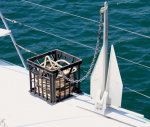
This is how we store our spare rode, 40m x 12mm 3 ply and 15m of 6mm HT chain.

I coil the rode religiously inside the perimeter and then drop the chain into the hole in the centre with the shackle on top. The crate sits in our bridge deck locker where we can make 2 stacks 3 crates high. Here were anchored over sand - making the Fortress an ideal choice. This is our FX 23, since retired, For those with sharp eyes the anchor is not yet attached to the lifelines.

Storing like this in milk crate makes it easy to move to the dinghy or simply deploy from the bow. Coiling the rope neatly is a bit of a faff - but what else do you do on a 100nm passage with no emergency to cope with.


IMG_0349.jpeg

Jonathan
 
I used to be asked by local owners for help with windlass, less so since the pandemic. My help is usually moral support rather than anything sophisticated (that'll please JD!). It not my yacht, nor windlass - and more importunely not my money - so I just offer advice and willing ness to wield my angle grinder.

I'm a quick learner and always now go equiped with an angle grinder. Too many windlass are made with aluminium components and the only means of removal is to chop them out (that's chop up the windlass, not the yacht) - as no-one ever appears to have Duralac handy when the installation, or servicing, was conducted.

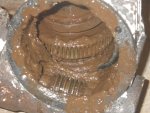
This is one such case and illustrates what happened when you don't service your windlass.

The lubrication in this gear box appeared to be mud, rust and seawater, I did not taste it to check if it was freshwater :).


IMGP4771.jpeg

I did ask the owner who had owned the windlass for 15 years when it was last serviced. He looked at me blankly - it had never been serviced.

What was amazing was that before we got to work with the angle grinder - the windlass worked 'perfectly' - but for how much longer......

I am constantly amazed at how much abuse a windlass can endure - and continue to work. All credit to windlass manufacturers.

Servicing should be easy - except most windlass appear to be installed as conveniently as possible for the installer with no thought for the owner. The major service points are the gear box, check and change the oil and grease the shaft - remembering to have Duralac handy for when you re-assmeble. Common service frequency is 12 months. But also check the electric connectors - there is a lot of vibration and the nuts securing the swaged terminals can loosen (been there, done that).

For those looking for a new windlass - Maxwell offer, here in Oz and Nz, a 24/365 hotline (well sort of hotline) send them an email and it will be attended to, whenever. They know their windlass are used at weekends and holidays (here - including Xmas) and someone is tasked to be on duty - I assume they have a roster. I don't know if you get the same service through Vetus. We used it once (turned out to be a loose power cable) and someone who bought a new windlass when they replaced 8mm G30 with 'my' High Tensile 6mm chain called them only a couple of days ago - the stripper (?) had been bolted on incorrectly. I only knew about this as it was thought to be a problem, with the chain.

Jonathan
 
Last edited:
IMG_20190330_144354673_HDR.jpg

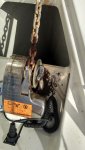
This didn't impress me much when I was viewing yachts for sale a couple of years ago, nor did the rusty allen key that was holding the vang strut to the mast. And made me wonder about the bits I couldn't see!
 
Top