Sea Change
Well-Known Member
Except for viewers in Scotland.I think that’s why it doesn’t translate to Europe. Here, building with sticks is the far inferior option and usually we use bricks and blocks.

Except for viewers in Scotland.I think that’s why it doesn’t translate to Europe. Here, building with sticks is the far inferior option and usually we use bricks and blocks.

Not sure what you mean? Scotland is also full of stone buildings and I can’t imagine wooden ones lasting a year!Except for viewers in Scotland.
Timber frame has been the standard for new builds in Scotland for the last fifty years or so. At least in my neck of the woods.Not sure what you mean? Scotland is also full of stone buildings and I can’t imagine wooden ones lasting a year!

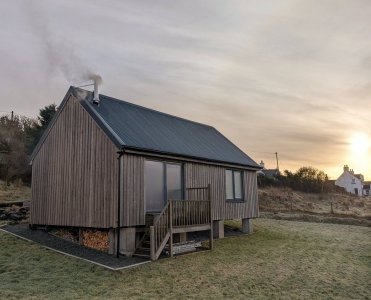
Well that 'shed' is what funds my cruising life.In my neck of the woods we call that a shed.
To get pedantic, a stick built house will have minimal prefabrication. Probably just the trusses, which is the same as for brick and block.Actually a timber framed house (in the UK) will typically have greater off site factory prefabrication compared to a more traditional loadbearing masonry (eg. brick and block) house construction.
So the ''stick built'' terminology as described earlier seems to me less appropriate for timber framed and more appropriate for loadbearing masonry construction.

Sure, it doesn't relate well to European construction techniques (other than, to some extent, in the UK).I think that’s why it doesn’t translate to Europe. Here, building with sticks is the far inferior option and usually we use bricks and blocks.
But it would be very appropriate for timber construction. That's where it comes from. Off site prefab panelized vs. built up on site from "sticks".Actually a timber framed house (in the UK) will typically have greater off site factory prefabrication compared to a more traditional loadbearing masonry (eg. brick and block) house construction.
So the ''stick built'' terminology as described earlier seems to me less appropriate for timber framed and more appropriate for loadbearing masonry construction.
Exactly. And that is exactly the analogue to boat constructionTo get pedantic, a stick built house will have minimal prefabrication. Probably just the trusses, which is the same as for brick and block.
Once you start pre-fabbing whole panels, or even move to SIPS, it's no longer what would be called a stick build.

We will agree to disagree then.…
But it's quite accurate in relation to boat construction.
The term is widely used in relation to boat construction. It's the normal terminology to distinguish prefab liner and grid construction, from conventional construction.We will agree to disagree then.
The term and usage really only works for certain types of land building construction (and not even most European at that).
Does not seem to be applicable or indeed used in terms of boat construction techniques.