
pinto
New Member
Hello, I'm seeking advice on remedial work and a good solution for re-fitting my boat's mast foot.
The boat is a 16' Hunter 490. Aquired as a project, but would like to sail one day! Mast is a replacement Selden - quite a large section for the size of boat. Rig is mast head - large genoa small main era - came with a Plastimo furler.
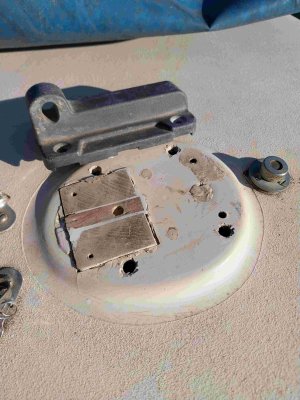
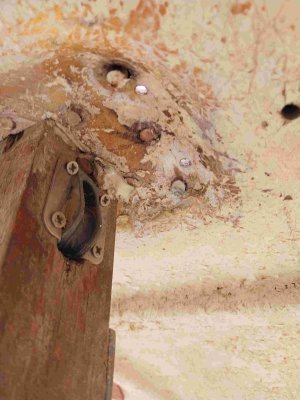
There is a mahogany compression post which looks in good condition and is just proud of the cabin top by a few mm - which may be an issue - I'm not sure if the cabin top has sunk a bit. The cabin top is thick layup in this area 10mm at the front and 7mm at the back. The grp is solid and still in original gelcoat.
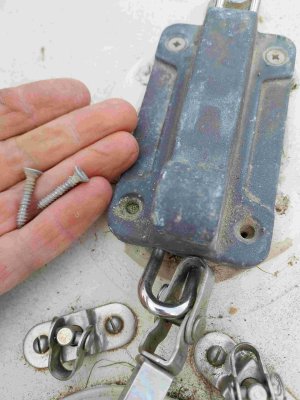
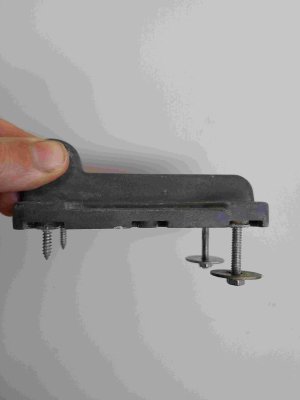
As can been seen there are numerious holes from former mast foot fastenings - all redundant and filled with silicone. Underneath there was a smeared lump of hard gunk - I assume to stop leaks - pulled away easily enough. The two cracks in the gel coat in the aft corners are not visable in the laminate from inside - I assume best to drill a small/shallow hole at the end of each and deal with when I get round to other gelcoat repairs? The Selden foot was fastened with two m5 countersunk bolts with penny washers underneath at the front and two screws into the end grain of the compression post at the back. Neadless to say the screws were loose and the foot rocked when lifted by hand.
Two issues: How best to address the holes and how best to re-fasten the foot.
Would it be best to use a large countersink bit to vee out the previous holes and fill with epoxy and 402 filler to make good the cabin top firstly? It seems a bit more structural given the forces on this area than just routine hole filling with thickened epoxy.
I'm assuming using longer wood screws into end grain isn't a good idea(?), so I'm wondering about fabricating a stainless bracket which acts like a saddle either side of the mast (cant go fore and aft because of the through sheaves for the keel lifting wire) and has a plate on top of the post which the mast is bolted to including through the deck (at least at the front). Obviously this would necessitate widening the gap in the cabin top either side of the post. Unfortunatly there isn't much flat surface behind the compression post for the foot to bolt through - If I used the same front holes, I would have to drill out the two shallow holes in the top of the compression post to accomodate the nuts for the two aft fastenings in the foot, which may set up a water-rot trap (best to seal the end grain with epoxy?).
Any thoughts or suggestions would be very greatly appreaciated.
The boat is a 16' Hunter 490. Aquired as a project, but would like to sail one day! Mast is a replacement Selden - quite a large section for the size of boat. Rig is mast head - large genoa small main era - came with a Plastimo furler.
There is a mahogany compression post which looks in good condition and is just proud of the cabin top by a few mm - which may be an issue - I'm not sure if the cabin top has sunk a bit. The cabin top is thick layup in this area 10mm at the front and 7mm at the back. The grp is solid and still in original gelcoat.
As can been seen there are numerious holes from former mast foot fastenings - all redundant and filled with silicone. Underneath there was a smeared lump of hard gunk - I assume to stop leaks - pulled away easily enough. The two cracks in the gel coat in the aft corners are not visable in the laminate from inside - I assume best to drill a small/shallow hole at the end of each and deal with when I get round to other gelcoat repairs? The Selden foot was fastened with two m5 countersunk bolts with penny washers underneath at the front and two screws into the end grain of the compression post at the back. Neadless to say the screws were loose and the foot rocked when lifted by hand.
Two issues: How best to address the holes and how best to re-fasten the foot.
Would it be best to use a large countersink bit to vee out the previous holes and fill with epoxy and 402 filler to make good the cabin top firstly? It seems a bit more structural given the forces on this area than just routine hole filling with thickened epoxy.
I'm assuming using longer wood screws into end grain isn't a good idea(?), so I'm wondering about fabricating a stainless bracket which acts like a saddle either side of the mast (cant go fore and aft because of the through sheaves for the keel lifting wire) and has a plate on top of the post which the mast is bolted to including through the deck (at least at the front). Obviously this would necessitate widening the gap in the cabin top either side of the post. Unfortunatly there isn't much flat surface behind the compression post for the foot to bolt through - If I used the same front holes, I would have to drill out the two shallow holes in the top of the compression post to accomodate the nuts for the two aft fastenings in the foot, which may set up a water-rot trap (best to seal the end grain with epoxy?).
Any thoughts or suggestions would be very greatly appreaciated.


