

Sea Change
Well-Known Member
The refurb of my masthead continues.
I've sourced a replacement divider and cut it to size. Just need to drill the holes in it for the sheave axles and the two transverse bolts which secure it to the mast.
I've had new sheaves made from Delrin.
Next problem is that the inner surfaces of the box are in really poor condition where the sheaves have been rubbing on them. The guy who made my new sheaves has persuaded me that I ought to do something about it before I install them, otherwise they'll be chewed to pieces pretty quickly.
The aftermost sheaves can, with difficulty, be removed and replaced with the mast up. Three forward ones cannot, without removing the mast box, which requires dropping the fire and back stays.
His suggestion was to cut out a complete circle to remove all the damaged aluminium, and weld in new pieces. So all the work is done from the outside. Sounds pretty good, but he doesn't do aluminium welding.
Any other thoughts? I wondered if I could just make up thin sheets of aluminium to line the sides, and accept that the sheaves would have to be a little thinner. I'm replacing some of the running rigging anyway so I could drop down a size.
The bodge approach would, I guess, be to just fair it all off with thickened epoxy, and sand it smooth. But I know that getting anything to adhere to aluminium is difficult, so it might risk chunks breaking off and jamming the sheaves.
Any other suggestions?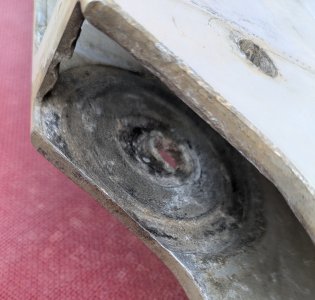
I've sourced a replacement divider and cut it to size. Just need to drill the holes in it for the sheave axles and the two transverse bolts which secure it to the mast.
I've had new sheaves made from Delrin.
Next problem is that the inner surfaces of the box are in really poor condition where the sheaves have been rubbing on them. The guy who made my new sheaves has persuaded me that I ought to do something about it before I install them, otherwise they'll be chewed to pieces pretty quickly.
The aftermost sheaves can, with difficulty, be removed and replaced with the mast up. Three forward ones cannot, without removing the mast box, which requires dropping the fire and back stays.
His suggestion was to cut out a complete circle to remove all the damaged aluminium, and weld in new pieces. So all the work is done from the outside. Sounds pretty good, but he doesn't do aluminium welding.
Any other thoughts? I wondered if I could just make up thin sheets of aluminium to line the sides, and accept that the sheaves would have to be a little thinner. I'm replacing some of the running rigging anyway so I could drop down a size.
The bodge approach would, I guess, be to just fair it all off with thickened epoxy, and sand it smooth. But I know that getting anything to adhere to aluminium is difficult, so it might risk chunks breaking off and jamming the sheaves.
Any other suggestions?


