Aquanaught
Active Member
FireBlitz 2Kg Clean Agent available here https://www.safefiredirect.co.uk/fireblitz-automatic-2kg-clean-agent-fire-extinguisher.aspx

Covers 3.4 cu m, which might be enough for oldgit's boat.FireBlitz 2Kg Clean Agent available here https://www.safefiredirect.co.uk/fireblitz-automatic-2kg-clean-agent-fire-extinguisher.aspx
Covers 3.4 cu m, which might be enough for oldgit's boat.

Of course there will be a fresh air feed to the engine bay . Diesel and petrol engines need an air supply.If you have an engin room with a fresh air feed, you also need a way to block that fresh air from feeding the fire in the same way as lifting the engine cover will cause a flash over
If you don't have a way to block the fresh air feed, you may be a fire extinguisher that has a volume in excess of the engine room volume.
If the engine i running the engine would consume of the fire extinguisher gas so again reducing the effective volume
Are you leaving the old extinguisher in place?In the end
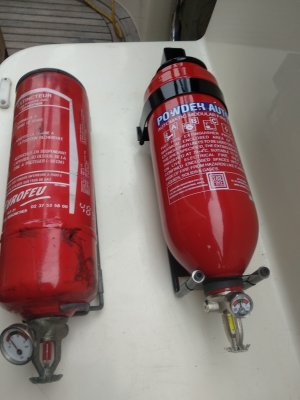
Purchased 2 x 2K from CPC. Cheapest on the market due to free P&P.
Construction far better inc holding bracket than the original installed unit and it would appear the Fireblitz.

Not rated for marine use AFAIK.Given the issues with powder in the engine compartment, would water mist be better?
They are capable of extinguishing class A (solids), class B (flammable liquids) and class C (flammable gasses) fires. Please note that the current certification standards do not allow yet the the formal certification of water-based extinguishers on B and C fires. Hence the limited number of classes stated on the front of all water mist extinguishers. Water mist extinguishers are nevertheless suited for B and C fires.
Water Mist Extinguishers
My boat a temp trigger shuts off the engine room blowers automatically, but there’s no way of closing the side vents.Of course there will be a fresh air feed to the engine bay . Diesel and petrol engines need an air supply.
Have you ever seen an arrangement on a boat that blocks off that fresh air feed manually or automatically ? I suspect not.
If an extinguisher goes off it will probably stop the engines as the engines will be starved of oxygen. In the case of powder the engines might be damaged. But the important thing is the folks on board survive.
Are you leaving the old extinguisher in place?


they had manual ones last week but only 1kg onesAldidl have them from time to time.
It's Halon automatic extinguishers in our engine room too, I also thought they had been banned, but as long as it passes inspection I will wait to change it.I understood that halon fire extinguishers were no longer permitted due to the impact on the ozone layer ?
I witnessed halon in action many years ago (demonstration )and they were far superior to the alternatives.
A potential headache was the only downside ( ozone notwithstanding!!)
It has been illegal to own a Halon extinguisher in the UK since 2003 . And in the EU since 2000. With some military and aviation exceptions.It's Halon automatic extinguishers in our engine room too, I also thought they had been banned, but as long as it passes inspection I will wait to change it.
I don't know if the military still use halon in their armoured fighting vehicles, I know they did as it gave the best protection against fire in a confined space like a tank.

Halon in a confined space is deadly! I worked in a place protected by a serious halon system with many massive cylinders of the stuff. We were warned that if the fire alarm went off we had some small number of seconds to get out before the halon was released, and that if we didn't, we'd be dead. I think it asphyxiates on its own, but releases serious poisons in contact with fire.It's Halon automatic extinguishers in our engine room too, I also thought they had been banned, but as long as it passes inspection I will wait to change it.
I don't know if the military still use halon in their armoured fighting vehicles, I know they did as it gave the best protection against fire in a confined space like a tank.
This seems to assume that the engine inhales from the engine compartment.If you have an engin room with a fresh air feed, you also need a way to block that fresh air from feeding the fire in the same way as lifting the engine cover will cause a flash over
If you don't have a way to block the fresh air feed, you may be a fire extinguisher that has a volume in excess of the engine room volume.
If the engine i running the engine would consume of the fire extinguisher gas so again reducing the effective volume
Anderson 22 ?Some years ago we were doing around 32knts in quite large waves.
Some years ago we were doing around 32knts in quite large waves. We were taking quite a hammering (but it was fun) until the engine spluttered and died.
Finally worked out that the auto fire supression system in the engine room had been triggered by the violent motion of the boat.
The large air intakes in the cockpit had louvres that were meant to close if the fire alarm was activated. They did not..
The engine fired back up 10 mins later without any problems.
It it had been a foam or powder system we would have had a big problem.
Teething problems with a new boat ?
This seems to assume that the engine inhales from the engine compartment.
If you had direct ducting of the engine air intake to the outside, it should be less of an issue, though I suppose the engine compartment probably still couldnt be sealed due to heat build up.
I've worked on a few motor boats which have the ability to close the vents to the engine space.Have you ever seen an arrangement on a boat that blocks off that fresh air feed manually or automatically ? I suspect not.
Of course there will be a fresh air feed to the engine bay . Diesel and petrol engines need an air supply.
Have you ever seen an arrangement on a boat that blocks off that fresh air feed manually or automatically ? I suspect not.
If an extinguisher goes off it will probably stop the engines as the engines will be starved of oxygen. In the case of powder the engines might be damaged. But the important thing is the folks on board survive.
Are you leaving the old extinguisher in place?