Wooden Boat - Rotten Beam fix

HMSOptimus

New Member
Joined
29 Jun 2025
Messages
11
Visit site
Hello All,

I am looking for some help and advise. I have wooden boat, built in 1962. The frame is built from Iroko and I have a spot of rot in the main beams.
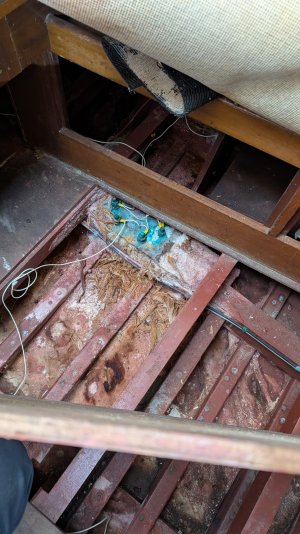
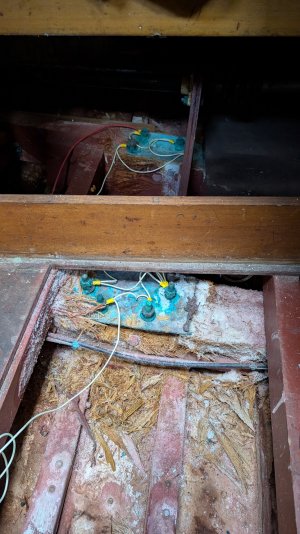
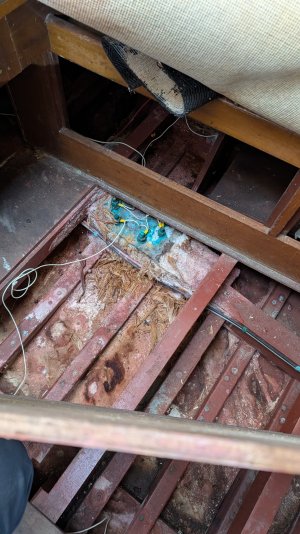
The P Bracket is bolted through with a plate on top. I notice these are connected with a number of wires, assuming going back to a battery (not sure) and I think some electrolysis or something has caused the beam to rot and the plate is green with white powered like you would find on a battery. It is localised to under the plate only, and this is the worst area. the other beams and brackets haven't been affected at all as much or at all.

I have an idea of removing the plate, scraping out all the rot and lose timber making a U shape and treating it. Then each side of the beam, putting in a longer and thicker piece to make is stronger and sistering it, bolting it through to increase the structural strength of the existing beam, wider and longer.
Then with the U shape void, pour some epoxy resin in to soak into the timber fibres and then put a new piece of wood in and pour some more epoxy resin to make the old beam complete again and reinforced.

I am asking, how would you suggest to fix this without taking all the planks apart and put new beams in, or any ideas. Also anyone know how this could have happened as the rest of the beam is solid and not damp or wet.

Thank you in advance,
David
 
There is a very good book, on kindle as well, call the big book of wooden boat restoration by Thomas larson. He talks about galvanic protection and how anodic protection setup incorrectly can cause wood to blacken and soften.

If it were me I would look to scarfing new wood to replace the old. I wouldn't mess around with the old wood.

The larson book will give advice on avoiding a repeat.
 
The word “beam” seems a bit imprecise! Do you mean “beam” as in beam shelf (I suspect not) or are you talking about the keel, hog or keelson (these are parts of the main centreline structures). If the latter then the usual repair would be to cut out any soft wood and scarf/replace with a new piece of the same species. You could use epoxy/thickened epoxy as a glue before mechanically fixing if needed (bronze screws/bolts would be preferable). Don’t fill in big voids with epoxy, it won’t be a good repair.
 
Remove all the wires - they are completely unnecessary and are probably the cause of the rot. Remove the plate and wash all the deposits away with water. Dig or cut out all the rot to bare solid wood. Then decide how to fill. A graving piece may be the simple answer but it really does depend on how extensive the rot is and how much solid timber you have left.

Photos would hep give more useful advice.
 
The word “beam” seems a bit imprecise! Do you mean “beam” as in beam shelf (I suspect not) or are you talking about the keel, hog or keelson (these are parts of the main centreline structures). If the latter then the usual repair would be to cut out any soft wood and scarf/replace with a new piece of the same species. You could use epoxy/thickened epoxy as a glue before mechanically fixing if needed (bronze screws/bolts would be preferable). Don’t fill in big voids with epoxy, it won’t be a good repair.
 
Remove all the wires - they are completely unnecessary and are probably the cause of the rot. Remove the plate and wash all the deposits away with water. Dig or cut out all the rot to bare solid wood. Then decide how to fill. A graving piece may be the simple answer but it really does depend on how extensive the rot is and how much solid timber you have left.

Photos would hep give more useful advice.
Thank you for this, i am going to remove all the wires and along the keel bolts as well. The idea is to clean and dig it all out, back to solid wood and then fill it with Oak or Iroko and scarf a new piece in using Epoxy Resin and bolts. It looks really bad, but I think it needs fixing sooner than later.
 

Attachments

  • PXL_20250623_114205484.jpg
    PXL_20250623_114205484.jpg
    943 KB · Views: 55
  • PXL_20250623_114954093.jpg
    PXL_20250623_114954093.jpg
    968 KB · Views: 52
The word “beam” seems a bit imprecise! Do you mean “beam” as in beam shelf (I suspect not) or are you talking about the keel, hog or keelson (these are parts of the main centreline structures). If the latter then the usual repair would be to cut out any soft wood and scarf/replace with a new piece of the same species. You could use epoxy/thickened epoxy as a glue before mechanically fixing if needed (bronze screws/bolts would be preferable). Don’t fill in big voids with epoxy, it won’t be a good repair.
Its one of the main beams which is part of the structure. as you can see, with the photos, the bolts for the P Brackets attached through into the thick piece of wood. I am looking to scarf and sister the wood, but I am trying to avoid taking the beam out because all the planks will be attached to it, and its a double diagonal hull.
Bolts is a good shout, but I am looking for any and all ideas to ensure its safe and passes a survey too.
Thank you
 

Attachments

  • PXL_20250623_114205484.jpg
    PXL_20250623_114205484.jpg
    943 KB · Views: 50
Bit tricky trying to work things out from your picture. I’m assuming that that the pieces going bottom left to top right are ribs, are they solid. Again I’m assuming that the metal plate is your backing plate for the P bracket and those bolts connect through to a similar plate under the hull. Are those wood shavings the soft wood removed from beneath/beside the plate? If so I’m guessing that is either a hog or top of the keel. Without seeing it and knowing the extent of the soft wood then it looks as if you could cut out a section with scarf joints at either end and replace with new wood (glued in with epoxy and then through bolted). If the rot doesn’t extend right through then you (hopefully) won’t find it extending into the keel rabbet and thus the planking won’t be affected. You should try to match the P bracket, backing plate and bolts in the same material (which will negate any electrolytic action).
 
The word "rot" sounds a bit imprecise/innapropriate too, since it usually implies microbial degredation of the wood structure, whereas this sounds like alkaline degredation due to electrolysis.

If true, thats a good thing, since its likely to be a lot more localised than wood eating funghi, and if you stop the electrolysis, you'll stop the rot
 
The word "rot" sounds a bit imprecise/innapropriate too, since it usually implies microbial degredation of the wood structure, whereas this sounds like alkaline degredation due to electrolysis.

If true, thats a good thing, since its likely to be a lot more localised than wood eating funghi, and if you stop the electrolysis, you'll stop the rot
If it is rot, the fungi causing it will extend far beyond the damaged wood, and you need to treat it with a fungicidal agent. But as above, it may not be rot.
 
That is as fine a case of Electrolytic rot as i have ever seen & i have seen many. Other wise known as Delignification. Its caused by the parts being bonded together by wires on the inside & lack or failure of anodes. As the electrical current flows through the damp timber there is a build up of sodium ions around the coper fastenings, Its literally Sodium hydroxide (caustic soda) build up in the timber & if you do a litmus test this will prove it.
Forget using epoxy or a wood hardener it isnt going to work. You need to remove the P brackets & bolts them replace that frame or floor (not beam) completely.
 
seasurveys.co.uk/Pdfs/electrolytic%20damage%20timber%20vessels.pdf
This provides a good explanation of what is going on.

Replacing the floors is a bit extreme until the plates are removed and the area is cleaned up. The first line of treatment suggested by John works. John surveyed a boat for me and found this condition where the rudder tube came through the keel and the alkali deposits split the Cascover sheathing. We cut the sheathing b ack to sound wood, dug out the affected wood, used the vinegar and then fresh water over a week or so. Once dry, filled with epoxy and sheathed with glass epoxy.

My suggestion to the OP is to remove the wires, nuts and plates and see how bad the timber is underneath. It may well be also the bolts are damaged. Possible to replace them one by one without removing the P brackets. If the P brackets are bronze, 316 bolts and backing plates can be used with plenty of sealant once the floor has been repaired. There is no need for any anodes for P brackets - just paint them with Hammerite special metal primer and antifoul. If the propellers need anodes then shaft anodes are the first option. Seacocks do not need anodes, but rudders may if they are mixed metal construction. Stern gland housings don't need anodes. If you do need to use a hull anode for the propellers or the rudders, keep the separate and located as close as possible to the piece being protected. good idea if possible to coat the holes for the mounting bolts with epoxy and use plenty of sealant (another John Lilley tip)
 
seasurveys.co.uk/Pdfs/electrolytic%20damage%20timber%20vessels.pdf
This provides a good explanation of what is going on.

Replacing the floors is a bit extreme until the plates are removed and the area is cleaned up. The first line of treatment suggested by John works. John surveyed a boat for me and found this condition where the rudder tube came through the keel and the alkali deposits split the Cascover sheathing. We cut the sheathing b ack to sound wood, dug out the affected wood, used the vinegar and then fresh water over a week or so. Once dry, filled with epoxy and sheathed with glass epoxy.

My suggestion to the OP is to remove the wires, nuts and plates and see how bad the timber is underneath. It may well be also the bolts are damaged. Possible to replace them one by one without removing the P brackets. If the P brackets are bronze, 316 bolts and backing plates can be used with plenty of sealant once the floor has been repaired. There is no need for any anodes for P brackets - just paint them with Hammerite special metal primer and antifoul. If the propellers need anodes then shaft anodes are the first option. Seacocks do not need anodes, but rudders may if they are mixed metal construction. Stern gland housings don't need anodes. If you do need to use a hull anode for the propellers or the rudders, keep the separate and located as close as possible to the piece being protected. good idea if possible to coat the holes for the mounting bolts with epoxy and use plenty of sealant (another John Lilley tip)
Thank you for this, I appreciate your response. I have found this to be very helpful. I am going to next at the boat in a week or so, so I will have a look and see how far the damage has gone. I am hoping it is only within the beam it bolts through and not affected the actual planks within the boat.

The P Brackets and bolts are bronze currently and does have anodes attached. I am thinking I will remove the wires and the hull anodes (don't like them on a wooden boat), then just leave the rudder and prop shaft anodes on.
I will see how the bolts are and may renew them if needed, but I think the general idea is, once the wires are disconnected, it will stop the electrolytic damage going further as the rest of the hull is sound wood.
Thank you again.
 
That is as fine a case of Electrolytic rot as i have ever seen & i have seen many. Other wise known as Delignification. Its caused by the parts being bonded together by wires on the inside & lack or failure of anodes. As the electrical current flows through the damp timber there is a build up of sodium ions around the coper fastenings, Its literally Sodium hydroxide (caustic soda) build up in the timber & if you do a litmus test this will prove it.
Forget using epoxy or a wood hardener it isnt going to work. You need to remove the P brackets & bolts them replace that frame or floor (not beam) completely.
Thank you for sharing your knowledge and advice. When you mention replacing the frame or floor (not beam), do you mean the frame beam to be replaced? I will carry some tests out next week. - Thank you
 
If it is rot, the fungi causing it will extend far beyond the damaged wood, and you need to treat it with a fungicidal agent. But as above, it may not be rot.
After reading the forum and taking advice, I am feeling a bit more relieved it is not "rot" but more electrolytic damage which I think is more manageable to be fixed and contained. I will attach some more photos once I have been there next week and dug out the soft wood.
 
Bit tricky trying to work things out from your picture. I’m assuming that that the pieces going bottom left to top right are ribs, are they solid. Again I’m assuming that the metal plate is your backing plate for the P bracket and those bolts connect through to a similar plate under the hull. Are those wood shavings the soft wood removed from beneath/beside the plate? If so I’m guessing that is either a hog or top of the keel. Without seeing it and knowing the extent of the soft wood then it looks as if you could cut out a section with scarf joints at either end and replace with new wood (glued in with epoxy and then through bolted). If the rot doesn’t extend right through then you (hopefully) won’t find it extending into the keel rabbet and thus the planking won’t be affected. You should try to match the P bracket, backing plate and bolts in the same material (which will negate any electrolytic action).
Thank you for this. I will attach some new photos next week once I have removed the plate, bolts and soft wood and see what state the timber is. I have some new Oak & Iroko to scarf in with bolts but hopefully will give a better idea once its all cleaned up. -Thank you for your time and advice, it is very helpful
 
Top