NormanS
Well-Known Member
Wing keels are far better than fin keels. -- at catching creel (pot) lines. 



I must be doing something wrong as I have never fouled a line with my pot catcher.?Wing keels are far better than fin keels. -- at catching creel (pot) lines.

Wing keels are far better than fin keels. -- at catching creel (pot) lines.
Not a worry for me as I start to panic in less than 10m as generally, in Scotland, it’s either 100m or zero metres - and not much in between.....I also wonder whether a careened wing keel boat would float or fill with water when tide comes back, due to increased heel.
Doesn't seem to be a problem.I also wonder whether a careened wing keel boat would float or fill with water when tide comes back, due to increased heel.
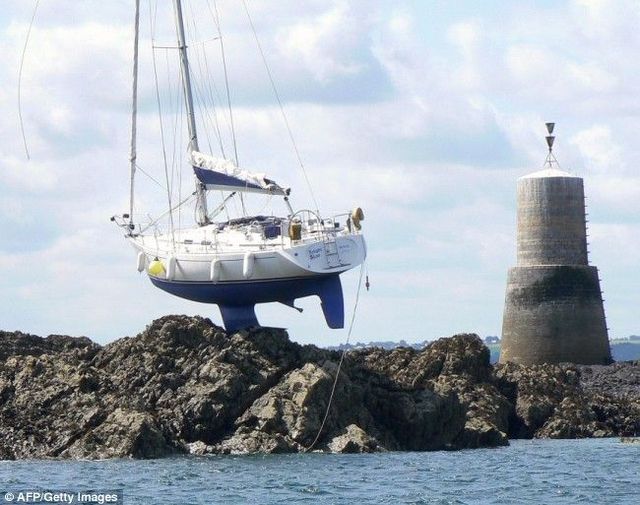

It is a possibility. Deeper twin keel designs might suffer that fate if they fell all the way over. Many traditional, narrow designs are subject to down flooding. From personal experience: a Folk boat will not come back up if dried out on her bilges.I also wonder whether a careened wing keel boat would float or fill with water when tide comes back, due to increased heel.
Doesn't seem to be a problem.

Doesn't seem to be a problem.

Aircraft do this because they have limits on their wingspan in order to fit into terminal gates. Winglets are always higher drag than if the equivalent area was added to the end of the wing.Aircraft design has developed into putting fins on wingtips to eliminate tip turbulence and improve lift, perhaps there's a connection.

How?If you run aground in a wing keel I have found the best draft reducing method to be to take the dinghy and anything else heavy but easily portable, and all the crew, to the bow. This often has the effect of reducing the draft.
On a lot of wing keel boats draft does reduce. Especially if the leading edge of the keel is a little bit shallower than the trailing edge, which is often the case.How?
Draft doesn't reduce, all that happens, is the bow may tip forward, with boat still attached to the bottom, which may allow reverse to pull it off, much like a bilge keel.
It changes the point of contact with the bottom, but can't see how it reduces draft.On a lot of wing keel boats draft does reduce. Especially if the leading edge of the keel is a little bit shallower than the trailing edge, which is often the case.
Certainly used to work well on the wing keeled Legend 336 that my Dad had a while back.
Might also make leading edge dig in further.
Yep it works.If you run aground in a wing keel I have found the best draft reducing method to be to take the dinghy and anything else heavy but easily portable, and all the crew, to the bow. This often has the effect of reducing the draft.
Ah, with a 2m keel and being the only crew member over 6 foot tall, I'm not keen to suggest that one.Yep it works.
Chucking the heaviest in the race crew over the side and getting them to push also works in less than 1.5m of water and is much quicker!?

Aircraft design has developed into putting fins on wingtips to eliminate tip turbulence and improve lift, perhaps there's a connection.
Aircraft do this because they have limits on their wingspan in order to fit into terminal gates. Winglets are always higher drag than if the equivalent area was added to the end of the wing.
In the same way, the area of a keel wing would be more efficient if it was simply used to extend the keel, with the added disadvantage that you need wings on both sides of a keel, unlike an aircraft.
Hmmm. Catalina's version of this is closer to my understanding of the reason for vertical winglets at the wingtips of modern aircraft.
If I may quote to you from an abstract in an article in the International Journal of Naval Architecture and Ocean Engineering
"The endplate causes a blockage effect on the flow, and an additional viscous effect especially near the endplate. These combined effects of the endplate significantly reduce the magnitudes of the velocities under the lower surface of the wing, thereby enhancing aerodynamic performance in terms of the force coefficients. The maximum lift-to-drag ratio of a wing with an endplate is increased 46% compared to that of wing without an endplate at the lowest clearance. The tip vortex of a wing-with-endplate (WWE) moved laterally to a greater extent than that of a wing-without-endplate (WOE). This causes a decrease in the induced drag, resulting in a reduction in the total drag."