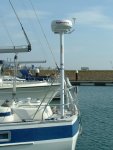
Where to mount a radar?

3) If on the right spreader, the only sector obscured by mast is a few degrees on the left hand side - the side you don't have to give way from. The all important bow and stern sections are unobstructed.
Scary logic there. May I remind you of Rule 19
A vessel which detects by radar alone the presence of another vessel shall determine if a close-quarters situation is developing and/or risk of collision exists. If so, she shall take avoiding action in ample time,
 
I've, had both, on my Dufour 40 it was on the foreword side of the mast. A Raymarine analogy system which was great until I destroy it short tack up the Sound of Mull with a 95% solent job.
My current Southerly has a pole on the port stern quarter. It was originally on a Scanstrut pole, however, I noticed a big blind spot on the Starboard forward sector when the wet main sail was store in the stack and pack. This was particularly noticeable on day when approaching Staffa in thick fog. A small motor cruiser suddenly appeared on my port side after crossing my bow. It wasn't visible on the radar on the Starboard side.
Asked Scanstrut if they could do a pole one longer, but they couldn't, so I made one using a carbon fibre pole, which solves the problem.
It's a Raymarine Quantum radar, and although the spec' says it should be better, I don't think that it's as good as the 18" analogy system.
 
Can you list the design features preventing this type of mounting?
It's not so much features preventing radome mounting as - was the spreader designed for the loads? Static loads are easy to calculate but the dynamic loads through wave action, the loss of tension from the shrouds on the lee side, etc. all have to be taken into account. The short socket, 2 pin attachment of my Seldén aerofoil section spreader has probably not had such loads taken into account in its design even though it can support my not insubstantial weight while mast climbing.
 
Spreaders are designed to take loads axially, not the bending loads associated with mounting a heavy radome on top.
I dare to say 3.2 kg radar dome doesn't produce "load" in the sense of this discussion. It is not any heavier than some of the birds sitting on the spreaders regularly. Sorry, not a valid point.
 
I dare to say 3.2 kg radar dome doesn't produce "load" in the sense of this discussion. It is not any heavier than some of the birds sitting on the spreaders regularly. Sorry, not a valid point.

Ah, I thought you were meaning real radars. The lightest Garmin radome is about 8kg, the lightest Raymarine about 6kg.
 
Hi
As per a previous post, I planning to upgrade my navigation instruments etc.

One of the new purchases was to be a radar.
The original intent was for it to be mast mounted but now I am wondering about a radar pole on the transom.
This would solve the problems associated with disconnecting each time the mast is lowered and also reduce the weight higher up as I also have in-mast reefing.

What are the thoughts?
What size boat? A large radar mounted on a small boat mast may be significant. On a large boat it will be irrelevant. Also, what do you intend to use your radar for? I know it may sound like a daft question but if you are doing long passages then a radar mounted high up will give you better range. If you cross an ocean a few miles extra range can be helpful so see fast approaching ships a little earlier. If you want to enter harbours in fog then mounting on a pole is fine. If you decide to mount on the mast, consider an external conduit. There are conduits designed specifically for this task. Taking the radar off or the mast down becomes far simpler.
 
The boat is 36ft and this is all in preparation for a trip across the pond in 2022.
I must admit I do like the look of the Scan Strut and the option to add an outboard davit as well as - one of these was also on my list.
As usual the list is just getting bigger and bigger and the budget smaller & smaller :rolleyes:
 
I don’t think poles are great. The mast and boom will block an important area of signal. Especially bad I think is where people put it on the stern at or near the level of the boom. A huge chunk of metal right in-front of it. I’d put it on the mast near the first spreader or maybe actually on it. Pick the stbd one if you do that as that is the side you want best vision from.

Surely the angle subtended by the mast is larger the closer you put the Radar to the mast.

Wherever you put it, make sure it's well above head height.
 
The boat is 36ft and this is all in preparation for a trip across the pond in 2022.
I must admit I do like the look of the Scan Strut and the option to add an outboard davit as well as - one of these was also on my list.
As usual the list is just getting bigger and bigger and the budget smaller & smaller :rolleyes:

This pic shows the ScanStrut pole I put on my old 35ft boat.

strut.jpg

strut2.jpg
 
I dare to say 3.2 kg radar dome doesn't produce "load" in the sense of this discussion. It is not any heavier than some of the birds sitting on the spreaders regularly. Sorry, not a valid point.
Really? A 3.2 Kg bird is a good sized beast, found this:- Heaviest Flying Birds | Incredible Birds
Maybe stick some spikes up there as well, because anything that size will crap like a good'un.
 
  • Like
Reactions: pvb
Scary logic there. May I remind you of Rule 19
Nothing scary about my logic. I am as aware of Rule 19 as you are. I am also aware that people make mistake or miss something time to time. If you are not one of them, my deepest admiration. You should reside on Olympus.
So the logic is: on a sail boat you have no choice but to have a certain section of the scan obscured. You have to chose one. Which one would that be? I choose the one where some overlook would least likely to have grave consequences. What would be your choice?
Thanks for the nit picking on the birds. You are RIGHT!!! You only missed I also was WRONG!!! with the weight of the radome by some 3 kg. Now how much does it change on my point the load on the spreader (on which I stand/sit on no problems) is negligible?
Anyway, it is a nice day - why not to go sailing!
 
Last edited:
Ours is on a Topper mast section (the bottom half I think) which is conveniently the correct size to use scaffolding fittings. The radar is attached using a key clamp, and the pole is secured to the pushpit. This is pretty solid, though I wouldn't use it as a davit without additional bracing.

The rader setup is pretty rudimentary, but loss of signal due to the mast has never been an issue. The only permanent modification to the boat was adding a power socket (bulgin connector) in the cockpit under the bridge deck. The display is secured to the bridge deck with a wing nut clamp. This allows the radar + display to be removed easily, so it only comes out for proper passages.
 
Really? A 3.2 Kg bird is a good sized beast, found this:- Heaviest Flying Birds | Incredible Birds
Maybe stick some spikes up there as well, because anything that size will crap like a good'un.
In my case I am talking about pelicans - over 6 kg. Fortunately, they are quick to learn and when scared by me shaking the rigging a few times, they don't come back for a while. But yeah... takes a bit of cleaning if I don't shoo away the bugger in time :-).
 
There is, surely another option, for everyone to argue over :)

Instead of going to the expense of an expensive Scanstrut and the disadvantages/advantages of the transom location why not stick with locating the unit on the mast.

And buying a cable mast length + a bit with an appropriate plug and another cable to run from the mast base to the display (or whatever).

I really cannot believe the reputable suppliers have not been asked to supply as suggested with a reliable connection (that would obviously be located just below deck). It will cost - but less than a Scanstrut.

If you are unaware feeding radar cable into masts demands at least 2 people and a lot of patience. Radar cable has the same flexibility as a game fishing rod and is difficult to feed in at the mast base and equally difficult to 'retrieve' from a few metres up the mast. Don't imagine for a second you can simply use a mouse line and pull it up - it will need to be coaxed at the mast base and coaxed simultaneously at the chosen location up the mast.

We have Simrad's Broadband and can 'see' our bowsprit, dinghy hanging off the transom and it picks up commercial vessels at about 25/30nm. Its not very good at picking up low lying coasts (you can see the coast long before the radar sees it (but we have a chart plotter for coastline :) ). It works well for navigating round thunderstorms. It is located at the spreaders on a dedicated bracket and the scanner is at about 17m off the waterline. You would not buy a Simrad or B&G unit unless you have their chart plotter as their radar software its not shared across competitive products.

Jonathan
 
From lots of experience of radar systems, albeit in a very different application, the following remarks may help:

1) The higher your radar scanner, the greater the range. Radar is pretty much line of sight - maybe a bit more because of refraction, but not a lot.
2) The resolution (i.e. "sharpness") in bearing is proportional to the size of the scanner - the bigger the scanner, the higher the resolution. Obvious practical limits here!
3) The resolution increases with frequency for a given scanner size. However, you are restricted to what is allowed by OfCOM and international agreements. But choosing a higher frequency model will give better resolution.
4) The quality of the connections between the scanner and the plotter matter a lot; bad connections can lose a very high proportion of the signal; 50% or more. The transmission line is usually matched very carefully to the scanner and receiver..
5) Modern radars use clever signal processing to get better resolution in range (e.g. chirped pulses).
6) Radars can have a minimum range as well as a maximum - the receiver is often "blanked" while the radar transmits. YMMV on modern radars.
7) Radar operates at frequencies and powers where there is potential for harm if exposed for long periods. Radars should be mounted above head level for persons in the cockpit. The signal attenuates rapidly (inverse square law) so persons at greater distances are unlikely to be affected.

1) is particularly important for detecting small vessels and other sea-level features. I can also think of places where too low a radar scanner might give a misleading indication of a coastline, where there is an extensive wave-cut platform with cliffs behind it.

On a sailing vessel, the mast (Main or Mizzen) provides the obvious best location in terms of height. Some obstruction is unavoidable on a sailing vessel - things like shrouds and stays as well as wet sails will also attenuate or confuse the signal. If I had one, I'd want it mounting on the forward side of the mainmast, probably above the cross-trees.
 
From lots of experience of radar systems, albeit in a very different application, the following remarks may help:
............................


This would be my choice if I ever fitted radar:

LMB-A2 Self Levelling Radar Mount – Backstay

About 1500 quid so not cheap. However:

With self levelling - is it good or just a gimmick?

Thanks.

PS
I have edited this as most of the questions seemed to be addressed on re-reading post 36!
 
Last edited:
From lots of experience of radar systems, albeit in a very different application, the following remarks may help:

1) The higher your radar scanner, the greater the range. Radar is pretty much line of sight - maybe a bit more because of refraction, but not a lot.
2) The resolution (i.e. "sharpness") in bearing is proportional to the size of the scanner - the bigger the scanner, the higher the resolution. Obvious practical limits here!
3) The resolution increases with frequency for a given scanner size. However, you are restricted to what is allowed by OfCOM and international agreements. But choosing a higher frequency model will give better resolution.
4) The quality of the connections between the scanner and the plotter matter a lot; bad connections can lose a very high proportion of the signal; 50% or more. The transmission line is usually matched very carefully to the scanner and receiver..
5) Modern radars use clever signal processing to get better resolution in range (e.g. chirped pulses).
6) Radars can have a minimum range as well as a maximum - the receiver is often "blanked" while the radar transmits. YMMV on modern radars.
7) Radar operates at frequencies and powers where there is potential for harm if exposed for long periods. Radars should be mounted above head level for persons in the cockpit. The signal attenuates rapidly (inverse square law) so persons at greater distances are unlikely to be affected.

1) is particularly important for detecting small vessels and other sea-level features. I can also think of places where too low a radar scanner might give a misleading indication of a coastline, where there is an extensive wave-cut platform with cliffs behind it.

On a sailing vessel, the mast (Main or Mizzen) provides the obvious best location in terms of height. Some obstruction is unavoidable on a sailing vessel - things like shrouds and stays as well as wet sails will also attenuate or confuse the signal. If I had one, I'd want it mounting on the forward side of the mainmast, probably above the cross-trees.
I think that you are being too dogmatic about your conclusion. Resolution is clearly a good thing, but for its main function of collision avoidance, a radar target is mostly either there or not. Most of us tend to use AIS rather than MARPA for plotting ships' courses, though no doubt a larger radar would help in this respect.

There may be extreme cases where a shoreline could be misleading, but combining the radar image with charts should make ambiguities minimal. Line of sight for a pole mount should be easily far enough to avoid all but the rarest hazards.

There are reasons why stern mounts are still very popular, especially on the Continent from my observations.
 
I think that you are being too dogmatic about your conclusion. Resolution is clearly a good thing, but for its main function of collision avoidance, a radar target is mostly either there or not. Most of us tend to use AIS rather than MARPA for plotting ships' courses, though no doubt a larger radar would help in this respect.

There may be extreme cases where a shoreline could be misleading, but combining the radar image with charts should make ambiguities minimal. Line of sight for a pole mount should be easily far enough to avoid all but the rarest hazards.

There are reasons why stern mounts are still very popular, especially on the Continent from my observations.
I don't draw any conclusions - I merely point out factors that must be taken into account. I state my preference; others may use the same information to reach other conclusions. My 7 points all result from the physics of radar.

BTW, I was thinking of a specific coast in a popular sailing area - much of the eastern side of the Clyde has low foreshores backed at some distance by cliffs. At a distance, the cliffs would stand out.
 
Will a low mounted radar pick up a pop up fish farm? My radar discovered an unmarked fish farm in a haze at midday about 5-10nm offshore 30nm north of Porto.. I marked it on the plotter. It was unusual for me to have the radar on during daylight and I can not remember why it was... I think it was early in the morning. This fish farm was very wide and I was going straight for it. As it was daylight I would have seen it in time but at night the radar would have been the only way to avoid this obstruction. I have never understood why new HR's have a radar on a pole - and not their mast. It is plainly obvious higher is preferred. For a small boat under 30 foot I see a pole could be more suitable if worried about the weight.

Stop! Scandy boats like radars on pole because they unstep mast every season and store boats inside?
 
Top