What's the fascination with long keels?

John,
Fin keels are a result of Darwinian evolution; Designer Chuck Paine's quite brilliant Victoria 30 looks very traditional, but handles sublimely and goes like a relative rocket, thanks to her modern fin keel...

The Victoria 30's that I know have a 'fin' keel that extends all the way back to the rudder, in fact the rudder hangs off it..... more of a long keel with a cutout at the front?
 
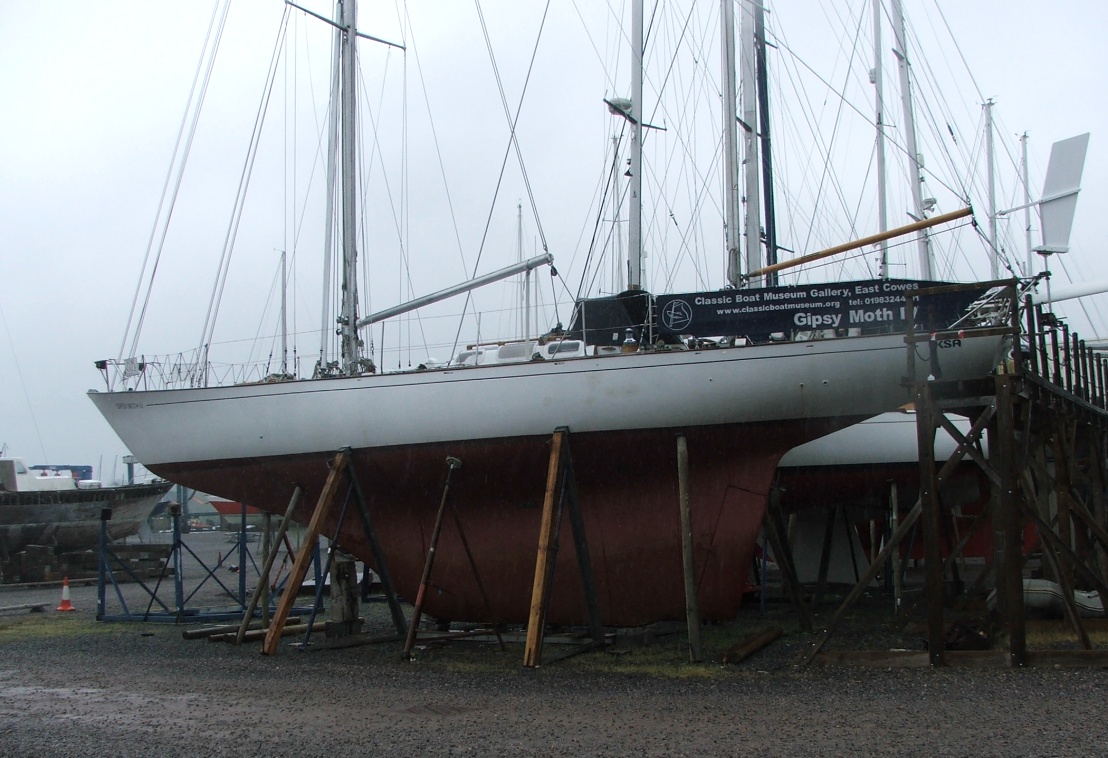
This long keeler was always said by her most famous skipper to have an uncomfortable motion:

gypsy+Moth.jpg
 
Plus the unsupported spade rudder is anathema to me - I'd never have a boat with one, as they are so vulnerable.

I don't have a position on this but the late Philippe Harlé, one of France's leading naval architects used to say that a skeg was a nonsense. He said that if it took a hit it could block the rudder. However if the rudder itself took the hit it might bend the stock but the rudder might remain operational.

FWIW.
 
John,

I'm with you all the way on this one !

I've sailed a few long keel boats, and the term 'wetted area drag' springs to mind.

The much vaunted longitudinal steering stability is pretty much an urban myth too; my Anderson with a rather narrow chord keel sails herself, it's all a matter of set-up and balance.

Short fins aren't always brilliant, such as when drying out; attention is required - my Carter 30 tried to sit on her back end, requiring ropes under the stern holding her level - and some examples like Listangs can't take the point loading on the hull but I think they're rare nowadays, tending to be 1960's-70's types.

Fin keels are a result of Darwinian evolution; Designer Chuck Paine's quite brilliant Victoria 30 looks very traditional, but handles sublimely and goes like a relative rocket, thanks to her modern fin keel...

In a Breton port, I met two skippers of the Royal Navy sailing yachts who had if I remember correctly Victoria 34's (or they may possibly have been 38's).

Both were scathing of them.
 
This long keeler was always said by her most famous skipper to have an uncomfortable motion:

gypsy+Moth.jpg

Benjenbav,

have a read of Sir Francis's books; he comes over as a brilliant navigator rather than sailor, but with an indomitable spirit I for one would not fancy going up against!- Try 'The Loneley Sea And The Sky', IMO one of the best books ever written - and there's a bit where he mentions working as a stoker and flattening someone who picked on him; Sir Francis was a fairly small chap,but then so was Nelson !

Also try the book 'Gypsy Moth Circles The World' if referring to keel & hull designs, but 'The Lonely Sea And The Sky' is the all time classic,IMO of course but I know others who agree.
 
In a Breton port, I met two skippers of the Royal Navy sailing yachts who had if I remember correctly Victoria 34's (or they may possibly have been 38's).

Both were scathing of them.

I've sailed the the JSSC Victorias and found them to be pretty good boats, so I'm quite surprised at their comments.

( no spray hoods or auto helms though which is a bit of a bummer).
 
If long keels are so good, why doesn't anybody make them any more.

I loved sailing the Nic 32, stable, good in very strong weather, lovely motion but a nightmare in marinas, cramped and not particularly fast.

But things move on and now with a conservative fin and skeg I'm a happy bunny and wouldn't go back for all the tea....

Island Packet do...............
 
I have sailed lots of types of yachts offshore. I love my 3/4 of a long keel yacht because she was a low cost yacht to buy and my wife liked her as did I.

I can't be bothered with comparisons to be honest. If one doesn't know what they are buying when committing to a yacht, then more fool them.

Its a plain fact obvious for all to see and read that many styles of hull sail very well and are very seaworthy in all sorts of conditions.

I have this feeling though that folks who buy expensive things are rarely going to say that they feked up e.g. my long keel / fin keel is sh it, my Oyster is actually quite ugly and not as good a build quality as I thought and looks quite similat to other yachts that cost at least £200k less than mine and sail better. Rather, they will defend their choice.
 
As for the speed thing, thinking back to the cruisers I hung around with, speed wasn't that big a deal. The boat has to be so many things at the same time that it's difficult to be able to look at any one aspect in isolation. And quite often the boat is the one you've got, not the one you'd like to have. Everyone likes to get their boats sailing well but a good passage is one where nothing broke! Cruisers tend to be cautious sailors. Catching a fish or 3 would gain points towards a good passage as well. But taking a day or 2 longer across an ocean really isn't that big a deal, it's cheaper out there for one thing. :)

So ignore it all and get a boat you feel safe in :)


Couldn't agree more with the above.
 
I don't have a position on this but the late Philippe Harlé, one of France's leading naval architects used to say that a skeg was a nonsense. He said that if it took a hit it could block the rudder. However if the rudder itself took the hit it might bend the stock but the rudder might remain operational.
FWIW.
I had long heard this argument, which was even more against the skeg - that with a strong impact, such as a hard grounding on rock or semi-submersible container, it was a potential leverage point to breach a hull's watertight integrity because it would normally be bonded in and result in a massive hole just where it could be difficult to access.

Far better in that scenario would be a spade rudder that gets bent out of true - perhaps not much more good as a rudder but not catastrophic and time to lash the oar, or whatever, overboard for emergency steering.

Well, it comforted me at the time that I had a boat with a spade rudder.
 
Would it be fair to say a long-keeler of 'n' feet is going to be heavier than a fin and skeg boat of equal length? I'd say it was more than likely.

That's where long-keelers can score on long ocean passages. A ton or more of food, water and gear as a % of displacement is negligible to a long-keeler, but could put a more modern, lighter, fine-keeler way down on her marks.
 
Benjenbav,

have a read of Sir Francis's books; he comes over as a brilliant navigator rather than sailor, but with an indomitable spirit I for one would not fancy going up against!- Try 'The Loneley Sea And The Sky', IMO one of the best books ever written - and there's a bit where he mentions working as a stoker and flattening someone who picked on him; Sir Francis was a fairly small chap,but then so was Nelson !

Also try the book 'Gypsy Moth Circles The World' if referring to keel & hull designs, but 'The Lonely Sea And The Sky' is the all time classic,IMO of course but I know others who agree.

Seajet. Thanks. That's the one that starts with the adder in the pocket? Anyway. I haven't got a copy at the moment so a few pounds will shortly be on their way to Amazon, I foresee.
 
Seajet. Thanks. That's the one that starts with the adder in the pocket? Anyway. I haven't got a copy at the moment so a few pounds will shortly be on their way to Amazon, I foresee.

benjenbav

yes that's the one; should be mandatory reading for anyone under 14 and / or imigrants to Britain or Australia !
 
Interesting thread and I am not even going to bother arguing.
I have owned a boat that was all ends and deep deep long keel, a bilge keeler, a fin and spade and currently a semi long keeler. All have behaved just fine at sea tho the longer keels are less forgiving in docking.
Peering into the bilges today I see, an engine set quite low, a water tank, an anchor and some chain, two batteries perched on a platform, a sump at arms length. I suppose that that lot would have to go somewhere else in a finkeeler with possibly a leg on the motor.
We all go to sea in what we own already, no?
 
Would it be fair to say a long-keeler of 'n' feet is going to be heavier than a fin and skeg boat of equal length? I'd say it was more than likely.

That's where long-keelers can score on long ocean passages. A ton or more of food, water and gear as a % of displacement is negligible to a long-keeler, but could put a more modern, lighter, fine-keeler way down on her marks.

on the other hand, traditional designs with narrower hulls can actually require fewer tons per inch immersion than modern AWB designs, which thus can better cope with additional food, water and fuel - assuming there is somewhere to put it that won't impact on living amenities.
 
I had long heard this argument, which was even more against the skeg - that with a strong impact, such as a hard grounding on rock or semi-submersible container, it was a potential leverage point to breach a hull's watertight integrity because it would normally be bonded in and result in a massive hole just where it could be difficult to access.

Far better in that scenario would be a spade rudder that gets bent out of true - perhaps not much more good as a rudder but not catastrophic and time to lash the oar, or whatever, overboard for emergency steering.

Well, it comforted me at the time that I had a boat with a spade rudder.

Makes me even happier I have a long keel with a rudder off the transom :) Though hitting something would be a big worry just a spade rudder sticking down off the keel, something that would really have me worried all the time would be running over a huge fishing net with lots of floats and the net popping up between the keel and the spade then jamming in the little gap between the top of the rudder and the keel. That's not an "if" you run over a net like that, it's when. Offshore bluewater it's going to happen. Then you're a bit stuffed.Probably in the middle of a moonless nigfht a very long way from anywhere. At least with a skeg there's a chance the net will clear under the rudder. Or attach some 100Kg line between the skeg and fin keel to hopefully keep wayward ropes and nets clear but snap before doing any damage if you ground on uneven bottom.
Lots of things to worry about. Just because other boats have made it doesn't mean you won't or shouldn't worry about these things.
 
on the other hand, traditional designs with narrower hulls can actually require fewer tons per inch immersion than modern AWB designs, which thus can better cope with additional food, water and fuel - assuming there is somewhere to put it that won't impact on living amenities.

I think the Cutlass would be an example of what you mean. As far as I remember, it was lighter than fin keeled boats of the same size, like the Tomahawk because its hull was inherently stronger in shape.

As far as sailing ability is concerned, I would be more concerned about a hull's balance under different conditions rather than its ability to track unaided, and as a mere offshore sailor rather than an ocean one I am happy to leave the rest up to my autopilot.
 
Top