Water tank - how to clean and make safe

Marceline

Well-Known Member
Joined
12 Sep 2020
Messages
389
Visit site
Hello (and another of my 'newb' questions)

So far we've never used the water tank on our boat just as it was always on a swing mooring and we've yet to visit a marina (planning to do that and more this year)

But taking many two litre bottles of tap water from home on/off is getting a chore and so as its on the hard currently and theres water access we want to try using the tank this seasons

How best is it to get a tank ready to be used safely - are there any chemicals to use ? Its now been a couple of years since it was last used so guess we'll need to fill/flush it a few times

we're still planning to take onboard litre bottle for drinking water - but to have a tank full we can use for washing pots/kettle etc would be very handy
 
You cannot beat scrubbing with a brush. No amount of filling and flushing will shift all deposits even with as many chemicals as you can find. If it has lain unused with stagnant water you might consider changing the hoses that will equally have deposits but cannot be brushed out. You can then fit a decent filter and drink from the tank, which we have done for the past 30 years in our current boat.
 
Thanks Boathook - not sure if it is flexable - we're heading to the boatyard this afternoon and will check
 
Hydrogen peroxide is good for killing off any nasties in the tank and pipework and if you leave it for a day you don't have to flush it as it breaks down to water, we've always used the boat tank and pipework for drinking with no problems.
Don't use a household hydrogen peroxide product as it's likely to have detergents and other stuff, you need just straight hydrogen peroxide specifically for water treatment, I use sanosil AG as I had a load at work.
 
Hello (and another of my 'newb' questions)

So far we've never used the water tank on our boat just as it was always on a swing mooring and we've yet to visit a marina (planning to do that and more this year)

But taking many two litre bottles of tap water from home on/off is getting a chore and so as its on the hard currently and theres water access we want to try using the tank this seasons

How best is it to get a tank ready to be used safely - are there any chemicals to use ? Its now been a couple of years since it was last used so guess we'll need to fill/flush it a few times

we're still planning to take onboard litre bottle for drinking water - but to have a tank full we can use for washing pots/kettle etc would be very handy
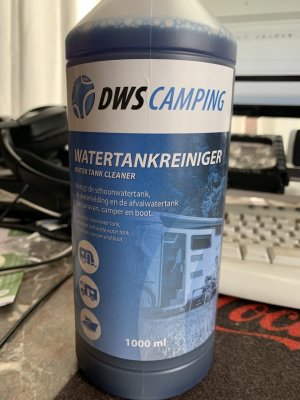
If the tank is reasonably clean but needs sterilising before use you can use Milton Fluid.

The recommended dose for sterilising a tank with Milton fluid is 30ml per 5 litres. Allow to soak for at least 15 minutes and then rinse out.

For a large tank you could use a thin domestic bleach but only at the rate of about 12ml per 5 litre and rinse more thoroughly

Subsequently dose the first fill each season, with 2.5ml Milton per 5 litres. The water is usable after 30 minutes but don't exceed the dose or your tea will taste foul.
.
 
Thanks everyone and cheers so much for your suggestions - will research them and give one (or many) a try :)

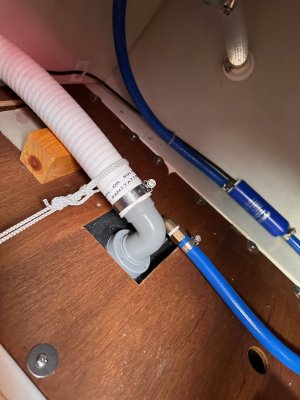
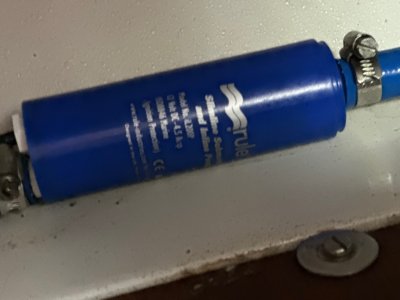
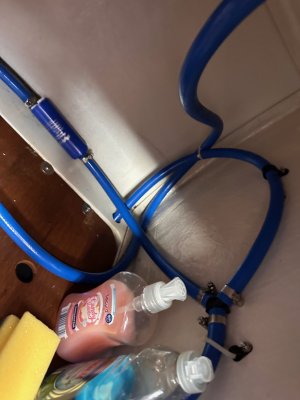
This was the photo of our tank underneath the sink cupboard - it looks like I can unscrew the boards holding it in place so I'll give that a go next week. Just checking, is that blue 'thingy' connected to the hoses the pump (theres a button on the sink unit for a Whale pump) ?

thumbnail_IMG_1597.jpgthumbnail_IMG_1601.jpgthumbnail_IMG_1598.jpg
 
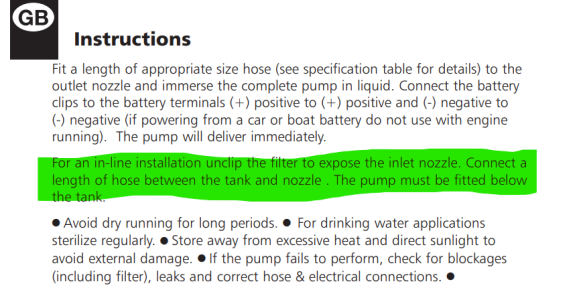
It appears to be an in-line centrifugal pump but it is not normally installed on top of the tank. This type cannot self-prime, so if it runs dry by water running back to the tank it will not pump. Ideally it would be a submersible type inside the tank or a diaphragm type above it. Alternatively you could site the existing pump at the foot of the tank so that it cannot run dry.
 
What is the 3 way thing the pump suction is connected to? Is it a changeover valve meaning there is another tank somewhere?

The instructions confirm what Vyv says about positioning the pump for inline operation

1708892427022.png
 
I have a box of 2000 tablets used by the Military to create drinking water from rivers / streams etc.

1 tablet for 20ltrs ... leave for 20 mins ..... tastes a touch like swimming pool water - but that's the bleaching action.

On the boat - I fill and drain the tank using the usual filler in .. and the sink pump. That gives a rinse of system. Then I half fill the tank. On my boat - that means about 30lts ... I dissolve at least 20 tablets in a bottle .... then pour that into the tank ... I then fill the tank till overflow - then pump through a couple of litres until I can smell the 'tablets' in the water coming through. Stop and leave system for 24hrs.

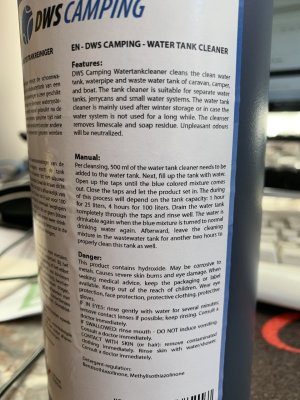
Instead of the tablets - you can use plain unscented bleach ... or as another above - go to camping shop and buy a proprietary fluid .... (Milton Fluid tends to be weaker - but if tanks are not bad - can be used).

They are near all based on bleaching agents.

Once tank has stood - then its pump out all .... fill to flush out - drain - fill to flush - drain ...

I recc'd that the sink outlet is used for all draining - not any drain plug in tank .... BUt if there is a drain plug - you could use it to drop out any sediment etc.

I usually find that there is a slight taste to the water for first day or so of use while pipes etc rid themselves of the 'bleach' ...
 
cheers again so very much - all really helpful and got some things ordered for next weekend when we'll try cleaning/filling the tank

cheers also about the info on the pump and how it's not in a best position/priming - that's very handy to know and am hoping the manual tap pump might be able to help prime it (if not, at least I know we'll need to try and put it lower)

thanks ever so much again to you all :)
 
Our tank had big blisters, making it unusable. As it has a removable lid, screwed down, I took that off and painted the inside with water based epoxy, stuff advertised as suitable for food prep surfaces. New pipes, new pump, it’s sorted.
 
I don't know the size of your tanks, but if they are big and you plan this fill/rinse/empty/fill/rinse/empty cycling it might be quicker to do it while on the hard, by syphoning the water out with a largish hose. I have about 400l and if I wanted to empty them with the electric water pump it would take hours, even with all taps open.
 
main reason to use the installed system to drain - is to get the flushing solution into every pipe / joint etc. to clean it all.

Of course if you have large tanks - then as long as a reasonable amount is passed via the system - rest can be pumped out by faster means.
 
I don't know the size of your tanks, but if they are big and you plan this fill/rinse/empty/fill/rinse/empty cycling it might be quicker to do it while on the hard, by syphoning the water out with a largish hose. I have about 400l and if I wanted to empty them with the electric water pump it would take hours, even with all taps open.
We have an 800 litre tank. It takes a while but only done the job 3 times in 12 years. The rest of the time the tank is in commission so it stays fresh. We only fill with RO water normally so little risk of contamination
 
We have an 800 litre tank. It takes a while but only done the job 3 times in 12 years. The rest of the time the tank is in commission so it stays fresh. We only fill with RO water normally so little risk of contamination
Similarly, done only one time in 25 years, the water remains fine even in warm waters. I once had to open the inspection hatch of one tank as a level sender was broken, I was very surprised to find the inside essentially clean. No watermaker but I use a mechanical filter at every filling, sometimes it stops its fair bit of algae, in particular in less-frequented pontoons with long pipework exposed to the sun.
 
Top