Wago connectors

You can use any of their range you deem suitable. The 221 series is smaller in physical size than 222 series. Ideal also make a nice version similar to the 221.

Wago connectors are not really pretty though, maybe you can bring the data wires into an adaptable box to keep them all covered and looking "better"?
 
Ah now this is all very helpful. Previously I've soldered those small wires together and insulated between with heat shrink. I've always felt this was not a proper job really, and Garmin give no advice that I've seen on joining the mechanics of joining data wires.

On the winter list will be redoing these connections, always assuming I get time and other more pressing boat works don't prevent it
 
I have found these 261 blocks excellent for fine instrument wires in dry locations - also available in 4, 6 and 8 way blocks too, IIRC, and strong sprung closures so ideal for fine wires and awkward places. https://uk.rs-online.com/web/p/non-fused-terminal-blocks/0815852/

I've got a couple of those in my parts bin, not sure where from, but they do indeed look good for NMEA0183 wiring and suchlike. They can be clicked together to make up strips of any length.

FWIW the guys in the electrical production bay downstairs from my office would insist on crimped-on ferrules on each wire going into such a block ;)

Pete
 
I've got a couple of those in my parts bin, not sure where from, but they do indeed look good for NMEA0183 wiring and suchlike. They can be clicked together to make up strips of any length.

FWIW the guys in the electrical production bay downstairs from my office would insist on crimped-on ferrules on each wire going into such a block ;)

Pete

IIRC they're nickel plated, and though I agree bootlace ferrules would be the ideal, I have found the grip on very fine instrument wires (not subject to strain) excellent without them.
 
though I agree bootlace ferrules would be the ideal, I have found the grip on very fine instrument wires (not subject to strain) excellent without them.

Yeah, I wouldn't bother on my boat either. It mostly just amuses me that even when I've popped in there to make up a quick-and-dirty bit of wiring to test something, I've sometimes been politely stopped on the way out the door and had ferrules added to my temporary creation :)

Pete
 
I am not convinced about using Wago blocks for signal wires - the do have a minimum specified wire size and I suspect that many data wires are thinner than that.

I also think the side-by-side style make them bulky when trying to make several connections (My MFD has a 10 way data cable)

I am just redoing the electronics and I am going for "blue sea" style barrier terminal blocks - they will take rings, forks or bare wires as you prefer.
 
I am not convinced about using Wago blocks for signal wires - the do have a minimum specified wire size and I suspect that many data wires are thinner than that.

Whatever your wiring connection need (except possibly the size of cable you need to cut with a hacksaw) I'm sure Wago have a connector series to suit. Their catalogue is about an inch and a half thick :)

I also think the side-by-side style make them bulky when trying to make several connections

Wago's DIN-rail CageClamp terminals come in at least a four-layer version, possibly more.

Pete
 
Last edited:
I have some of the 261 blocks. They take quite a lot if squeeze to open, I use a mole grip.

They're designed to be poked with a flat-bladed screwdriver, which works fine for me. Surely you can't get mole grips around them when they're screwed to a mounting surface?

Pete
 
IIRC they're nickel plated, and though I agree bootlace ferrules would be the ideal, I have found the grip on very fine instrument wires (not subject to strain) excellent without them.
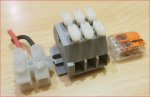
I run a controls business which has used cage clamp screw less connections on a lot of major components for over 15 years. We have been advised by all manufacturers not to use bootlace ferrules on this type of terminal for the recommended gauges of wires that they are approved. Using boot lace ferrules creates a highly loaded point of conduction in the clamp. This both reduces the current carrying capacity and potentially increase the chance of a poor contact if oxidised. Cage clamp terminals are designed to encourage wrap of the stripped bare cables around the internal clamp contact. This increases the contact area considerably.

Eliminating ferrules helps towards building a control panel considerably quicker. You don't faff around with picking up a crimping tool, fitting a bootlace ferrule (without twisting the wires) and crimping each and every cable end is incredibly time consuming and unnecessary.

Most good cage clamp terminals are simply opened by slipping in a screw driver of the right size to open the clamp. I cant think why one would choose some that need mole grips! Inserting a stripped cable is easy and connection is guaranteed without the need for checking tightening torque of screws.

Screw connections should always have boot lace terminations and is a requirement within our build specification. They also need checking after a day or so as very often the connected materials creep and the torque of the screw connection needs a tweak.
 
I run a controls business which has used cage clamp screw less connections on a lot of major components for over 15 years. We have been advised by all manufacturers not to use bootlace ferrules on this type of terminal for the recommended gauges of wires that they are approved. Using boot lace ferrules creates a highly loaded point of conduction in the clamp. This both reduces the current carrying capacity and potentially increase the chance of a poor contact if oxidised. Cage clamp terminals are designed to encourage wrap of the stripped bare cables around the internal clamp contact. This increases the contact area considerably.

Eliminating ferrules helps towards building a control panel considerably quicker. You don't faff around with picking up a crimping tool, fitting a bootlace ferrule (without twisting the wires) and crimping each and every cable end is incredibly time consuming and unnecessary.

Most good cage clamp terminals are simply opened by slipping in a screw driver of the right size to open the clamp. I cant think why one would choose some that need mole grips! Inserting a stripped cable is easy and connection is guaranteed without the need for checking tightening torque of screws.

Screw connections should always have boot lace terminations and is a requirement within our build specification. They also need checking after a day or so as very often the connected materials creep and the torque of the screw connection needs a tweak.

Thanks - as I said (and as prv concurred) I find the grip of the 261 block's clamps excellent on bare instrument wires, but I have tended to go along with the notion that bootlace terminations would be even better. Your post has further reassured me and dispelled any residual qualms of conscience! :)
 
A good point to mention. I do have a photo somewhere from one of the tug boats where a ferule (crimped with the correct tool) had caused a high resistance joint and heated up the cable and tracked back about 3 inches. Only picked up on a visual inspection of a service generator, otherwise would have gone unnoticed until it melted.

We have been advised by all manufacturers not to use bootlace ferrules on this type of terminal for the recommended gauges of wires that they are approved. Using boot lace ferrules creates a highly loaded point of conduction in the clamp.
 
They're designed to be poked with a flat-bladed screwdriver, which works fine for me. Surely you can't get mole grips around them when they're screwed to a mounting surface?

Pete

True, once mounted, they need to be pushed. To be honest, I have yet to mount any, they are simply lurking in my toolbox!
TS
 
For the wires of my Nexus/Garmin instruments I have used properly crimped 0.5mm bootlace ferrules and have never had any problems in the six years since I installed them.
 
For the wires of my Nexus/Garmin instruments I have used properly crimped 0.5mm bootlace ferrules and have never had any problems in the six years since I installed them.

Yes, and my soldered and taped Garmin data cables have been totally reliable for several years to, but that does not prove anything
 
Top
