Victron battery bank dead after just three seasons, any bright ideas?

Agreed. But replacing like for like requires no rewiring, extra purchases or knowledge.

I would only ever buy bluetooth LiFePo batteries,
But that is just 4 x cells in a box, with a BMS, for a significantly higher cost.
I am not going to buy separate cells and a BMS, so Paul's quoted price is a bit low. Also need DC-DC charger and new shorepower charger.

My question was about the enhanced performsnce of EFB.

- W
They are still lead acid, although they might last a bit longer than basic open cell batteries, might.

But, you paid £240 for a usable 100Ah, the 314Ah LifePO4 pack give you 250 usable Ah. The get 250 usable Ah with your LA batteries you need to spend £600.

£600 would buy all that most people need for a Lithium installation, so on a cost basis alone it's a no brainer, that's not even factoring in the other, significant benefits of Lithium, especially for someone such as yourself who lives aboard much of the time. When your new batteries get tired, consider Life PO4
 
But that is just 4 x cells in a box, with a BMS, for a significantly higher cost.

They are still lead acid, although they might last a bit longer than basic open cell batteries, might.

But, you paid £240 for a usable 100Ah, the 314Ah LifePO4 pack give you 250 usable Ah. The get 250 usable Ah with your LA batteries you need to spend £600.

£600 would buy all that most people need for a Lithium installation, so on a cost basis alone it's a no brainer, that's not even factoring in the other, significant benefits of Lithium, especially for someone such as yourself who lives aboard much of the time. When your new batteries get tired, consider Life PO4
Should have said, this is for the Scottish boat, the Albin Vega. Not a liveaboard, just occasional extended cruising.

When Avy-J's batteries are replaced it will be with LiFePo, for sure.

- W
 
In my case it does require some rewiring because of Advanced. I could just disconnect but that means I rely on IP43 and 60W solar (both can be set to lithium) to charge service batteries and alternator for engine battery. Can anyone recommend a 250Ah LiFePO4 pack with Grade A cells, built in quality bluetooth BMS? At home base I probably wouldn't hesitate but cruising in Spain with dead batteries is a bit different
 
Agreed. But replacing like for like requires no rewiring, extra purchases or knowledge.

I would only ever buy bluetooth LiFePo batteries, I am not going to buy separate cells and a BMS, so Paul's quoted price is a bit low. Also need DC-DC charger and new shorepower charger.

My question was about the enhanced performsnce of EFB.

- W
Any enhanced performance between lead batteries is insignificant compared to the leap in performance when moving to lithium. I cannot emphasise enough the vast difference. Paul had it right. There is zero reason to buy anything other than moderately priced lead
 
In my case it does require some rewiring because of Advanced. I could just disconnect but that means I rely on IP43 and 60W solar (both can be set to lithium) to charge service batteries and alternator for engine battery. Can anyone recommend a 250Ah LiFePO4 pack with Grade A cells, built in quality bluetooth BMS? At home base I probably wouldn't hesitate but cruising in Spain with dead batteries is a bit different
Just charge the engine battery with the alternator, as it does now, but with no connection to the domestic bank and fit a DC-DC charger.
 
Just charge the engine battery with the alternator, as it does now, but with no connection to the domestic bank and fit a DC-DC charger.
I can do this but need to be sure I can get high quality LiFePO4 in Spain so looking for recommendations. I can get Victron Orion XS €400 ouch. It requires 20mm2 and all my lugs and crimpers are at home!
 
I have just joined forum group to add more information. I have had two sets of Leoch lead/carbon AGMs fail, the first after 18 months and the second after 20 months. The first were replaced under warranty because I had so much data to prove I had charged them correctly. The second set have just died on me very suddenly. My set-up is 4 x 90Ah Leoch Lead carbon deep cycle AGMs, a 50A Victron IP43 charger and a Victron Smartshunt connected on VictronConnect with bluetooth. The IP43 gets current and battery voltage feedback from the shunt. I use expert mode on the IP43, with Absorption of 14.7, Float 13.8v and storage mode of 13.2v. These are voltages measured directly on the battery terminal. After the first set of batteries died I checked with the suppliers that the spec sheet was correct and they confirmed these voltages. I don't have an inverter so don't have any high loads but I wanted lots of back up capacity for anchoring. I also have 100W solar via an MPPT controller on a good day I get about 60 to 65W (June solstice, 42N, panel horizontal). Over winter I disconnect all negatives and batteries have no charge, every two months batteries are reconnected, charged and quickly go into float.

We live aboard for 5 months. I know for sure my batteries have been fully charged regularly, when in a marina overnight the charger regularly goes into storage mode 13.2v. Up until recently the batteries accepted a fair amount of bulk charge and reasonably long absorption with IP43 set on smart absorption. The batteries have died in a matter of weeks, from lasting for a three day (two night passage) using autohelm, all instruments ,fridge and LED nav lights and not going below 50%SoC at end of passage, to not lasting overnight at anchor with fridge and led anchor light, with battery voltage down to 11v and fridge hunting on low voltage

On the recommendation of the suppliers I have tried each battery individually, discharging with 10A load then fully charging until float is reached, a really tedious and time consuming task. Each "fully charged" 90Ah battery has a nominal capacity of about 5Ah before voltage drops through the floor. Each battery then takes about 10Ah of charge mainly bulk then some in absorption.

I am in the process of making another claim, but batteries were bought in UK and we are in Spain with dead batteries. I wouldn't use these rubbish batteries ever again, but it is interesting that this thread started with Victron Lead carbon batteries. So I am steering clear of lead carbon. Previously I had Numax cheap and cheerful sealed lead acid, with a pretty old charger and they lasted 3 or 4 years.

So this is really a warning DO NOT buy Leoch lead carbon deep cycle batteries.
Substitue 90Ah for 115Ah, and you’ve exactly described the failure mode I experienced. Both my banks ended-up with the individual batteries capable of providing around 10Ah before the voltage collapsed under load.

I’ve still not got to the bottom of what went wrong in my case. If I was to hazard a guess, and this is purely gut-feel, it would be that the storage mode of 13.2V combined with the lead-carbon battery characteristics results in the bank APPEARING to to being maintained at 100% charge when behind the scenes the electrolyte/plates are not ACTUALLY fully charged. With a constantly-cycling fridge, for example, each fridge cycle doesn’t get replenished fully and,over time, this kills the battery. Pure speculation, I know!

Another observation I had at the time was that the resting voltage of the lead-carbons at fully charged was always just over 13V, which I think is quite high for a lead acid, and I wondered if this sort of voltage level ‘confused’ the charger into thinking the bank was full too early in a recharge cycle.

Anyway, these are my random thoughts on what I think happened to me. And, BTW, LiFePO4s are fantastic and I’ve no regrets about changing away from AGMs. I now treat my domestic bank like a fuel tank - just top it up every so often and not get hung-up on whether it is at 100% or 50%… game-changer!
 
Substitue 90Ah for 115Ah, and you’ve exactly described the failure mode I experienced. Both my banks ended-up with the individual batteries capable of providing around 10Ah before the voltage collapsed under load.

I’ve still not got to the bottom of what went wrong in my case. If I was to hazard a guess, and this is purely gut-feel, it would be that the storage mode of 13.2V combined with the lead-carbon battery characteristics results in the bank APPEARING to to being maintained at 100% charge when behind the scenes the electrolyte/plates are not ACTUALLY fully charged. With a constantly-cycling fridge, for example, each fridge cycle doesn’t get replenished fully and,over time, this kills the battery. Pure speculation, I know!

Another observation I had at the time was that the resting voltage of the lead-carbons at fully charged was always just over 13V, which I think is quite high for a lead acid, and I wondered if this sort of voltage level ‘confused’ the charger into thinking the bank was full too early in a recharge cycle.

Anyway, these are my random thoughts on what I think happened to me. And, BTW, LiFePO4s are fantastic and I’ve no regrets about changing away from AGMs. I now treat my domestic bank like a fuel tank - just top it up every so often and not get hung-up on whether it is at 100% or 50%… game-changer!
That's interesting. I have an all Victron system and about a year ago (in fact I've just realised that I'm the OP!) I had a very depleted 750ah domestic AGM bank for no apparent reason. I was left wondering whether the Victron Smart Shunt (an ah counter which are notoriusly unreliable for getting out of sync with the batteries) was reporting to the charger via the VE bus that the batteries were fully charged when in fact they weren't. Especially when solar has been maintaining an apparently high voltage for several hours which tricks the shunt in to believing all is fully charged when in fact it isn't. I've never fully resolved the matter.
 
Substitue 90Ah for 115Ah, and you’ve exactly described the failure mode I experienced. Both my banks ended-up with the individual batteries capable of providing around 10Ah before the voltage collapsed under load.

I’ve still not got to the bottom of what went wrong in my case. If I was to hazard a guess, and this is purely gut-feel, it would be that the storage mode of 13.2V combined with the lead-carbon battery characteristics results in the bank APPEARING to to being maintained at 100% charge when behind the scenes the electrolyte/plates are not ACTUALLY fully charged. With a constantly-cycling fridge, for example, each fridge cycle doesn’t get replenished fully and,over time, this kills the battery. Pure speculation, I know!

What charger ?
Another observation I had at the time was that the resting voltage of the lead-carbons at fully charged was always just over 13V, which I think is quite high for a lead acid, and I wondered if this sort of voltage level ‘confused’ the charger into thinking the bank was full too early in a recharge cycle.

Anyway, these are my random thoughts on what I think happened to me. And, BTW, LiFePO4s are fantastic and I’ve no regrets about changing away from AGMs. I now treat my domestic bank like a fuel tank - just top it up every so often and not get hung-up on whether it is at 100% or 50%… game-changer!
 
That's interesting. I have an all Victron system and about a year ago (in fact I've just realised that I'm the OP!) I had a very depleted 750ah domestic AGM bank for no apparent reason. I was left wondering whether the Victron Smart Shunt (an ah counter which are notoriusly unreliable for getting out of sync with the batteries) was reporting to the charger via the VE bus that the batteries were fully charged when in fact they weren't. Especially when solar has been maintaining an apparently high voltage for several hours which tricks the shunt in to believing all is fully charged when in fact it isn't. I've never fully resolved the matter.
If the Smart shunt is correctly configured it should automatically sync with the batteries whenever they reach 100%. If you don't get to 100% every day the SOC gradually drifts more an more out of sync.
 
What charger ?
Bank 1 was, for the first year, on an old Sterling charger (30A on an AGM setting) followed by a couple of months on an Easy Solar on AGM DIP switch setting. Bank 2 was only ever on the EasySolar with same standard AGM settings. I never had the dongle-thing to make any changes to the charge profile myself (I do now!).
 
Substitue 90Ah for 115Ah, and you’ve exactly described the failure mode I experienced. Both my banks ended-up with the individual batteries capable of providing around 10Ah before the voltage collapsed under load.

I’ve still not got to the bottom of what went wrong in my case. If I was to hazard a guess, and this is purely gut-feel, it would be that the storage mode of 13.2V combined with the lead-carbon battery characteristics results in the bank APPEARING to to being maintained at 100% charge when behind the scenes the electrolyte/plates are not ACTUALLY fully charged. With a constantly-cycling fridge, for example, each fridge cycle doesn’t get replenished fully and,over time, this kills the battery. Pure speculation, I know!

Another observation I had at the time was that the resting voltage of the lead-carbons at fully charged was always just over 13V, which I think is quite high for a lead acid, and I wondered if this sort of voltage level ‘confused’ the charger into thinking the bank was full too early in a recharge cycle.

Anyway, these are my random thoughts on what I think happened to me. And, BTW, LiFePO4s are fantastic and I’ve no regrets about changing away from AGMs. I now treat my domestic bank like a fuel tank - just top it up every so often and not get hung-up on whether it is at 100% or 50%… game-changer!
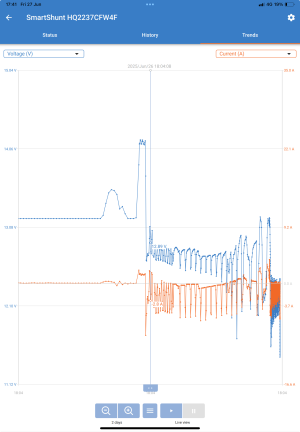
Interesting thoughts. Attached is a screenshot of yesterday and today, we were in a marina and charger was in storage mode 13.2 and only fridge on. If your fridge theory is correct you would expect to see a current draw whilst voltage was at 13.2v it is flat at zero going in or coming out of batteries so charger is compensating to maintain constant voltage. Just to the left of centre is where charger was disconnected and engine started, we then motored for an hour to an anchorage. The dips to the right are the fridge coming on and off overnight plus 0.2A anchor light, during today there is some solar charge but boat is swinging at anchor so there is panel shading. The orange and blue solid stuff on the right is where the fridge is hunting on and off, ie current draw voltage crash, fridge switches off.
 

Attachments

  • Screenshot 2025-06-27 at 17.41.23.png
    Screenshot 2025-06-27 at 17.41.23.png
    468.4 KB · Views: 8
If the Smart shunt is correctly configured it should automatically sync with the batteries whenever they reach 100%. If you don't get to 100% every day the SOC gradually drifts more an more out of sync.
Agree. I found the default voltage and tail current was ending abs charge too early. I set voltage higher and tail current to 1% of C20 battery rating both conditions have to be met to switch from abs to float. The Smartshunt then syncs with charger.
 
Interesting thoughts. Attached is a screenshot of yesterday and today, we were in a marina and charger was in storage mode 13.2 and only fridge on. If your fridge theory is correct you would expect to see a current draw whilst voltage was at 13.2v it is flat at zero going in or coming out of batteries so charger is compensating to maintain constant voltage. Just to the left of centre is where charger was disconnected and engine started, we then motored for an hour to an anchorage. The dips to the right are the fridge coming on and off overnight plus 0.2A anchor light, during today there is some solar charge but boat is swinging at anchor so there is panel shading. The orange and blue solid stuff on the right is where the fridge is hunting on and off, ie current draw voltage crash, fridge switches off.
Those figures are battery killers.
 
I'd be grateful for any views on the below as I have a problem with our recently installed battery bank. The story is that in January 2022 I installed a new battery bank complete with new Victron Multi 3kw/120A and a Balmar 70A alternator etc. The battery bank comprises 6 x Victron Super Cycle AGM 125ah batteries.

Earlier this summer we had a couple of low voltage alarms, didn't worry too much about it initially as the fridge had been running for four hours overnight. However recently we were out sailing and had further low voltage alarms, something is up. I've extracted from VRM the graph below which covers a 26hr period during which we departed the marina berth (batteries fully charged, shorepower on), then anchored overnight then returned to the marina the next day. Here follows a description of what happened:

06.00 1st October - on marina berth, Multi in Storage mode 13.3v, 0.2A
08.54 - departing berth, engine running, shorepower off, 14.5v, 6.0A
09.15 - engine off, sailing, 13.34v, -4.5A Nav kit drawing power
12.00 - anchoring, engine on 14.4v, 23A Alternator charging
12.30 - anchored, engine off, 13.3v, -0.5A
20.45 - fridge on, 12.66v, -6.0A
21.30 - fridge off, 12.75v, -0.5A
02.00 2nd October - fridge on 12.65v, -6.3A
04.30 - fridge off, 12.66v, -0.5A
08.10 - departing anchorage, engine on, 14.4v, 27.7A
08.32 - Sailing, engine off - 12.88v, -5.5A
10.16 - Sailing, Voltage alarm 12.2v, -6A
11.05 - arrived close to marina, 11.12v, -5.5A
11.33 - arrived marina, engine on 14.3v, 31A
11.54 - on berth, engine off 12.9v, -5A
13.20 - on berth, fridge on 12.0v, -3A
13.30 - on berth, fridge off 12.5v, -0.5A
15.30 - fridge on, 12.3v, -6.6A
15.50 - shorepower reconnected

The above is a bit long-winded (!) but it explains the profile below.

View attachment 183901

Conclusion? Batteries are knackered. But how can that be? Here is the Victron shunt history which has not been reset since installation:

View attachment 183899

So the deepest discharge has been 131ah (17.5% of battery bank capacity). Min battery voltage at 10.71v - I don't know when this was, it could have been recently. The max voltage of 15.16v happened very soon after installation when the Balmar regulator was pushing very high voltages immediately after engine start then reducing to 14.8v after a few minutes. I subsequently changed the charge profile so that the max charge voltage was 14.9v.

Today I've had a look at the batteries. They look absolutely fine, no evidence of heating or case distortion. The batteries are temperature monitored to the Balmar and the Victron Multi. In the past 180 days the battery temperature has not exceeded 19deg C.

I have done further tests today. I won't bore you with all the details but in essence I turned the charger off, applied a 28A then a 50A load for a short period then left the batteries with a 5A load, you'll see below that the voltage began to plummet two hours later down to 11.5v.

View attachment 183900

I disconnected the batteries today to test the voltage of each individual battery, they all seemed pretty much the same, no variation between them.

So, I'd be grateful if anyone has any bright ideas. The future options seem to be new AGMs (Rolls or Lifeline not Victron) or maybe think about LifePo4.
Three seasons with lead batteries is not all that bad, by my standards. I get 4 or 5 seasons out of them if I am REALLY careful with them, but I've had many sets that didn't go beyond 3.

These batteries are 19th century Dr. Frankenstein technology which is inherently fragile. Lead oxide paste, lead plates, which start falling apart and flaking off into the bottom of the battery from the first cycle. You have to frequently get them to 100% to prevent sulphation of the plates, and it is agonizing process to do so since they accept very little charge after they reach about 85%. Bah!

I had new battery boxes made a few years ago so that I could at least use heavier-duty golf cart batteries, hoping for a better result. It was a waste of money.

I'm now building a lithium system. The EVE LiFePo4 cells now cost less than golf cart batteries even on a nominal capacity basis, and are far cheaper on a usable capacity basis. They have cycle life of at least 10x and maybe 20x of any lead batteries, so on a per-cycle basis they are an order of magnitude cheaper. There is no longer any good reason not to go to the trouble to convert the electrical system to use these, unless you really just don't spend any time not plugged into shore power.
 
Three seasons with lead batteries is not all that bad, by my standards. I get 4 or 5 seasons out of them if I am REALLY careful with them, but I've had many sets that didn't go beyond 3.

These batteries are 19th century Dr. Frankenstein technology which is inherently fragile. Lead oxide paste, lead plates, which start falling apart and flaking off into the bottom of the battery from the first cycle. You have to frequently get them to 100% to prevent sulphation of the plates, and it is agonizing process to do so since they accept very little charge after they reach about 85%. Bah!

I had new battery boxes made a few years ago so that I could at least use heavier-duty golf cart batteries, hoping for a better result. It was a waste of money.

I'm now building a lithium system. The EVE LiFePo4 cells now cost less than golf cart batteries even on a nominal capacity basis, and are far cheaper on a usable capacity basis. They have cycle life of at least 10x and maybe 20x of any lead batteries, so on a per-cycle basis they are an order of magnitude cheaper. There is no longer any good reason not to go to the trouble to convert the electrical system to use these, unless you really just don't spend any time not plugged into shore power.
Prior to the Victron AGMs I had Lifeline AGMs from which I had fifteen years of excellent service and they were still showing no signs of degradation when I sold the boat. The Lifelines were/are very expensive but I think it was a false economy going for the cheaper Victron batteries, never again.
 
At the present time there are, IMO, only two sensible choices for domestic batteries. Moderately priced sealed lead acid or LifePO4. Any variation of expensive lead acid batteries make no sense.
Having killed my current AGMs by accidentally discharging them down to about 11.4v, I can't get over a desire for lead carbon batteries.

They were good and usable batteries, but with this single mistake I reduced the capacity by at least 25% in a single stroke. Good lead carbon batteries would not suffer this fate.

Now of course one should not discharge one's batteries so deep, and I debate with myself whether the cost would be worth it, but I cannot shake the idea that they would have survived.
 
Having killed my current AGMs by accidentally discharging them down to about 11.4v, I can't get over a desire for lead carbon batteries.

They were good and usable batteries, but with this single mistake I reduced the capacity by at least 25% in a single stroke. Good lead carbon batteries would not suffer this fate.

Now of course one should not discharge one's batteries so deep, and I debate with myself whether the cost would be worth it, but I cannot shake the idea that they would have survived.
4 x 314Ah LifePO4 cells and a JK BMS costs £350 - Usable Ah = 250

A 110Ah lead carbon battery costs about £200. Usable Ah = 55

So to get the same AH from the lead carbon as the Lithium, you need 5 batteries @ £200 = £1000

That 4 x the cost for the same Ah, 5 x the space, 7 x the weight and vastly poorer charging rate.

The BMS stops you over or under charging the battery.
 
4 x 314Ah LifePO4 cells and a JK BMS costs £350 - Usable Ah = 250

A 110Ah lead carbon battery costs about £200. Usable Ah = 55

So to get the same AH from the lead carbon as the Lithium, you need 5 batteries @ £200 = £1000

That 4 x the cost for the same Ah, 5 x the space, 7 x the weight and vastly poorer charging rate.

The BMS stops you over or under charging the battery.
It seems to me that the swap over to lithium is disadvantaged by some sparkies not knowing their onions but claiming that they do. My boat, on the Clyde, has been operated on, prior to my ownership, by a well known "marine electrical contractor". The standard of work has been shockingly bad, I'd not have them back on board for any reason. So, Lithium interests me, but only when I can find a sparky who really does know his onions.
 
Top