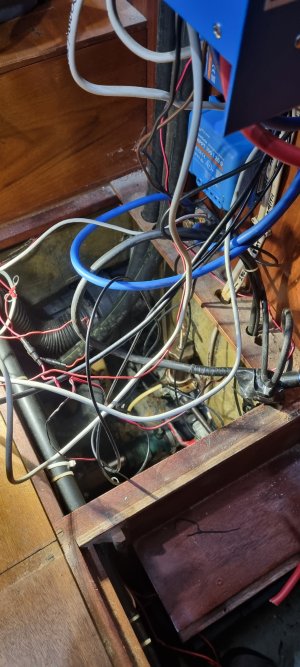
Victron battery bank dead after just three seasons, any bright ideas?

Those figures are battery killers.
Which ones? The abs 14.7v and float 13.8v are those recommended by Leoch, I have checked multiple times. I agree the low voltages are killers, but I only have those low voltages because a bank of 360Ah batteries can't sustain a 5A load for 15minutes. This happened very quickly, I crossed Biscay 55 hours mostly sailing
Those figures are battery killers.
Abs 14.7v and float 13.8v are the recommended voltages. I agree low voltages are killers but I only have them because 360Ah bank can't sustain a 5A load for 15 minutes when it was fully charged 12 hours before. I crossed Biscay 6 weeks ago 55hours mainly sailing, two nights, all instruments and autohelm steering, voltage never dropped below about 12.2v under load, batteries were 60% charged when we arrived and were then fully charged on mains charger. I have read lead carbons have this sudden voltage drop so everything looks good then suddenly voltage drops dramatically. So once they start to go you are in a vicious circle. I have ordered lead acid because I just have survive and on a cruise is not the place to install a safe Lithium system.
 
It seems to me that the swap over to lithium is disadvantaged by some sparkies not knowing their onions but claiming that they do. My boat, on the Clyde, has been operated on, prior to my ownership, by a well known "marine electrical contractor". The standard of work has been shockingly bad, I'd not have them back on board for any reason. So, Lithium interests me, but only when I can find a sparky who really does know his onions.
I agree. There are many things to consider, fusing for massive currents you can draw from LiFePO4, battery to battery charging to save alternator if BMS disconnects on high voltage, emergency switching to engine battery if BMS disconnects on low voltage, and you lose all service power, no instruments, radio etc. Insurance companies are getting twitchy about lithium and DIY installations, although many DIY are better than "professional". Yesterday I heard of an insurance company putting restrictions on charging electric bike on board (OK different lithium technology) including fire extinguisher suitable for lithium fires, no unattended or overnight charging. All sensible measures.
 
Which ones? The abs 14.7v and float 13.8v are those recommended by Leoch, I have checked multiple times. I agree the low voltages are killers, but I only have those low voltages because a bank of 360Ah batteries can't sustain a 5A load for 15minutes. This happened very quickly, I crossed Biscay 55 hours mostly sailing

Abs 14.7v and float 13.8v are the recommended voltages. I agree low voltages are killers but I only have them because 360Ah bank can't sustain a 5A load for 15 minutes when it was fully charged 12 hours before. I crossed Biscay 6 weeks ago 55hours mainly sailing, two nights, all instruments and autohelm steering, voltage never dropped below about 12.2v under load, batteries were 60% charged when we arrived and were then fully charged on mains charger. I have read lead carbons have this sudden voltage drop so everything looks good then suddenly voltage drops dramatically. So once they start to go you are in a vicious circle. I have ordered lead acid because I just have survive and on a cruise is not the place to install a safe Lithium system.
I was referring to the low voltage drops.
 
I agree. There are many things to consider, fusing for massive currents you can draw from LiFePO4,
You cannot draw massive current from LifePO4, the BMS limits current draw, commonly to 200A, although 300A BMS are now available, but a typical leisure boat won't draw anything near that. I wouldn't normally connect windlass and thrusters to the LifePO4 bank. The change from "normal" fusing is because of the potential current in the event of a short in the battery cables.
battery to battery charging to save alternator if BMS disconnects on high voltage,
B to B charging is not for that reason, it is to limit the alternator output to a level it can continuously sustain, because the low resistance of LifePO4 would allow the alternator to output its maximum rating for as long as it takes to charge the battery. Light duty alternators are not rated for continuous max rating.
emergency switching to engine battery if BMS disconnects on low voltage, and you lose all service power, no instruments, radio etc.
This should already be in place with your LA installation, for the reason you give and also for emergency starting if the engine battery dies. Additional consideration need to be taken for emergency engine starting with LifePO4 as it may not be possible to start the engine from the LifePO4 battery.
Insurance companies are getting twitchy about lithium and DIY installations, although many DIY are better than "professional". Yesterday I heard of an insurance company putting restrictions on charging electric bike on board (OK different lithium technology) including fire extinguisher suitable for lithium fires, no unattended or overnight charging. All sensible measures.
It is true that some "professional" installations are extremely poor (not just LifePO4), but i've seen some incredibly dangerous DIY stuff too. I spend a decent amount of my working time un-bodging other peoples cock ups.

How about a recent DIY inverter installation ?

20241009_111703.jpg
 
4 x 314Ah LifePO4 cells and a JK BMS costs £350 - Usable Ah = 250
It's pointless to compare lead-carbon batteries with LifePO4 because lead-carbon batteries are a drop in replacement and LifePO4 aer not.

Obviously if I wanted LifePO4 then I would choose LifePO4 - we all know that LifePO4 has far more usable capacity.

If someone is choosing lead-carbon batteries then there must obviously be some reason they prefer a lead-acid type battery. There might be insurance issues. Lead-carbon batteries are an alternative to AGM, not to LifePO4.
 
I don’t think anyone was arguing against lead based batteries, simply saying that if lead is the answer then the additional cost for lead carbon is extremely hard to justify as it doesn’t improve the battery much in the real world so AGMs would be usually the best choice. If spending the extra money may as well go lithium and do it properly.
 
I don’t think anyone was arguing against lead based batteries, simply saying that if lead is the answer then the additional cost for lead carbon is extremely hard to justify as it doesn’t improve the battery much in the real world so AGMs would be usually the best choice. If spending the extra money may as well go lithium and do it properly.
Having killed my current AGMs by accidentally discharging them down to about 11.4v, I can't get over a desire for lead carbon batteries.

My AGMs were good and usable batteries, but with this single mistake I reduced the capacity by at least 25% in a single stroke. Good lead carbon batteries would not suffer this fate.

Now of course one should not discharge one's batteries so deep, and I debate with myself whether the cost would be worth it, but I cannot shake the idea that they would have survived.
 
Victon's data sheets claim "Tests have shown that our lead carbon batteries do withstand at least five hundred 100% DoD cycles." I'm not planning to replicate this, but I don't believe that they're lying and it implies that these batteries are considerably more resilient to deep discharging than cheap AGMs.
 
Victon's data sheets claim "Tests have shown that our lead carbon batteries do withstand at least five hundred 100% DoD cycles." I'm not planning to replicate this, but I don't believe that they're lying and it implies that these batteries are considerably more resilient to deep discharging than cheap AGMs.
Tests in a lab. Lead battery manufacturers claim all sorts but reality is somewhat different, in my experience
 
Having killed my current AGMs by accidentally discharging them down to about 11.4v, I can't get over a desire for lead carbon batteries.

My AGMs were good and usable batteries, but with this single mistake I reduced the capacity by at least 25% in a single stroke. Good lead carbon batteries would not suffer this fate.

Now of course one should not discharge one's batteries so deep, and I debate with myself whether the cost would be worth it, but I cannot shake the idea that they would have survived.
I wouldn't waste your money. This thread started with Victron Lead carbon, then Leochs. After two sets have failed in the same manner I have come to the conclusion they perform well in laboratory conditions, where they are cycled to varoius states of discharge then immediately recharged. They don't perform well in real life.
 
I wouldn't waste your money. This thread started with Victron Lead carbon, then Leochs. After two sets have failed in the same manner I have come to the conclusion they perform well in laboratory conditions, where they are cycled to varoius states of discharge then immediately recharged. They don't perform well in real life.
But only some situations/installations - others seem to have success with their installation and use-pattern. There doesn't seem to be an obvious answer as to why the 3 individual setups described in this thread all seemed to fail in the same manner/symptoms with the same(ish) charging equipment.
 
This thread opened with Victron Super Cycle batteries which had been charged at 15V and discharged to 11.12V and 10.71V.

Victron's Super Cycle are not the same as their lead-carbon batteries, @MB58 - I'm pretty sure the "super cycle" are just posh AGMs. They are very nearly as expensive as the lead carbon, if I recollect, but if you compare the datasheets you'll see there's quite a gap between them.

I didn't scrutinise yet what happened with the Leochs, but will do when I'm sober.
 
Last edited:
Victon's data sheets claim "Tests have shown that our lead carbon batteries do withstand at least five hundred 100% DoD cycles." I'm not planning to replicate this, but I don't believe that they're lying and it implies that these batteries are considerably more resilient to deep discharging than cheap AGMs.
Victron is a highly reputable company which wouldn't risk its reputation by lying about one niche product, so I'm sure you're right there.

But how do the economics work out? If it has triple the usable life of ordinary FLA batts but costs triple -- who cares? LiFePo4 has 10x or 20x the useful life and costs LESS than ordinary FLA batteries.
 
Victron is a highly reputable company which wouldn't risk its reputation
I think you'd be surprised. Victron have released multiple sub-par products recently, and their support in the UK has been extremely poor for us so as far as I'm concerned their reputation is in the mud. I'm sure that BMSTech will swap faulty units out quickly, but any genuine product issue and they just close the ticket as unfixable. Examples include a buzzing charger, B2B that makes tachometers go crazy, B2B that interferes with VHF (now allegedly fixed), and charger that immediately alarms when turned on because "bulk time exceeded" with no way to silence the alarm other than a full reset of the device. Every one of these were raised with Victron/BMSTech and not one was addressed or taken seriously.
 
I think you'd be surprised. Victron have released multiple sub-par products recently, and their support in the UK has been extremely poor for us so as far as I'm concerned their reputation is in the mud. I'm sure that BMSTech will swap faulty units out quickly, but any genuine product issue and they just close the ticket as unfixable. Examples include a buzzing charger, B2B that makes tachometers go crazy, B2B that interferes with VHF (now allegedly fixed), and charger that immediately alarms when turned on because "bulk time exceeded" with no way to silence the alarm other than a full reset of the device. Every one of these were raised with Victron/BMSTech and not one was addressed or taken seriously.
I hate to say it - but I know what you mean. Buying Victron kit from the box shifters is a dodgy business because they have no backup or knowledge to offer, once you've bought it you're on your own. Victron aren't interested, they say speak to your supplier. So buy the kit from a decent marine sparks, you pay more, but it comes with at least some backup/support. But therein lies the problem, finding a decent marine electrician. I expect there are some about (Paul Rainbow of this parish is one) but there are an awful lot of pretenders out there......
 
I should add that BMSTech are both the imported and the Victron official support in the UK so should absolutely be in a position to support.
Paul is good, but he’d be in the same position as the rest of us with these issues as they’re a mix of hardware and software bugs, not installation issues or device failures.
The problem comes when you explain to support that it’s a product problem and replacement will result in the same outcome. Victron don’t want to hear about design problems or software bugs, at least from the UK.
 
Top