Test run of the Lithium system that has been sitting in my cellar for most of this year.

Baggywrinkle

Well-Known Member
Joined
6 Mar 2010
Messages
10,582
Location
Ammersee, Bavaria / Adriatic & Free to roam Europe
Visit site
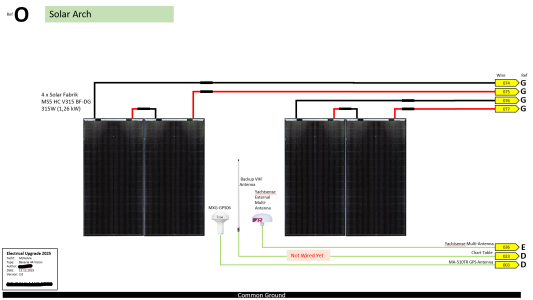
I started this year with good intentions and a huge upgrade plan for the boat. I completely underestimated the time the project would take and ended up giving up in the summer to go sailing - admittedly I lost 2 months at the beginning of the year getting the solar arch made, and another month on the bowsprit and code-zero fittings, so that didn't help. I ended up connecting the solar panels to the 520Ah of Gel batteries the boat already had, and put the lithium install on hold until this winter.

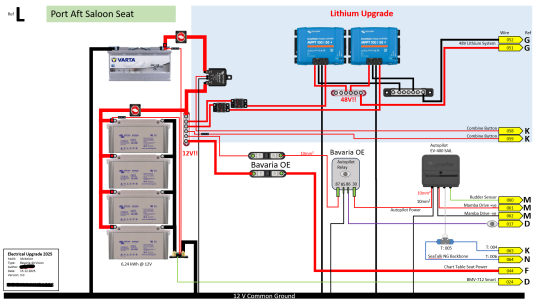
This is the overview of the upgrade, I've got all the bits in green finished and I have ripped out everything that was there before including the wiring.
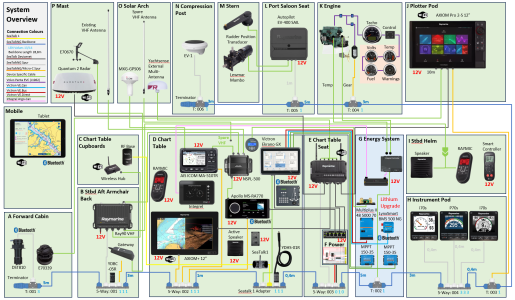
1765740376465.pngWell, winter has come around and I was starting to panic a bit about the batteries sitting in the cellar since March and self-discharging - so I was spurred on to hook it all up and charge them, and also complete the commissioning and setup of all the components - spurred on by @geem post about induction instead of gas.

The reasoning behind what I have built is as follows ...

•The Integrel E-Power system was chosen as an alternative to fitting a diesel generator. The ability to generate 6-9kW from the main propulsion engine in an intelligent manner tailored to the particular engine/prop combination is unique in the market and makes Integrel stand out from Wakespeed, Balmar, Zeus etc. It does however force a 48V Lithium system which in itself is not a problem, but the shortage of native 48V components at this time forces a dual voltage system.

•The original 12V Gel bank of 520Ah was retained as it provides a large buffer to run heavy 12V loads – this was done because the boat has a number of 12V electrical winches, a 12V windlass, and a 12V bow thruster – but the current inverter load will be on the Lithium system when it is installed.

•For the 48V -> 12V charging, 2 x 100-50 Smart Solar MPPTs were chosen instead of Orions. This solution is not recommended due to possible shorting of the MPPT inputs resulting in large current draw exceeding the MPPT spec. A Battery Protect has been installed between the 48V feed and the MPPTs which “may” mitigate this. This solution is in use on many boats, and feedback from both the boating community and Victron community is positive. Maybe a 100A 48V-12V Orion will be offered by Victron eventually.

•For winter storage, the solar panels can be routed to the 100-50 Smart Solar MPPTs charging the 12V system, and the 48V system can be shut down. This is a hidden benefit of the decision to use MPPTs for 48V to 12V charging.

•Both Victron and Integrel can communicate and implement Victrons Distributed Voltage and Current Control (DVCC). NMEA2000 was chosen over hard wired ATC/ATD signals and/or VE.Can conversion connections. The Ekrano GX and the Integrel Controller are connected to the Raymarine SeatalkNG network with appropriate cables as described in the Inegrel E-Power Installation Guide V5.5 from June 2025, section 5.9, “CAN bus Networks with Victron over VE.Can”. The ATD/ATC connections to the Integrel Smart Switch will therefore be left disconnected.

•The main 48V Battery shut off is implemented using the Victron Smart BMS remote Switch input. Additionally the cable run from the batteries to the Lynx Class-T Power In are both extremely short and will be physically protected, so a combination of Class-T fuses and BMS disconnect should provide adequate protection.


This is hopefully the final version of the wiring diagram, so any feedback would be very welcome, especially if anyone notices any glaring errors. ..
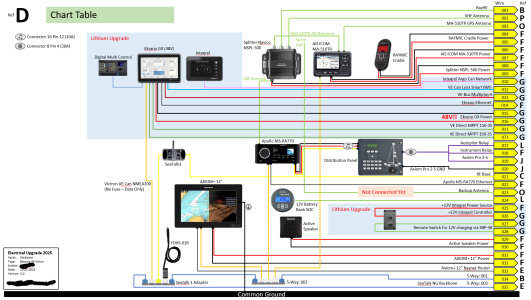
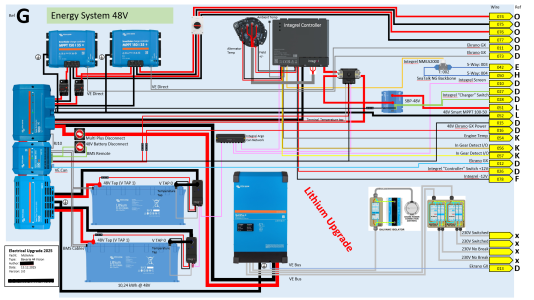
1765740556312.png1765740165737.png

1765740662985.png

1765740751344.png

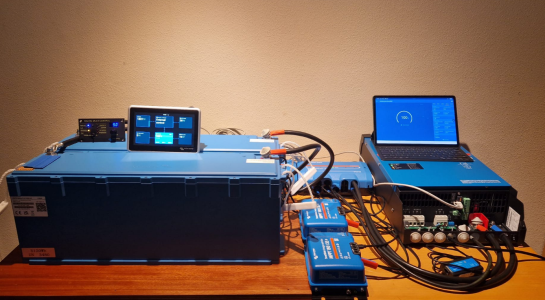
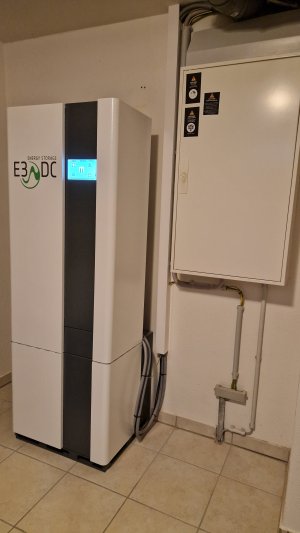
This is it all connected and working on the bench, after 8 hours and 5,7kWh from a 16A mains socket all the 16 cells are perfectly balanced and happy. Result!!! .... now to build it into the boat.

1765740224896.png
 
Congrats!

What concerns self-discharge -- I have 16 grade-A EVE cells which have been waiting for my repeatedly delayed lithium build, for more than a year.

They are still at 70%. Self-discharge for a completely disconnected lithium battery stored at moderate temperatures is very small, much less than the spec.
 
Congrats!

What concerns self-discharge -- I have 16 grade-A EVE cells which have been waiting for my repeatedly delayed lithium build, for more than a year.

They are still at 70%. Self-discharge for a completely disconnected lithium battery stored at moderate temperatures is very small, much less than the spec.
My batteries were delivered in April but I'm not sure what the state of charge was. For international shipping they should be between 30% and 50% but some suppliers do a courtesy charge on delivery so they can be delivered at 100%.

When I connected them 8 months later they took 5,7 kWh which is 55% of the capacity, so they must have been sitting at about 45% after 8 months. As I didn't know the state of charge on delivery, I don't know what the self discharge rate is for these batteries. The cells themselves are connected to circuitry as they are intelligent batteries, so the self-discharge rate is probably more than cells connected to nothing.

A self-discharge rate of 0.5% to 2% per month at room temperature is expected, but as self discharge is the number one battery killer and it continues even if the battery/bms shuts down, I was a bit anxious - they weren't cheap and to brick them before even getting them fitted would be very stupid.

As it is, they charged fine, and all the cells balanced to the same voltage so it's all good.

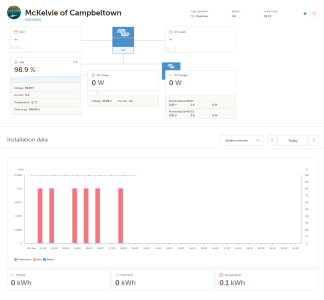
In the picture below, self consumption of the system is 10W ... and this includes connection to WiFi and the VRM Portal for remote monitoring. Inverter/Charger is off, but the two MPPTs are on with no panels attached.

I can remotely turn the solar on and off so can hopefully prevent the Li sitting permanently at 100% (1,2kW of panels on the boat) ... and the Li bank charges the 12V LA bank ... would be great to get it all automated so that the boat just sits there and looks after both the Li and the LA banks.

1766481849675.png
 
All very neat.

Why did you not connect the solars, charge the batteries and use the power running a power cable from the cellar to a fridge, deep freeze - or whatever.

Jonathan
 
I started this year with good intentions and a huge upgrade plan for the boat. I completely underestimated the time the project would take and ended up giving up in the summer to go sailing - admittedly I lost 2 months at the beginning of the year getting the solar arch made, and another month on the bowsprit and code-zero fittings, so that didn't help. I ended up connecting the solar panels to the 520Ah of Gel batteries the boat already had, and put the lithium install on hold until this winter.

This is the overview of the upgrade, I've got all the bits in green finished and I have ripped out everything that was there before including the wiring.

View attachment 203566Well, winter has come around and I was starting to panic a bit about the batteries sitting in the cellar since March and self-discharging - so I was spurred on to hook it all up and charge them, and also complete the commissioning and setup of all the components - spurred on by @geem post about induction instead of gas.

The reasoning behind what I have built is as follows ...

•The Integrel E-Power system was chosen as an alternative to fitting a diesel generator. The ability to generate 6-9kW from the main propulsion engine in an intelligent manner tailored to the particular engine/prop combination is unique in the market and makes Integrel stand out from Wakespeed, Balmar, Zeus etc. It does however force a 48V Lithium system which in itself is not a problem, but the shortage of native 48V components at this time forces a dual voltage system.

•The original 12V Gel bank of 520Ah was retained as it provides a large buffer to run heavy 12V loads – this was done because the boat has a number of 12V electrical winches, a 12V windlass, and a 12V bow thruster – but the current inverter load will be on the Lithium system when it is installed.

•For the 48V -> 12V charging, 2 x 100-50 Smart Solar MPPTs were chosen instead of Orions. This solution is not recommended due to possible shorting of the MPPT inputs resulting in large current draw exceeding the MPPT spec. A Battery Protect has been installed between the 48V feed and the MPPTs which “may” mitigate this. This solution is in use on many boats, and feedback from both the boating community and Victron community is positive. Maybe a 100A 48V-12V Orion will be offered by Victron eventually.

•For winter storage, the solar panels can be routed to the 100-50 Smart Solar MPPTs charging the 12V system, and the 48V system can be shut down. This is a hidden benefit of the decision to use MPPTs for 48V to 12V charging.

•Both Victron and Integrel can communicate and implement Victrons Distributed Voltage and Current Control (DVCC). NMEA2000 was chosen over hard wired ATC/ATD signals and/or VE.Can conversion connections. The Ekrano GX and the Integrel Controller are connected to the Raymarine SeatalkNG network with appropriate cables as described in the Inegrel E-Power Installation Guide V5.5 from June 2025, section 5.9, “CAN bus Networks with Victron over VE.Can”. The ATD/ATC connections to the Integrel Smart Switch will therefore be left disconnected.

•The main 48V Battery shut off is implemented using the Victron Smart BMS remote Switch input. Additionally the cable run from the batteries to the Lynx Class-T Power In are both extremely short and will be physically protected, so a combination of Class-T fuses and BMS disconnect should provide adequate protection.


This is hopefully the final version of the wiring diagram, so any feedback would be very welcome, especially if anyone notices any glaring errors. ..
View attachment 203567View attachment 203564

View attachment 203568

View attachment 203569

This is it all connected and working on the bench, after 8 hours and 5,7kWh from a 16A mains socket all the 16 cells are perfectly balanced and happy. Result!!! .... now to build it into the boat.
View attachment 203565

Nice work. I can totally relate to how much time this sort of project takes to plan and install. And drawing the diagrams is largely the easy bit!

I don’t like the MPPTs being used as DC converters but you already understand the risks. If the MPPT decides to short the PV input I suspect it will wipe out your Class T fuses (as well as blowing up the MPPTs).

Just make sure you never get the max voltage settings wrong… and don’t tell Victron.
 
All very neat.

Why did you not connect the solars, charge the batteries and use the power running a power cable from the cellar to a fridge, deep freeze - or whatever.

Jonathan
Because my solar panels are unfortunately mounted on a solar arch on the back of the boat 650km away, and I didn't have a long enough cable.
 
Nice work. I can totally relate to how much time this sort of project takes to plan and install. And drawing the diagrams is largely the easy bit!

I don’t like the MPPTs being used as DC converters but you already understand the risks. If the MPPT decides to short the PV input I suspect it will wipe out your Class T fuses (as well as blowing up the MPPTs).

Just make sure you never get the max voltage settings wrong… and don’t tell Victron.
I'm not happy with them either really ..... if only Victron would do an Orion XS 48-12 50 :( .... the MPPTs will be pulling around 12,5 A on the 48V side for 50A on the 12V side, which is probably more than the battery can take. I did think about fusing the 48V side with 20A fast blow fuses ... and if they ever blow, then I need to remove the MPPTs.
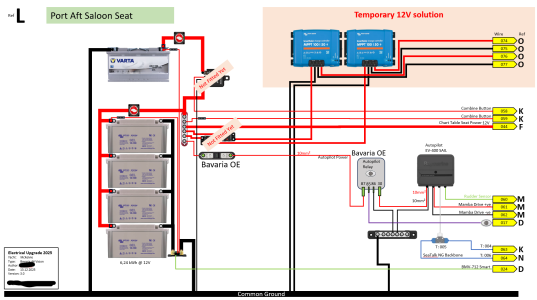
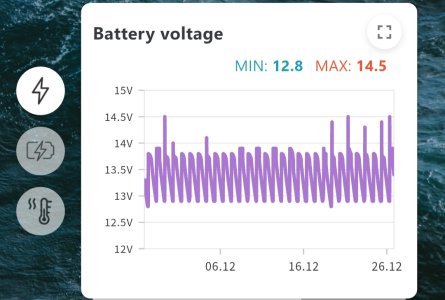
Currently the boat is sitting in the Marina with the solar keeping the 12V LA bank full with the 2 x Smart Solar MPPTs 100-50s .... which is fine. Looks like this ...

1766780941204.png

.. and this is the daily cycle ...

1000026410.jpg

When I add the Li bank, then I need a different strategy, as the Li shouldn't be cycled from 99% to 100% every day, but I still need to keep the LA bank in float/storage at 100%.

I've been playing with Victrons VRM Portal since I set it all up ..... I can turn off the inverter and disconnect the batteries from the loads (including the MPPTs) remotely, and the Ekrano, Batteries, and BMS remain online using about 0,05kWh a day.

Disconnecting the loads means over winter I can leave the Lithium at around 70% and it won't be charged every day by the solar, but the 12V bank will also not be charged any more.

Still mulling over how I can fix this. The charging of the 12V LA bank is actually still up in the air. The expensive solution is a Mastervolt Mac Plus 48-12 but I don't really want another ecosystem on board, the Orion-Tr-Smart 48 I 12-30 apparently runs quite hot and is not particularly efficient compared to the Orion XS 1400 ..... if only they could up the input voltage of the XS to 48V,
 
I'm not happy with them either really ..... if only Victron would do an Orion XS 48-12 50 :( .... the MPPTs will be pulling around 12,5 A on the 48V side for 50A on the 12V side, which is probably more than the battery can take. I did think about fusing the 48V side with 20A fast blow fuses ... and if they ever blow, then I need to remove the MPPTs.

Currently the boat is sitting in the Marina with the solar keeping the 12V LA bank full with the 2 x Smart Solar MPPTs 100-50s .... which is fine. Looks like this ...

View attachment 204067

.. and this is the daily cycle ...

View attachment 204069

When I add the Li bank, then I need a different strategy, as the Li shouldn't be cycled from 99% to 100% every day, but I still need to keep the LA bank in float/storage at 100%.

I've been playing with Victrons VRM Portal since I set it all up ..... I can turn off the inverter and disconnect the batteries from the loads (including the MPPTs) remotely, and the Ekrano, Batteries, and BMS remain online using about 0,05kWh a day.

Disconnecting the loads means over winter I can leave the Lithium at around 70% and it won't be charged every day by the solar, but the 12V bank will also not be charged any more.

Still mulling over how I can fix this. The charging of the 12V LA bank is actually still up in the air. The expensive solution is a Mastervolt Mac Plus 48-12 but I don't really want another ecosystem on board, the Orion-Tr-Smart 48 I 12-30 apparently runs quite hot and is not particularly efficient compared to the Orion XS 1400 ..... if only they could up the input voltage of the XS to 48V,

Why not just bin the MPPTs off and use a couple of 230V chargers via the inverter to charge the lead acid bank?

I wouldn’t worry about “floating” the lfp batteries at 100%. We have literally thousands of them doing that in standby applications with no noticeable capacity loss.

You could use Node Red and the Cerbo’s API to control it though if you really want to.
 
If I was designing from scratch I’d go for multiple combi charger/inverters for redundancy 3 ideally (I’ve had breakages and relying on one is bad) and with extra high capacity as they usually drop charge current a fair bit when warm, up to a quarter, plus the batteries can take a fast charge easily up to spec limits. If you have an excess it’s possible to dial current down. The opposite is not possible. I suspect it’s far too late to hear this though. For others it’s a consideration.
 
Last edited:
If I was designing from scratch I’d go for multiple combi charger/inverters for redundancy 3 ideally (I’ve had breakages and relying on one is bad) and with extra high capacity as they usually drop charge current a fair bit when warm, up to a quarter, plus the batteries can take a fast charge easily up to spec limits. If you have an excess it’s possible to dial current down. The opposite is not possible. I suspect it’s far too late to hear this though. For others it’s a consideration.
I suppose I could leave the original 12V inverter and charger in place as a backup should the 48V one die ...
 
Why not just bin the MPPTs off and use a couple of 230V chargers via the inverter to charge the lead acid bank?

I wouldn’t worry about “floating” the lfp batteries at 100%. We have literally thousands of them doing that in standby applications with no noticeable capacity loss.

You could use Node Red and the Cerbo’s API to control it though if you really want to.
I did think of that with 230V chargers, and after the comment from @Zing I'm now leaving the original 12V charger and inverter on the boat and wired as emergency backups. Generally I try and avoid daisy-chaining dependencies, which would be the case if charging of the 12V bank was dependent on the inverter and a 230V charger. I don't have anything critical on the 230V system, it's more of a luxury, critical stuff is all on the 12V side.

I appreciate the comment on "floating" lfp batteries, I guess the 150 I 35 MPPTs will give a safe float voltage and I'm worrying for nothing... what systems do you know of that do this?

... I do have a spare Raspberry Pi which is currently a redundant Cerbo GX (Venus OS) so that had crossed my mind as a Node Red "charging master", but the Admiral is already getting fed up with the amount of time I've spent on boat projects last year, need to tread carefully.
 
Can I ask what you used to create the schematic diagrams - they look very good!
Powerpoint 😍 ..... not easy but I created all the pics with Photoshop by removing the backgrounds and saving as PNGs as they support transparency, then pasted them into PPT and grouped the pic with tiny circles as the connectors (which have 8 attachment points for lines). The auto-routing of PPT for lines isn't great but useable.

.. but the Victron Community has many fans of this ... Flowchart Maker & Online Diagram Software
 
Top