Treating the bottom of my Iron Keel

Jon magowan

Well-Known Member
Joined
23 Jan 2023
Messages
155
Visit site
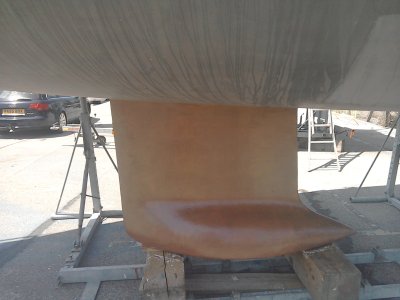
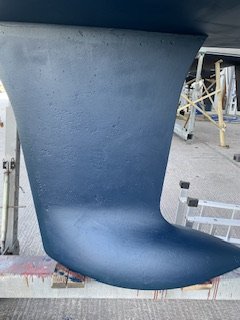
Here is a picture of my cast iron keel on my Bavaria. It’s been blasted and treated with epoxy primer etc. The boat is due to go back in the water in a couple of days.
The only part of the boat that I couldn’t access was obviously the flat bottom of the keel since the boat is resting on it. I will be able to get to the bottom of the keel briefly when the boat is in the sling on the way to the water. The staff have said they will give me a little while to do whatever I need to do before dunking the boat.
My question is, what should I do to the flat bottom of the keel in the short while I have to treat it ? Obviously it’s rusty, pitted and just raw, exposed cast iron. Do any options exist given the short time scale or do I just live with it ?
 

Attachments

  • IMG_2175.jpeg
    IMG_2175.jpeg
    28.6 KB · Views: 25
live with it and maybe next time it is out get thicker blocks under either end of the keel and see if you can do anything with the bit in the middle. Then next year have one block in the middle and deal with the end. Had the same issue when I re coppercoated mine but did manage to clean a section of the underside and put on some conventional AF, but not sure it did any good!
 

Attachments

  • IMG_20200623_150038.jpg
    IMG_20200623_150038.jpg
    650.9 KB · Views: 20
I have the same issue with my steel boat keel. I did what I could when lifted with a travel lift but last several years it been antifouled on a scrubbing post or a wheeled dolly supported on the keel.

You could try jacking the keel up and packing it with thin pieces of wood to give access a Tranona suggested moving the packing to gain access to all parts of the keel bottom
 
Can it not be put in a cradle with a spot of clearance under the keel next time, and do a proper job with no time pressure?
You’d have to be very careful about how much load is on each pad of the cradle. Boats normally rest on the hard with most of their weight on their keels and the cradle taking a little load but mostly just keeping the boat upright.
 
You’d have to be very careful about how much load is on each pad of the cradle. Boats normally rest on the hard with most of their weight on their keels and the cradle taking a little load but mostly just keeping the boat upright.

I have a 20 ton ferro boat sitting on 2 railway ties with no issue and I can jack up the boat supported by gum poles to move the railway ties to an different location to allow cleaning ad painting the underside of my keel
 
This is a general problem which I have faced for decades.
My priority would be to stop water getting between your lovely new epoxy and the metal - possibly with some underwater primer.
See if you can persuade the yard team to lift you last thing one day and put you in the day after to gain time
If not see if they can have lunch between lift and launch.
If they have been party to the blasting and epoxy coating then they should be able to tell you how to seal the bottom edge.

Typically I have just had to slap a very thick layer of anti foul but occasionally they will be helpful.
 
I have a 20 ton ferro boat sitting on 2 railway ties with no issue and I can jack up the boat supported by gum poles to move the railway ties to an different location to allow cleaning ad painting the underside of my keel
Your ferro boat is quite probably much structurally stiffer than a modern production GRP fin-keeler. I really wouldn't like to see my (Jeanneau but most makes are now similar) supported just by pads to the hull with keel in the air. OK short term in correctly positioned lifting strops, but not just pads. Like most people I do a minimal scrape of dried rust/weed/dead sea squirts and slap AF on the underside of the keel in the few minutes before launch.
 
I have a 20 ton ferro boat sitting on 2 railway ties with no issue and I can jack up the boat supported by gum poles to move the railway ties to an different location to allow cleaning ad painting the underside of my keel
Might be no issue with that boat but there are plenty of GRP boats that would be seriously compromised by being suspended on a few pads.
 
Your ferro boat is quite probably much structurally stiffer than a modern production GRP fin-keeler. I really wouldn't like to see my (Jeanneau but most makes are now similar) supported just by pads to the hull with keel in the air. OK short term in correctly positioned lifting strops, but not just pads. Like most people I do a minimal scrape of dried rust/weed/dead sea squirts and slap AF on the underside of the keel in the few minutes before launch.

i would no support on pads under the hull my railway ties are under the keel
 
Can it not be put in a cradle with a spot of clearance under the keel next time, and do a proper job with no time pressure?
That is on a Bavaria with a draught of over 2m (compared with my sister with the 1.5m keel) and will end up very high off the ground to get any working clearance underneath. We discussed this at great length when the Coppercoat was originally applied - the boat was straight from the factory - and the yard were not prepared to block it so high and leaving it in slings for the 4 days it takes was not practical or affordable.
 
It seems there is no real practical, proper solution to the problem. By that, I mean treated to the same degree as the rest of the keel.
So, let’s say the bottom of my iron keel never gets any attention. What is likely to happen over the course of, let’s say, 10 years ?
 
Ok my boats quite a bit smaller, but when the boat was on the crane to be lifted in. I gave the bottom of the keel a quick scrape and a splat of antifoul.
 
It seems there is no real practical, proper solution to the problem. By that, I mean treated to the same degree as the rest of the keel.
So, let’s say the bottom of my iron keel never gets any attention. What is likely to happen over the course of, let’s say, 10 years ?
Not a lot. our hoist crew scrape the bottom of the keel as part of the pressure wash process and that gets rid of most of the rust, barnacles weed etc. Then roll over some AF while in slings before launching at the same time as doing the pads. Lot of bulk in the keel!
 
Ok, so I’ll probably leave it and try not to lose any sleep !
By the way, is there any such thing as a quick dry anti foul paint ? My SeaJet stuff takes at least one hour just to go off and 18 hours before immersion. Not much point putting that on just before launch presumably.
 
Why do people buy boats that cannot be properly maintained? Presumably this is why racers dry sail their boats. Though if I owned a fin keeler I’d be tempted to have a cradle built that would do the job, ie give the support that is needed. We have a slip cradle, though if we want to remove the centreboard we need to have her lifted higher.
 
Because for most people it is no big deal and having it cleaned once or twice a year is fine. Having said that many of the smaller keel boats that are raced in our club do indeed have cradles that will allow access under the keel, but for a cruiser the benefits are small if any
 
Ok, so I’ll probably leave it and try not to lose any sleep !
By the way, is there any such thing as a quick dry anti foul paint ? My SeaJet stuff takes at least one hour just to go off and 18 hours before immersion. Not much point putting that on just before launch presumably.
Pity you did not Coppercoat having gone to the trouble of blasting.

This is the AF I use CU-PRO Antifouling | Commercial Grade | For Leisure Use which has similar drying/immersion times.
 
Ok, so I’ll probably leave it and try not to lose any sleep !
By the way, is there any such thing as a quick dry anti foul paint ? My SeaJet stuff takes at least one hour just to go off and 18 hours before immersion. Not much point putting that on just before launch presumably.
I think OP will find that A/F applied to bottom of keel will be sufficiently dry or at least resistant to water washing off the A/F befoe it hits the water. Not ideal but not worth worrying about. ol'will
 
Top