Trailer brakes

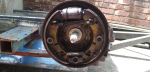
Its the old hydraulic cylinder........ the assembly is I guess an old car rear brake assembly
Looks pretty similar, but not the same, as the ex Mini rear brakes that I have on my trailer. The trailer brakes will operate the old hand brake mechanism

IIRC the cylinder is bolted on so does not move but the pistons should move, although maybe rusted into position now,
Maybe its only held with clip so that it slides a bit ... I forget. sorry.

It may have some automatic adjustemt ( although the mini ones dont) otherwise the part at the bottom incorporates the adjuster .... square head on the back
????

If you remove the shoes note the position of all the bits an pieces carefully first.... but you know that from overhauling your car brakes.
 
Last edited:
I cannot see how the cylinders are fixed on mine but it looks as though the old brakes pipe where rigid, not hoses, so I guess it would not have moved.

Just realised your trailer is upside down . They could be old Mini brakes. .....If the wheels are 10" diam very likely to be ex Mini
 
Last edited:
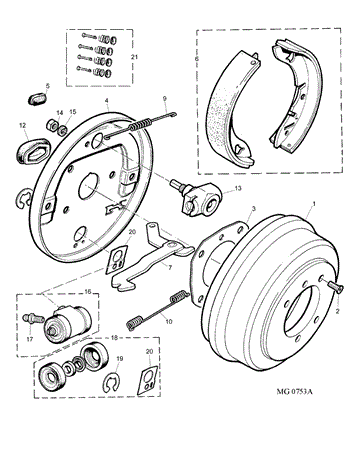
From that site parts diagram shows that the wheel cylinder is held with a circlip #17 ....... I was not looking for that

image.axd
 
It's not Mini brakes. The adjuster on the Mini is part of the back plate whereas the one in the picture has a bolt-in alloy adjuster.
It is an Austin 1100/1300 brake. (Or maybe a later Classic Mini or Metro brake)

Like this
rearbrakesproperlyassembled.jpg


Note that the spring across the handbrake mechanism in your picture is the wrong way around.
The wheel cylinder is not a sliding one. It has a rolled pin locating it in back plate.
It doesn't need to work as it is compressed in normal use, only being extended during braking, using the hydraulic system. But it needs to be there as it locates the heel of the brake shoe.

It should be held in place with a circlip. The rolled pin stops it rotating and damaging the bleed nipple.

image.axd


Metro brakes from Rimmer Bros catalogue
GRID000428.jpg
 
Last edited:
Very helpful replies there chaps. Well done to Vic's for identifying that the trailer was upside down.

I'm still not sure what the cylinder is supposed to do but they were quite loose and the fixings on the back were no longer usable or identifiable so we ended up welding the cylinders to the backplate and braking seems to be improved.
 
Very helpful replies there chaps. Well done to Vic's for identifying that the trailer was upside down.

I'm still not sure what the cylinder is supposed to do but they were quite loose and the fixings on the back were no longer usable or identifiable so we ended up welding the cylinders to the backplate and braking seems to be improved.

If you haven't got hydraulic brakes on the trailer it's doing nothing except locate the ends of the shoes. As shown in the posts above it's a standard back plate assembly.

Some cylinders are supposed to move a bit and I think yours should - it's the only way to centralise the shoes. The adjuster at the bottom of the photo will be fixed.
 
Last edited:
It seems OP is using the handbrake actuation as the brake actuator for the trailer. A fine arrangement.
As a matter of interest perhaps but not to OP I had very similar looking brakes on my trailer but off a much bigger car (6cyl GM Holden). I have a hydraulic cylinder on the over ride coupling. Brakes worked well but were a constant source of maintenance demands. I arrived one day to boat ramp with brakes very hot. The problem was the alloy pistons seized in the steel cylinders. Corrosion with dunking in the salt water was horrible. I did solve the problem by making nylon pistons from some nylon rod I got. The piston only supports the rubber cups that do the sealing. Solved a lot of problems.
However that was long ago in a different state. Now I only tow 500 metres the backing plate has mostly rusted away and shoes have long been removed. I just drive very carefully. `just waffling ol'will
 
This has brought back unhappy memories of trying to sort brakes. In my youth it was Spridgets, Minis, Cortinas and recently, granddaughter's Panda, they all seem poorly engineered and easy to assemble incorectly.
For what it's worth, the linings in the OP photo look a bit skinny.
 
The cylinder should not move, the two pistons in the same bore allow for the wear on the shoes. Also, welding the cylinder to the b/plate is a bit iffy, the cylinder is cast iron...
Are hydraulic brakes allowed on trailers in UK? I know that the handbrake cable is being used in the example, but just curious.
 
The VOSA document on trailer construction standards doesn’t mention hydraulic brakes, nor does it mention air brakes, simply laying down the standards expected (https://www.towingandtrailers.com/wp-content/uploads/2019/07/IVA-manual-2018-09-01.pdf). Given that air brakes are common on larger trailers, I’d think that hydraulic brakes are also permitted. However, I wouldn’t want them on a boat trailer for the reasons outlined by ol’will.
 
If you haven't got hydraulic brakes on the trailer it's doing nothing except locate the ends of the shoes. As shown in the posts above it's a standard back plate assembly.
Some cylinders are supposed to move a bit and I think yours should - it's the only way to centralise the shoes. The adjuster at the bottom of the photo will be fixed.

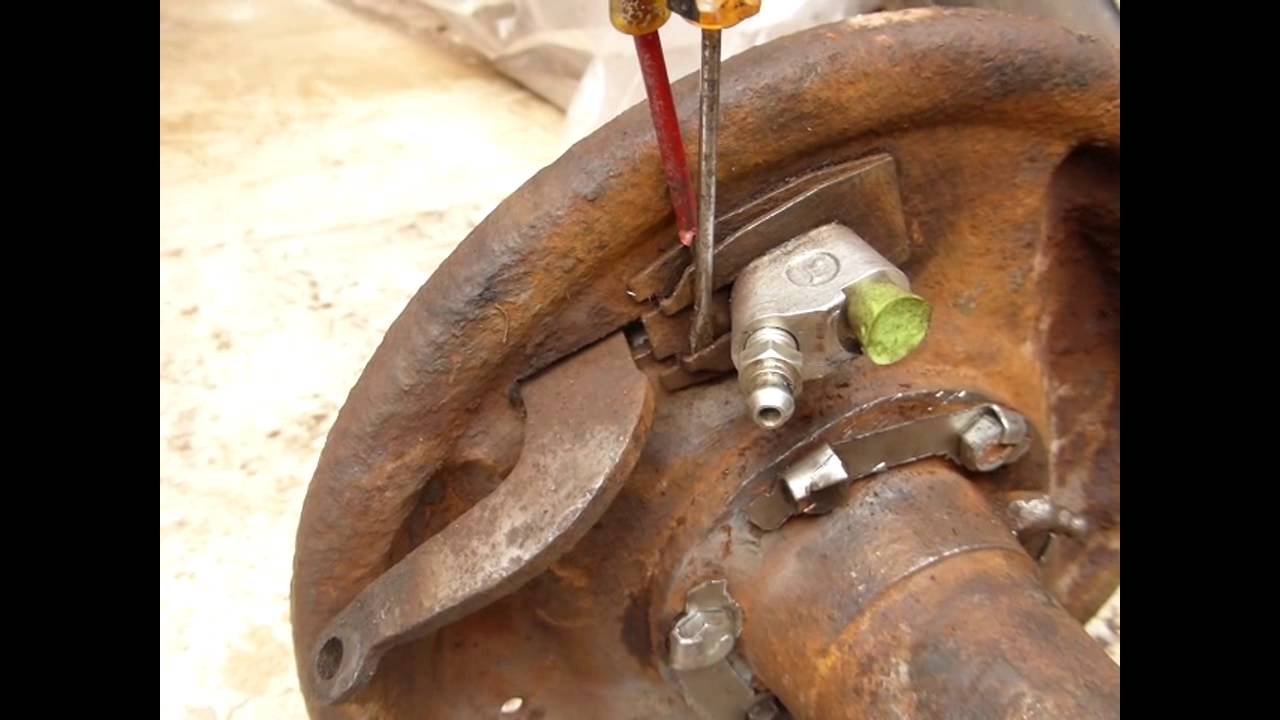
This cylinder is not supposed to move in that installation. Some older cars used to have a strange setup with two sliding clips on top of each other to prodvide that movement. In the diagrams and photo shown you can see the hole for the cylinder boss which the circlip fixes to and the small hole the rolled pin fits into to securely locate the cylinder, as DownWest suggests.

The cylinder should not move, the two pistons in the same bore allow for the wear on the shoes. Also, welding the cylinder to the b/plate is a bit iffy, the cylinder is cast iron...
Are hydraulic brakes allowed on trailers in UK? I know that the handbrake cable is being used in the example, but just curious.

I think that in virtually every installation in which the cylinder slid (Wolsley, Humber, Triumph) the handbrake lever mechanism acted on that end of the brake shoe as well.
This is a TR4, apparently.


maxresdefault.jpg


This fits a Midget
181-285_1.jpg


I don't think that anything but mechanically operated brakes are allowed in the UK on any trailer that is not Plated and inspected annually. (ie above 3500Kg gross weight.)
But working your way through the rules is heavy going. You can bet your boots that the day you get stopped in a roadside examination the DVSA inspector will be an expert.
 
Last edited:
The cylinder should not move, the two pistons in the same bore allow for the wear on the shoes. Also, welding the cylinder to the b/plate is a bit iffy, the cylinder is cast iron...
Are hydraulic brakes allowed on trailers in UK? I know that the handbrake cable is being used in the example, but just curious.

I'm assuming no hydraulics are fitted here, so the pistons aren't doing anything. It looks like a standard backplate being operated by the handbrake cable - which is what WilliamH says above.
 
I'm assuming no hydraulics are fitted here, so the pistons aren't doing anything. It looks like a standard backplate being operated by the handbrake cable - which is what WilliamH says above.
While it is normal for the wear to be compensated by the pistons moving in the cylinder, likely the ones in the pic are rusted solid as never moved by the hydraulics and not greased either, so if adjusted at rest, one shoe will rub the drum, indicating one should back off a bit, while the other will be further away. While this would give hydraulics a bit of a slack pedal, the use of the handbrake cable only will compensate. Wear will be uneven on the linings as the 'leading' one wears faster.
 
The hand brake levers posted by VicS operates on both brake at the same time and will ensure the same operating pressure on both brake shoes

The one posted by Caraway only has a single piston so is a sliding brake slave cylinder and the sliding cylinder will allow even pressure on the brake shoes from the hydraulic pressure and the hand brake lever
 
It's a leading / trailing brake, it expand one leading shoe, assumming clockwise rotation RH shoe, trailing is the LH shoe in photo. Master clynder would have been able to slide, this equalizes the load between the two shoes. You can have twin leading, cylinder fixed and link between the shoes slides.

Back in the 60's / 70's we had mechanical disc brakes, electric brakes, vaccumm brakes, air brakes, very little hydraulic, though I did once design a hydraulic system. Stopped designing trailer under in the late 70's, but not changed I think, upto 3500 kg you can have mechanical and your choice if type approved, above 3500 kg you are power.

Brian
 
On Heralds the handbrake mechanism is a single lever which forces the leading (iirc) shoe away from the cylinder, to the cylinder has to be able to move to let the other shoe do any work. In this case it seems that the handbrake mechanism moves both shoes itself, so the cylinder can be fixed.
 
While it is normal for the wear to be compensated by the pistons moving in the cylinder, likely the ones in the pic are rusted solid as never moved by the hydraulics and not greased either, so if adjusted at rest, one shoe will rub the drum, indicating one should back off a bit, while the other will be further away. While this would give hydraulics a bit of a slack pedal, the use of the handbrake cable only will compensate. Wear will be uneven on the linings as the 'leading' one wears faster.

No, the adjuster is to compensate for the wear.
 
Top