Tie up your boat - MBY video

Use of locking turns is a personal choice. If you are of the opinion they are useful in your situation then use one.
The problem that John Morris alludes to on larger vessels happens when the ropes get wet/dry out the locking turn can become fast. Very difficult to remove.
Then there are steel wire ropes in use for springs. A locking turn in this rope is very difficult to undo especially when mooring ropes need to be adjusted for tides.
Smaller boats with smaller diameter ropes are easier to handle and a locking turn easier to undo.
I don't use locking turns but they are not poor seamanship, merely a dfferent method of securing.

If the rya are issuing ship licenses fair point. But if ship practice does not scale down to boat use then it should be voluntarily only
 
Locking turns are for dinghys IMHO and have vanishly few uses on larger boats.
My very strong feeling is that 0880 is much better.
0880 doesn’t slip and can always be undone. I’ve never failed a YM candidate for using locking turns on cleats but I sometimes ask why they do it and if I see a candidate using cleats properly I am delighted to be able to mention something else positive about this aspect of their seamanship.
Define "dinghys" vs. "larger boats".
I suppose that my old 53 footer could be called a dinghy, if compared to the QM2... :)
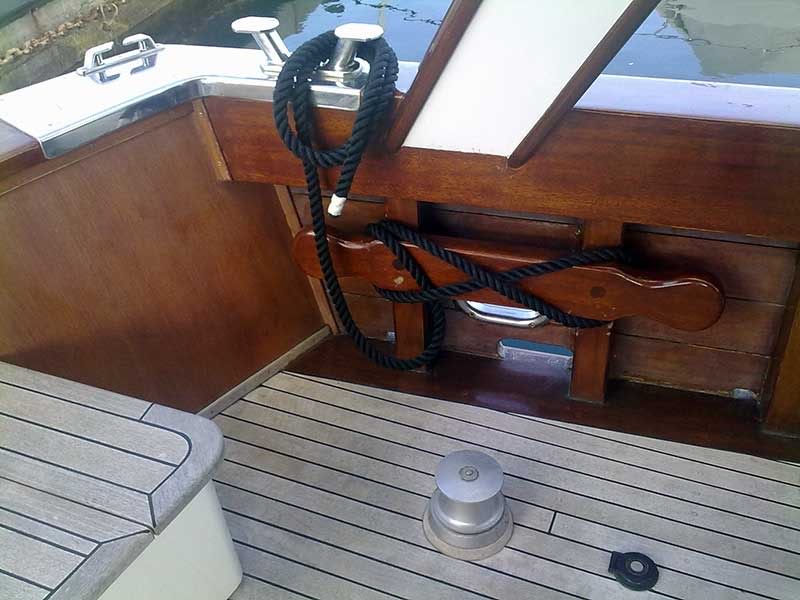
But if a 35T boat is large enough to fall into your "larger boats" category, well, you can trust me if I tell you that her wooden cleats would have spoilt in a second your assumption that 0880 doesn't slip, regardless of the type of line (the one in the pic below being 24mm, for the records).
Besides, she has been moored for years in a marina where occasionally the ferry wash was enough to pack up completely the pretty substantial mooring compensators.
And in spite of that, I never had any difficulties to untie the "poor seamanship" cleat hitch below, with not one but TWO locking turns - go figure.
uIllqNfG_o.jpg


Otoh, I agree that locking turns are a no-no on ships, but there are specific reasons for that:

1) ships normally use mushroom cleats, obviously very large and very high, and installed on the deck.
This allows deck hands to make much more than just two "8" rounds. In fact, I've never, ever seen a final "0" on ferries or ships.
On top of being useless, it somewhat increases the chances to tangle cables, for which at that size is essential to have their position always clearly in sight.

2) cables are obviously pulled using a winch, so you actually want them to slip, in the first part of the maneuver (after just the first "O" turn, or after that plus one "8"), before eventually secure them with several "8"s.

3) at that size, a locking turn could definitely get pulled to the point of being impossible to undo, even with a crowbar. The forces involved with pleasure boats are almost a joke, in comparison.

Now, if you ask me at which vessel size/weight to draw the border line between the two techniques, I don't have any scientific answer.
But fwiw, I can think of captains and crews of pleasure boats up to 140 feet, who regularly use a final locking turn.
As opposed to that, funnily, most of the times I had completely unexperienced guests onboard trying to help with mooring lines, they used your preferred technique... :)
Just because it's more intuitive, I suppose.

All that said, as a Schettino compatriot, I guess I can't pretend to teach a RYA instructor what is good vs. poor seamanship... :rolleyes:
I'm just saying it as I see it, nothing else.
 
Last edited:
Hear hear. The more I think about it, the more I think it's pretty crummy if RYA are teaching oxxo without a locking turn, or two. Shoddy practice in my book. Mind you RYA taught me 3x as standard anchor scope, so "go figure".
 
Hear hear. The more I think about it, the more I think it's pretty crummy if RYA are teaching oxxo without a locking turn, or two. Shoddy practice in my book. Mind you RYA taught me 3x as standard anchor scope, so "go figure".

I'm not convinced that 'RYA' are teaching (or more specifically examining) anything in particular. What is well illustrated here and indeed on other threads is that many of their examiners are old codgers who appear to operate more on a basis of prejudice and/or dogma than any real expertise and that consistency (and I'd suggest by extension QA from the RYA) is notably lacking. Alongside this we have the RYA 'centres' who are essentially or absolutely holiday operators where to all intents and purposes the tickets come along included with the payment for the holiday.
 
I'm afraid I'm in the OXX-lock club too. In fact I often put a second lock on for good measure. Just seems wrong to leave the boat with a loose X or O. I'm 100% confident that the OXX will take the strain so the lock never gets tight.
 
Worth bearing in mind also that by doing one complete loop, then wrapping diagonally over the top and locking against it, apart from being quick, efficient, neat and secure, it also leaves room for more warps if required - something that circling and zig zagging endlessly sometimes doesn't do, especially if the cleats are a little small.
 
The fact that it is considered relevant to mentioned at all in reference to an RYA assessment does rather reinforce the view that some at least of the examiners have dubious priorities in what they looking at, and forming a view on the basis of, even if not passing/failing on that specific point. It does nothing to dispel the impression of amateur and amateurish system that appears, as has been said by someone else on here before, to be a run by old men for old men.

I'm not convinced that 'RYA' are teaching (or more specifically examining) anything in particular. What is well illustrated here and indeed on other threads is that many of their examiners are old codgers who appear to operate more on a basis of prejudice and/or dogma than any real expertise and that consistency (and I'd suggest by extension QA from the RYA) is notably lacking. Alongside this we have the RYA 'centres' who are essentially or absolutely holiday operators where to all intents and purposes the tickets come along included with the payment for the holiday.

Have you had a run in with an examiner? You seem to condemn us all in fairly forceful terms.... (And I was still very much in my 30's when I was originally appointed an Examiner. And we get QA'd regularly along with feedback from Examinees; especially the ones who fail...) There is no 'RYA way'. We are asked to make a judgement about whether someone is competent and safe.

Whether the examining system and qualifications gained is perfect is another matter (of course it isn't) but better people then you and I have deemed it among the best in the world and it's recognised by owners all over the world etc. In fact if you want to stick to less then 25 metres and under 200 tonnes, its the only Captains ticket you need once you pass the other bits and get it commercially endorsed.

I note that some people seem to be convinced that a final turn round the bottom isn't very secure and is going to get 'kicked off'. It is secure and it doesn't get kicked off. I think they need to experiment and stop getting hung up over something that has become force of habit for them.
 
I note that some people seem to be convinced that a final turn round the bottom isn't very secure and is going to get 'kicked off'. It is secure and it doesn't get kicked off. I think they need to experiment and stop getting hung up over something that has become force of habit for them.

Hopefully it's not too secure otherwise you might come back and find that it's locked up and you have to cut it ;)
 
I note that some people seem to be convinced that a final turn round the bottom isn't very secure and is going to get 'kicked off'. It is secure and it doesn't get kicked off. I think they need to experiment and stop getting hung up over something that has become force of habit for them.
John this has nothing to do with force of habit. The final O in oxxo is not secure, intrinsically. It is just a bit of rope wound around a cleat, and on a dock it could easily be moved by a child or another cleat user accidentally, while on a boat it could disturbed by a cleaner, or whatever. It is intrinsically just not secure and that crystal clear fact isn't going to be changed by any experiment. A locking turn clearly (a) Creates a defence against "kicked off" interference, plus (b) as discussed above saves the day in case the line does actually slip on the cleat (obviously unlikely if you have done it right). It is clearly the better choice in yacht mooring and not one single argument has been advanced to the contrary in this thread other than " quick getaway". You really are arguing for the unarguable here John.
 
Once again I am loving this thread. I am of course a “locker” and have never had a line slip nor jam on neither big nor small boats. If by definition, an extra 0 or turn stops the non-lockers from slipping, then it makes perfect sense that that same extra turn would stop a locked final turn from tightening. JFM is quite right in that this is the same thing. BasicLly if a non locker made his cleat fast, and along came JFM and put an extra locked turn in it then that would be an additional security. If the non lockers cleat was secure, then JFMs extra turn wouldn’t tighten......simples

But more importantly, I hope this debate rages forever...... back when I had a crew on board my 30ton Boat, they would invariably be RYA trained and qualified and on several occasions RYA instructors. They were almost always non lockers as seems to be the modern way, and fairly early on we would have a friendly debate about the pros and cons of locking the cleat off. Every year I would finish by suggesting that £50 says they will have a line on a cleat slip before the end of the season, and every season I would collect my £50 when something somewhere duly slipped. Happily without consequence.
 
Out of interest, does anyone do OXXO+bitter end made fast back on board? Obviously requires extra cordage but facilitates getting underway without stepping ashore whilst avoiding chafe.

And, as the cyclists among us know, pretty much anything that helps avoid chafe is a price worth paying.

I often planned to use the above method but tended to be an OXXLock-er in practice.
 
Once again I am loving this thread. I am of course a “locker” and have never had a line slip nor jam on neither big nor small boats. If by definition, an extra 0 or turn stops the non-lockers from slipping, then it makes perfect sense that that same extra turn would stop a locked final turn from tightening. JFM is quite right in that this is the same thing. BasicLly if a non locker made his cleat fast, and along came JFM and put an extra locked turn in it then that would be an additional security. If the non lockers cleat was secure, then JFMs extra turn wouldn’t tighten......simples

But more importantly, I hope this debate rages forever...... back when I had a crew on board my 30ton Boat, they would invariably be RYA trained and qualified and on several occasions RYA instructors. They were almost always non lockers as seems to be the modern way, and fairly early on we would have a friendly debate about the pros and cons of locking the cleat off. Every year I would finish by suggesting that £50 says they will have a line on a cleat slip before the end of the season, and every season I would collect my £50 when something somewhere duly slipped. Happily without consequence.
But some will argue (ie rya) that it’s because you failed to cleat it properly and if the ship is lost, too bad cause it’s your fault for sloppy seamanship. But at least the rope is still in good condition.
It’s a play on the kingdom was lost for the want of a nail. What is being proposed is that the nail is as valuable as the Kingdom.
A rope is a tool, to be used for a purpose (secure a boat) and if it is sacrificed for that purpose, so be it
 
John this has nothing to do with force of habit. The final O in oxxo is not secure, intrinsically. It is just a bit of rope wound around a cleat, and on a dock it could easily be moved by a child or another cleat user accidentally, while on a boat it could disturbed by a cleaner, or whatever. It is intrinsically just not secure and that crystal clear fact isn't going to be changed by any experiment. A locking turn clearly (a) Creates a defence against "kicked off" interference, plus (b) as discussed above saves the day in case the line does actually slip on the cleat (obviously unlikely if you have done it right). It is clearly the better choice in yacht mooring and not one single argument has been advanced to the contrary in this thread other than " quick getaway". You really are arguing for the unarguable here John.

I've finally realised why I seem to be arguing against a brick wall with so many people.

The simple answer is that I NEVER leave a boat secured using OXO or OXXO or any other sort of combination to a cleat on a dockside. I always tie a knot...

My preferred knot is a round turn and two half hitches if there's any tide or there's a chance of the line needing to be undone under strain. On a normal pontoon in sheltered waters, then a bowline threaded through the cleat and back over the horns of the cleat can't be undone easily or 'kicked off'.

All my ramblings have been about how I make off the line refer to the cleat at the boat end. Boat cleats are invariably lower and shorter and the final turn round with a tug locks the line under the 088...

None of this is set in stone and as far as examining is concerned, if its reasonably seamanlike and safe then its OK. Looking at the way the line is lead onto the cleat and the way its made off is a small part of an overall picture of someones 'seamanship'. I don't ever remember failing anyone in the last thirty years for 'seamanship' but it all adds up to the picture of the ability of the person. (if you're interested, I only ever remember failing one candidate for passage planning, but that's another story. )

For all the expostulations of those who say that they've always used a locking turn, I've been brought up not to use locking turns sailing and motor boating on big boats for the last fifty years (I started young) and never had one fail so I think my £50 is safe...
 
I've finally realised why I seem to be arguing against a brick wall with so many people.

The simple answer is that I NEVER leave a boat secured using OXO or OXXO or any other sort of combination to a cleat on a dockside. I always tie a knot...

My preferred knot is a round turn and two half hitches if there's any tide or there's a chance of the line needing to be undone under strain. On a normal pontoon in sheltered waters, then a bowline threaded through the cleat and back over the horns of the cleat can't be undone easily or 'kicked off'.

All my ramblings have been about how I make off the line refer to the cleat at the boat end. Boat cleats are invariably lower and shorter and the final turn round with a tug locks the line under the 088...

None of this is set in stone and as far as examining is concerned, if its reasonably seamanlike and safe then its OK. Looking at the way the line is lead onto the cleat and the way its made off is a small part of an overall picture of someones 'seamanship'. I don't ever remember failing anyone in the last thirty years for 'seamanship' but it all adds up to the picture of the ability of the person. (if you're interested, I only ever remember failing one candidate for passage planning, but that's another story. )

For all the expostulations of those who say that they've always used a locking turn, I've been brought up not to use locking turns sailing and motor boating on big boats for the last fifty years (I started young) and never had one fail so I think my £50 is safe...
Crikey. So now you're agreeing that oxxo is wrong on the dock end and some extra "lock" is needed. Good. And on the boat end you're saying oxxo is ok provided the cleat happens to be so puny that the 4 or so layers of line causes the last "0" to jam. Sure you can make a case for something in special circs e.g. a self jamming cleat, but in the generic situation where the cleat is correctly sized and the last "0" does not jam, what then John? All I can deduce from your post is that you would positively support use of a locking turn (or 2 half hitches or whatever, urgh on a yacht deck).

In other words you're agreeing that a naked oxxo is not ok. We're all agreed then.:encouragement:
 
Last edited:
Crikey. So now you're agreeing that oxxo is wrong on the dock end and some extra "lock" is needed. Good. And on the boat end you're saying oxxo is ok provided the cleat happens to be so puny that the 4 or so layers of line causes the last "0" to jam. Sure you can make a case for something in special circs e.g. a self jamming cleat, but in the generic situation where the cleat is correctly sized and the last "0" does not jam, what then John? All I can deduce from your post is that you would positively support use of a locking turn (or 2 half hitches or whatever, urgh on a yacht deck).

In other words you're agreeing that a naked oxxo is not ok. We're all agreed then.:encouragement:

I wondered a while ago whether you were trolling...

Now I know.
 
I wondered a while ago whether you were trolling...
Now I know.
I don't think he was.
With his last post, if anything, jfm subtly drifted a bit from the specific subject at hand into a philosophical debate, sort of.
But still very logic and faultless, hence hardly qualifiable as a troll.
I'd rather come to terms with that, in your boots... :)
 
I wondered a while ago whether you were trolling...

Now I know.
Absolutely not, as already commented by Mapism above. This is meant to be a decent yachting forum. You argue for oxxo at length while waving an RYA instructor badge, while others argue a locking turn is important. You question the seamanship of the locking turn.

Then you admit that a lock is after all needed at the dock end of the line, while at the yacht end only the low height of some cleats makes the last "o" ok because it jams the line. In other words you agree a naked oxxo is not generically ok, at either end of the line, after all. Which is what the locking turn "side" in this debate have said from the beginning.

All I care about is that daft ideas like naked oxxo being generically suitable for tying up yachts are not left to stand as a sensible ideas on here, lest anyone new to yachting reads that. And that's where we now are so we've reached the end of the road. That is not trolling, as you well know.
 
Last edited:
Top