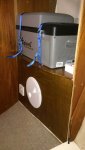
Thermoelectric 12V portable coolbox

eddystone

Well-Known Member
Joined
18 Aug 2013
Messages
1,936
Location
North West Devon
Visit site
Having abandoned the idea of converting the coolbox to a fridge (cost/lack of space for compressor etc.,etc) I'm looking at a very small portable fridge for milk and smaller perishables, couple of cans of cider etc - maybe 14L or thereabouts. Am I right in thinking that compressor types use more electricity than thermo-electrics? I've seen a Dometic 14L thermo-electric which claims to lower temperature by 27C and I could velcro to the floor as a footstool between chart table and quarter berth. I'm quite nervous about draining the battery as years ago I had an el cheapo Halfords one which completely flattened my car battery overnight. I have 2 x 85aH batteries in parallel and 2 x 20W NASA panels. I wouldn't want to drain the batteries below 60% charge but to check voltage I have to remove bunk cushions etc. to put a multi-meter on the terminals. So my assumption is a decent quality small thermo-electric unit would be best fit. If it were possible to find significantly higher rated semi flexible panels as the NASA ones with the same footprint I would do that but seems to contradict laws of physics.

BTW is I get a cheap LED type battery voltage indicator a) do they just wire straight to the battery and b) do you need one for each battery?
 
Having abandoned the idea of converting the coolbox to a fridge (cost/lack of space for compressor etc.,etc) I'm looking at a very small portable fridge for milk and smaller perishables, couple of cans of cider etc - maybe 14L or thereabouts. Am I right in thinking that compressor types use more electricity than thermo-electrics? I've seen a Dometic 14L thermo-electric which claims to lower temperature by 27C and I could velcro to the floor as a footstool between chart table and quarter berth. I'm quite nervous about draining the battery as years ago I had an el cheapo Halfords one which completely flattened my car battery overnight. I have 2 x 85aH batteries in parallel and 2 x 20W NASA panels. I wouldn't want to drain the batteries below 60% charge but to check voltage I have to remove bunk cushions etc. to put a multi-meter on the terminals. So my assumption is a decent quality small thermo-electric unit would be best fit. If it were possible to find significantly higher rated semi flexible panels as the NASA ones with the same footprint I would do that but seems to contradict laws of physics.

BTW is I get a cheap LED type battery voltage indicator a) do they just wire straight to the battery and b) do you need one for each battery?
I have a pair of these, one for each battery, just wired direct to the battery isolation switch and negative. New 2 Wire Blue DC 4.5-30V LED Panel Digital Display Voltage Meter Voltmeter: Amazon.co.uk: Business, Industry & Science

Also, in my limited experience, thermoelectric and compressor fridges use about the same energy. The former is a constant, say, 1 amp, versus the compressor that cycled on and off. Mine uses 5 amps but only runs for a fith of the time.

www.solocoastalsailing.co.uk
 
I’ve got two (don’t ask!) of these and I’ve found them excellent. They will actually freeze things if they are left on maximum even in the heat of summer (UK summer to be fair)
The advantage I found was that they’ll run on 240v mains to cool at ho e before you go to the boat and use 240 on hookup and then revert to 12v when underway. To be honest if you’re only going out for a few hours I’ve forgotten to swap it from 240v to 12v and it has still been very cold. It was surprising chilled even after 48hours onboard.

Mobicool MT48W AC/DC - 48 L Thermoelectric Coolbox, Metallic Blue – 12/230 V A++
by sotel-electronics
Learn more: Mobicool MT48W AC/DC - 48 L Thermoelectric Coolbox, Metallic Blue – 12/230 V A++: Amazon.co.uk: Car & Motorbike
 
I have an Alpicool 22 litre compressor fridge on my little boat in Portugal and it's an absolute godsend, works brilliantly and fairly quiet. They are significantly less expensive than other compressor coolboxes, are made in China so if you buy from Banggood.com (which isn't pornography!) you may get it cheaper than on Amazon where they also sell them. You'll also see them rebranded (e.g. as "Ice Cube") and sold for more. Compressor are much better than other types, well worth paying the extra in my opinion...
 
Thermo-electric only reduce the temp by a fairly narrow margin and are not thermosticly controlled. Good if you want to cool on the way down to the boat, less so when on the limited battery power aboard. If serious, get a compressor fridge unit.
 
  • Like
Reactions: pvb
I have an Alpicool 22 litre compressor fridge on my little boat in Portugal and it's an absolute godsend, works brilliantly and fairly quiet. They are significantly less expensive than other compressor coolboxes, are made in China so if you buy from Banggood.com (which isn't pornography!)

We have an compressor Alipcool C20 too, but mostly run it as a freezer. Uses more power to keep down to -18c during the summer, but that's to be expected. As a fridge it uses about the same as our Isotherm G80 which we fitted to the coolbox, say 3Ah. Like all the camping fridges the insulation is a bit thin so we cover it with a bath towel, but even the high end Domestic ones have an optional 'dog coat' type of covering to help keep them insulated. For the money quite happy with it and we now have ice on board for the first time. At 20 litres it was big enough to hold all the Christmas dinner stuff for the two of us last December.

Ed, you mentioned fitting a volt meter. I would go a bit further and fit a battery monitor, one that will show volts, current (A) and one that will give a % state of charge (SOC). The popular marine one is a NASA BM 1 in a variety of sizes. This will give you all three to monitor your batteries via a wired remote gauge, rather than looking for the volt meter every few hours. There are cheaper car varieties if you shop around carefully,

NASA Marine BM-1 Compact, battery monitor, 12V 100Amps | eBay
 

Attachments

  • Aplicool.JPG
    Aplicool.JPG
    172.1 KB · Views: 16
OK so the basic message is that compressor types use more power but that's more than cancelled out by the fact that the compressor doesn't need to run as much.

Re battery monitor, just to be clear if I have 2 x leisure batteries in parallel, I only need to connect the meter to one?
 
We have an compressor Alipcool C20 too, but mostly run it as a freezer. Uses more power to keep down to -18c during the summer, but that's to be expected. As a fridge it uses about the same as our Isotherm G80 which we fitted to the coolbox, say 3Ah. Like all the camping fridges the insulation is a bit thin so we cover it with a bath towel, but even the high end Domestic ones have an optional 'dog coat' type of covering to help keep them insulated. For the money quite happy with it and we now have ice on board for the first time. At 20 litres it was big enough to hold all the Christmas dinner stuff for the two of us last December.

Ed, you mentioned fitting a volt meter. I would go a bit further and fit a battery monitor, one that will show volts, current (A) and one that will give a % state of charge (SOC). The popular marine one is a NASA BM 1 in a variety of sizes. This will give you all three to monitor your batteries via a wired remote gauge, rather than looking for the volt meter every few hours. There are cheaper car varieties if you shop around carefully,

NASA Marine BM-1 Compact, battery monitor, 12V 100Amps | eBay
Hi Pete Interesting your comments about Alipcool C20 I am in Spain ( or rather boat is?)Looking for small freezer.I have fridge onboard with small freezer box for a bit of ice.Would you reckon the Alpicool C20 would be good for in marina constant fezzes use for bits of meat fish etc?Do they do bigger one?Did you buy in Portugal?Cheers Rich
 
OK so the basic message is that compressor types use more power but that's more than cancelled out by the fact that the compressor doesn't need to run as much.

Perhaps not. So in a UK summer our G80 fridge kit (compressor)uses about 3-4A It runs for a couple of minutes every ten during the day and perhaps a gap of 15 minutes during the night when we use it less. I am not sure there is any power savings with a thermo-electric type. The difference is the compressor will go down to the temperature safe to keep food. The TE type only drop the temperature so many degrees below the ambient temperature.
 
Hi Pete Interesting your comments about Alipcool C20 I am in Spain ( or rather boat is?)Looking for small freezer.I have fridge onboard with small freezer box for a bit of ice.Would you reckon the Alpicool C20 would be good for in marina constant fezzes use for bits of meat fish etc?Do they do bigger one?Did you buy in Portugal?Cheers Rich

No I wouldn't buy it for that purpose. If you have access to mains power then I would choose one of the mini freezers, the sort of thing you might put in a flat or student apartment. They are about 30-40 litres and use the same power about 40w, but they are a 1/3rd of the price. Why didn't we buy one? couldn't find one that fitted through the door of the rear cabin.

Linky

The Alpicool came from e bay last November, though I think the seller was in China, just claimed be in the UK. Guess no one buys camping fridge freezers in November so the price of £200 was worth the gamble compared to £550 for a Domestic equivalent.
 
Last edited:
OK so the basic message is that compressor types use more power but that's more than cancelled out by the fact that the compressor doesn't need to run as much.

It's not the power that they use when they are running that matters, it's the consumption over a few hours or days that count. In that respect the compressor coolboxes are way better than the thermoelectric ones. I have a Waeco CF18 18 litre compressor coolbox. By not opening it too often and trying to put already cooled stuff in it straight from a supermarket fridge I can get power consumption down to less than 10 Amp-hours per 24 hour day in a UK summer. A none too big solar installation can easily keep up with that.

I've never known anyone who has bought a compressor coolbox regret their decision whereas owners of thermoelectric ones are often disappointed by their power consumption and lack of cooling performance.
 
It's not the power that they use when they are running that matters, it's the consumption over a few hours or days that count. In that respect the compressor coolboxes are way better than the thermoelectric ones. I have a Waeco CF18 18 litre compressor coolbox. By not opening it too often and trying to put already cooled stuff in it straight from a supermarket fridge I can get power consumption down to less than 10 Amp-hours per 24 hour day in a UK summer. A none too big solar installation can easily keep up with that.

I've never known anyone who has bought a compressor coolbox regret their decision whereas owners of thermoelectric ones are often disappointed by their power consumption and lack of cooling performance.
+1 for compressor type fridge and throw away the peltier electronic cooler as power hungry failures. However here in oz with hot summers most people still go for ice in an insulated container for 3 or 4 days max trip. I have a little WAECO not used on the boat freezes well but insulation is pretty poor. Needs an over coat. ol'will
 
Top