The pro's and cons of steel boat building

Status
Not open for further replies.
Far too many small steel fishing vessels come to grief.
There's nothing magic about a steel hull.

 
I don’t think anyone doubts that a steel boat can be stronger than a GRP one. It’s the wild and completely OTT allegations of doom and disaster facing all people who cruise and live on GRP yachts that is irritating.

Your words, not mine. I made no such statement. You concede the argument , when you have to put words in my mouth ,so you will have something to argue against.
I have stated that not having worry about hitting things in the night, drastically reduces one stress level and gives one great peace of mind when sailing at night.
You have constantly implied that plastic boats never hit things at night, nor any other time, and that none has ever been lost at sea that way. You imply that only steel boats hit things, and being made of steel , automatically causes them to hit things!
 
Carbon fibre is stronger than steel. Just so you know.
And it doesn't rust.

Yes, Bob Perry keeps bragging about his. $1,000,000 for a 37 footer. Totally irrelevant to 99% of cruisers.
Will anyone pay a million dollars for a 37 ft used sailboat
 
Yes, Bob Perry keeps bragging about his. $1,000,000 for a 37 footer. Totally irrelevant to 99% of cruisers.
Will anyone pay a million dollars for a 37 ft used sailboat
And your approach is totally irrelevant to 99% of cruisers. Virtually no-one has the time or space to build a steel hull in their backyard.
Far more GRP boats have cruised long distance and around the world than steel boats.

Yours is not the only way. Yours is not the best way - at least not for everyone. For most people, GRP is BY FAR the best choice. If you don't recognise that, you are ignorant. I mean that in the literal sense of the word, not as an insult.
 
Your words, not mine. I made no such statement. You concede the argument , when you have to put words in my mouth ,so you will have something to argue against.
I have stated that not having worry about hitting things in the night, drastically reduces one stress level and gives one great peace of mind when sailing at night.
You have constantly implied that plastic boats never hit things at night, nor any other time, and that none has ever been lost at sea that way. You imply that only steel boats hit things, and being made of steel , automatically causes them to hit things!


I've sailed at night - alone, for weeks at a time - and didn't really worry about hitting anything. My GRP boat and I made it through alive. I wouldn't have been any less stressed in a steel hull.
Maybe you are more nervous than most cruisers? Or maybe your navigation is such that you need to worry about hitting things?
 
Yes, Bob Perry keeps bragging about his. $1,000,000 for a 37 footer. Totally irrelevant to 99% of cruisers.
Will anyone pay a million dollars for a 37 ft used sailboat

Completely relevant for many modern boat owners. Both my last two boats have Kevlar reinforcement in the vulnerable areas of the bow and forward parts of the keel. Many new boats now is the same or carbon reinforcement in hull construction.

The probability of collision or grounding that results in loss of the boat is statistically insignificant and very low on the list of concerns by most sailors unless paranoid like you or perhaps deliberately sailing in areas where the risk is marginally higher.

That is why the number of sailors that choose steel is equally statistically insignificant. Human beings are good at risk assessment - that is rationally assessing the nature of risks and the probability of them occurring. They then take a rational view on how to avid them and then how to mitigate if they do occur.

Nobody intelligent and rational listen to doom mongers like yourself particularly when you make claims that are not supported by any evidence.
 
Your words, not mine. I made no such statement. You concede the argument , when you have to put words in my mouth ,so you will have something to argue against.
I have stated that not having worry about hitting things in the night, drastically reduces one stress level and gives one great peace of mind when sailing at night.
You have constantly implied that plastic boats never hit things at night, nor any other time, and that none has ever been lost at sea that way. You imply that only steel boats hit things, and being made of steel , automatically causes them to hit things!

Sometimes, it’s best to let people condemn themselves with their own words. If you are starting to deny that you’ve consistently made claims about how much more at ease people sailing one of ‘your boats’ are and how lots of GRP boats are lost at sea with their crew drowning (hence no witnesses) then I’m happy to stop replying as anyone reading this thread will be able to see your arguments for what they are: exaggerated nonsense. I’ve never claimed that GRP boats never hit things; and yet you suggest I’m putting words in your mouth!!!! Madness.

It’s sad as the whole subject of yacht design and construction is an interesting one and it shouldn’t be hijacked by crazy unsubstantiated nonsense about one material etc.
 
Last edited:
Nice stuff there, but mega build times for the amateur. In reality, drifting into ship building, so not for this discussion.
One of the problems is BS style of boat is not so bad for the builder, if he/she wishes to set off. But the general crudness of the construction makes them a bit of a problem to sell on. While he insists that his upkeep is a few hours a year, the steel boats for sale don't seem to get a decent price, if they sell at all.

If, like SC, I wanted a 30 ft cruiser would I look at at steel?, No way! Far too many GRP boats that will probably take me around the local area, or, round the world, if I wish.. Focus on the rig, not problems with the hull.

Costa Vida.jpg
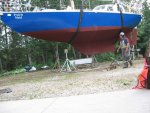
This is what he is calling "Crude"?
Pretty crude eh?
Zero filler of any kind. I would define a "Crude steel boat" as one with a high gloss, looking like a new plastic boat hull, which is made up of mostly filler. ( like putting lipstick on a pig?)Less crude is one with a few minor imperfections, which has zero filler.
A friend built a Brewer design which was indistinguishable from a new plastic hull. People were impressed .It took two 45 gallon drums of filler to make her that fair. It took him 3 years to build just the shell, a job I do in a matter of days.

An Alaskan who had done several Pacific crossings on one of my 36 footers, decided he needed a twin keel version of the same boat for full time Alaska cruising. He sold the 36 in a couple of days .Others wanting it, were a day or two too late.He got his asking price no arguement. In 87, when I had my last boat for sale, and boats were selling much more quickly than today, an article in Pacific Yachting magazine, said the time it it took to sell a sailboat was 2 years. That's about how long it took to sell mine, for over 4 times what I had spent on her

One should be careful to distinguish between resale price and resale value. Resale price is what you can get for her , resale value is the difference between what you an get for her and what you paid for her in the first place. It is not uncommon to spend an extra $40K on a boat to increase the resale price by $20 K, a net loss of $20K. The more the boat costs in the first place, the greater the loss.
Several of my 36 footers have recently sold for $44 to $47 K ,far more than their owners had into them ,fairly quickly, while others who wanted them, just missed the opportunity by a few days .
In his book 'Modern Ocean Cruising" Jimmy Cornel interviews circumnavigators , 8 out of 10 who said they would prefer a metal boat ,several who have already started.

One common theme in these debates, is the greatest critics of steel boats are those who have never owned, built ,lived aboard, maintained long term , or crossed oceans in them, but are assumed to know more about the subject than someone who has built several dozen of them, lived aboard them for over 40 years , maintained for over 40 years , and made many ocean crossings in them.
They do grossly outnumber those who have actual decades of experience on the subject matter.
The title of this debate is "Pros and cons of steel boats" ,not "Cons only, of steel boats". . Seems the only guy giving pros, is the only guy with the most long term experience in them .
Plastic posts have no relevance to those who don't want a plastic hull.
A very experienced long distance steel boat cruiser I met last summer had switched to plastic, and said it felt like he was sailing around in a fragile eggshell. Plastic boaters around her are often afraid to sail after dark, due to the logs around here . I have no such worries.
Plastic boaters take a huge financial loss when they sell older plastic boats these days
 
Last edited:
nomadic1.jpg
Another "Crude" one.
Wouldn't be so 'Crude "if it contained a couple of 45 gallon drums of filler, would it?
This hull has none! How "crude" is that?
 
Last edited:
I do slightly disagree about not for this discussion, though I take your point about build times and skills involved. But that serves further to accent how expensive building a proper steel boat actually is before even thinking of fitting it out. However the discussion is about steel boat building - yes you are bang on about some of them being small ships as it were. Point is I would trust these a great deal more than something without any structural thought to the design beyond "can I weld that bit to that bit cheaply enough.?" The origami boat ethos has a following, but it is fundamentally flawed in the lack of shear panels. I simply cannot reconcile that against the greater cost of doing things properly. It is just an overgrown stitch and glue canoe, and the upscaling is fundamentally flawed. Also It is one thing to do things "in the field" to effect a temporary repair to put a machine back in to action or enable it to go down the line for proper repair, and another altogether to make something "IN A FIELD" with a dodgy stick welder and a few ratchet straps.
When one talks of steel boat building, it should be in the context of actual manufacturers or providers of kits that conform to at least some of the received wisdom, and importantly regulations here this side of the pond, to enable it to actually be used, insured, and later sold. The Brent Swain ethos has no place in europe where things have to be built properly.

The ongoing suggestion being that, that which has cruised for over 40 years, with zero serious structural failures, at sea, several circumnavigations, Cape Horn , and the NW passage, including survivuig pounding on lee shores and coral and rocks, in big surf, for weeks ,is not strong enough, but those which meet the rules, but break up in minutes in the same conditions, are strong enough! Show me a Lloyds approved wooden boat, or plastic boat, which can survive for weeks pounding on a lee shore in big surf , as mine have.
So much for their credibility!
None of my boats has had any problem getting insurance, for a good price.
Is someone here suggesting that bureaucrats always get it right, and are infallible?
Rules prohibit progress!
 
View attachment 72581


One common theme in these debates, is the greatest critics of steel boats are those who have never owned, built ,lived aboard, maintained long term , or crossed oceans in them, but are assumed to know more about the subject than someone who has built several dozen of them, lived aboard them for over 40 years , maintained for over 40 years , and made many ocean crossings in them.
They do grossly outnumber those who have actual decades of experience on the subject matter.
The title of this debate is "Pros and cons of steel boats" ,not "Cons only, of steel boats". . Seems the only guy giving pros, is the only guy with the most long term experience in them .
Plastic posts have no relevance to those who don't want a plastic hull.
A very experienced long distance steel boat cruiser I met last summer had switched to plastic, and said it felt like he was sailing around in a fragile eggshell. Plastic boaters around her are often afraid to sail after dark, due to the logs around here . I have no such worries.
Plastic boaters take a huge financial loss when they sell older plastic boats these days

This is unbelievable.

The only criticism of GRP boats comes from a person who has never owned one, built, one, lived on one, voyaged on one, kept them long term etc is YOU.

So how dare you say you know their pros and cons?

Many of the people who have tried to engage with you have done just that - and several have either owned steel boats as well so are in a far better position to take a view on this subject than you are.

NOBODY doubts the pros of steel as a material - how could they as they are self evident. However the equally know the cons and on balance for most people the cons outweigh the pros which is why the material is and always will be a minority choice for building a yacht.

And once again please do not insult our intelligence by trotting out your half baked stories about people you claim to know who are frightened of sailing in a GRP boat. They are also (if they even exist) in a tiny paranoid minority.

As to old GRP boats being cheap these days. That is true, but not because they are falling apart but because the maintenance cost of the hardware that is needed to keep them sailing. It is even worse for rusting old steel boats which are rotting away and you cannot give them away.
 
I don’t think anyone doubts that a steel boat can be stronger than a GRP one. It’s the wild and completely OTT allegations of doom and disaster facing all people who cruise and live on GRP yachts that is irritating.

We were having drinks last night with some people who are just completing a circumnavigation on a sister ship to our current GRP boat. They have no regrets about the boat and it’s strength or construction whatsoever. A nine year circumnavigation much of it in the Pacific. Their welcome home party is on 02 September.

If Brent would lose some of his single minded fixation (some of it irrational IMHO) he would gain a lot more respect. You can’t keep saying ‘I’m not flat, the bands sharp’ to justify being out of step with the wisdom of many people (if you’ll forgive the mixed metaphors).

If Columbus would have just accepted the " wisdom of many people," and admitted the world is flat, and that if one sailed too far, they would fall of the edge, he would have had a lot more credibility in his time. Who was he to say that everyone else was wrong and he alone was right. Surely they could not have all been wrong, and only he right! That would have been impossible, wouldn't it?
If Galileo would only accepted the "Wisdom of many people" and admitted that the earth is the centre of the universe, and all the planets, stars and the sun revolved around it, he would have had a lot more credibility, in his time. Who was he to say that everyone but him was wrong, and only he was right. That would be impossible , wouldn't it?
That is the type of argument you are making here!

Plastic boats are wonderfully strong enough ,until you hit a container in the night and sink. One can, and many do circumnavigations, without that experience ,and remain naive until they do They rely on chance and odds, while others prefer to eliminate or drastically improve the odds, in their favour, and leave less to chance, by cruising in a steel hull ( good seamanship)..
 
Last edited:
This is unbelievable.

The only criticism of GRP boats comes from a person who has never owned one, built, one, lived on one, voyaged on one, kept them long term etc is YOU.

So how dare you say you know their pros and cons?

Many of the people who have tried to engage with you have done just that - and several have either owned steel boats as well so are in a far better position to take a view on this subject than you are.

NOBODY doubts the pros of steel as a material - how could they as they are self evident. However the equally know the cons and on balance for most people the cons outweigh the pros which is why the material is and always will be a minority choice for building a yacht.

And once again please do not insult our intelligence by trotting out your half baked stories about people you claim to know who are frightened of sailing in a GRP boat. They are also (if they even exist) in a tiny paranoid minority.

As to old GRP boats being cheap these days. That is true, but not because they are falling apart but because the maintenance cost of the hardware that is needed to keep them sailing. It is even worse for rusting old steel boats which are rotting away and you cannot give them away.

BC coast is littered with old abandoned plastic boats. I know of only one steel one, a landing craft, beached because it woudn't sink( to much foam in it.)
 
BC coast is littered with old abandoned plastic boats. I know of only one steel one, a landing craft, beached because it woudn't sink( to much foam in it.)

That may be because the plastic boats float after the keels fall off, while the steel boats sink out of sight?
 
Status
Not open for further replies.
Top